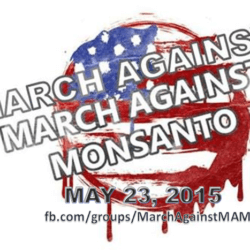
I’ve had some time to reflect on the March Against Monsanto two weekends ago. I almost feel sorry for the protesters I had come to counter-protest in downtown Chicago. They were an odd collection of characters: aging hippies, ragtag Millennials wearing gas masks and granola-ish mommies with children dressed in bee costumes (honeybees are the new spotted owl).
Transport them back to any given decade – 60s anti-war demonstrations, 80s nuclear war protests or 2000s Occupy Wall Street – you’ll find a strong resemblance, like a counterculture family reunion. Irony was lost on the picketers carrying signs about poisoned food or mothers claiming to protect their children while standing next to guys wearing profanity-laced T-shirts and screaming epithets at us.
We crossed paths when I joined a small but valiant group of folks trying to balance out the anti-GMO marchers during third annual March Against Monsanto. I learned about the counter-protest, called the March Against Myths or MAMyths, on Twitter from chief organizer Kavin Senapathy, a mom like me fed up with the bs from the GM fear-peddlers. My teenage daughter accompanied me – under duress, of course – and she was alternatively horrified by her mother and the protesters. Fortunately she could mostly pretend to ignore it all by texting her similarly-horrified friends on her iPhone.
Monsanto and the genetically modified seeds they develop are this decade’s rallying point for hippie ideologues, their latest example of corporate malfeasance that’s destroying our health and our planet. Big banks, oil companies and Halliburton can breathe a sigh of relief as biotech companies are now the target of activists.
GMOs are the result of extensive scientific research and testing, and have been part of America’s agricultural system for two decades. Nearly 90 percent of all corn and soybeans in the U.S. are genetically modified, most designed to be pest-resistant. Numerous studies and most scientific organizations around the world support the safety of genetically engineered crops. U.S. farmers use GM seeds to boost yield on less land using fewer resources.
But why let facts get in the way of a good protest?
In reality, the few protesters we talked to didn’t know very much about GMOs at all. When confronted with facts or pushed for answers themselves, they questioned our motives (corporate “shills”) or walked away. One protester, desperate to back up his wholesale indictment of the American food system, insisted he ate worms and grubs out of his suburban yard. He claimed he never ate at restaurants and his wife did all their grocery shopping at Whole Foods, one of the few corporations accepted by the current counterculture, even though it has about the same annual sales as Monsanto.
This was a big dude, impossible to maintain his husky stature on bugs alone. You had the sneaking suspicion he would stop at McDonalds on his way home for a Big Mac and Diet Coke.
They screamed at us across Dearborn Street outside of Federal Plaza in the Chicago’s Loop. “How much is Monsanto paying you?” was the frequent retort. They held crude signs – in both design and text – with juvenile messages such as “OMG, GMO, WTF” and “Muck Fonsanto.” Some people honked their horns in support of the Monsanto marchers.
I admired the earnest efforts of my protesters-in-arms: scientists, farmers, writers and moms like me who believed they might have a chance to inform the misinformed and reason with the unreasonable. I also suspected my side didn’t have a lot of political experience, otherwise they would’ve known the intransigence of the opposition wasn’t rooted in science or logic but a hatred toward American capitalism.




I’ve worked in politics on and off for nearly 30 years; I know the futility of debating people who lack facts or refuse an honest exchange of ideas. Their positions are embedded in a fierce political ideology so emotion – rather than evidence – often rules the day (I see this on both sides of the political aisle).
It wasn’t really a March Against Monsanto or even GMOs as much as it was a protest against most things American, expect for the right to protest. (Ironically enough, the city’s Memorial Day parade was taking place just to the east of us).
Yet GMO foes are suffering from a major case of cognitive dissonance. They are rejecting crop biotechnology out of hand even though the evidence suggests it is helping to achieve one of their stated goals: sustainanability. The National Research Council reported in 2010 that “genetic-engineering technology has produced substantial net environmental and economic benefits to U.S. farmers compared with non-GE crops.” Other benefits include low tillage, less farmland needed for higher yields and “improvements in water quality resulting from the complementary nature of herbicide-resistance technology.”
Another analysis that reviewed nearly 150 studies of GM crops over ten years concluded that “GM technology adoption has reduced chemical pesticide use by 37 percent, increased crop yields by 22 percent, and increased farmer profits by 68 percent.”
The “Feed the World” mantra of the counterculture only has a chance with genetically engineered crops. Seeds are being designed to resist drought, high salinity and flooding conditions. Other crops are fortified with needed nutrients that are lacking in the diets of hundreds of millions of children in poor countries, causing blindness, disease and even death.
The counter-protest was fun and a very small step in refuting the misinformation spread by biotech foes. But like most political issues, minds will be changed in the vast middle. It’s my hope we can take this campaign to those folks moving forward.
Julie Kelly is the owner of Now You’re Cooking in Orland Park, Illinois. She is a cooking instructor and food writer, but her biggest job is being a mom. She can be reached at [email protected] or on Twitter at @Julie_kelly2.