Why? Genetics.
Being human means being a part of the human condition, which is a nice way of saying that probability governs almost everything, and the dice rolls that don’t work out our way we still need to deal with and adapt to. Not everything can be predicted or treated. The vast number of combinations and permutations underlying genetics makes uncertainty part of the equation, and frankly, different people having different genes is what makes society interesting. Even response to sham treatments–the placebo effect itself — seems to have some basis in differential genetics between different people.
For a sense of how seemingly-similar people can be affected differently by a simple medication, take a look at the below infographic from Live Science:
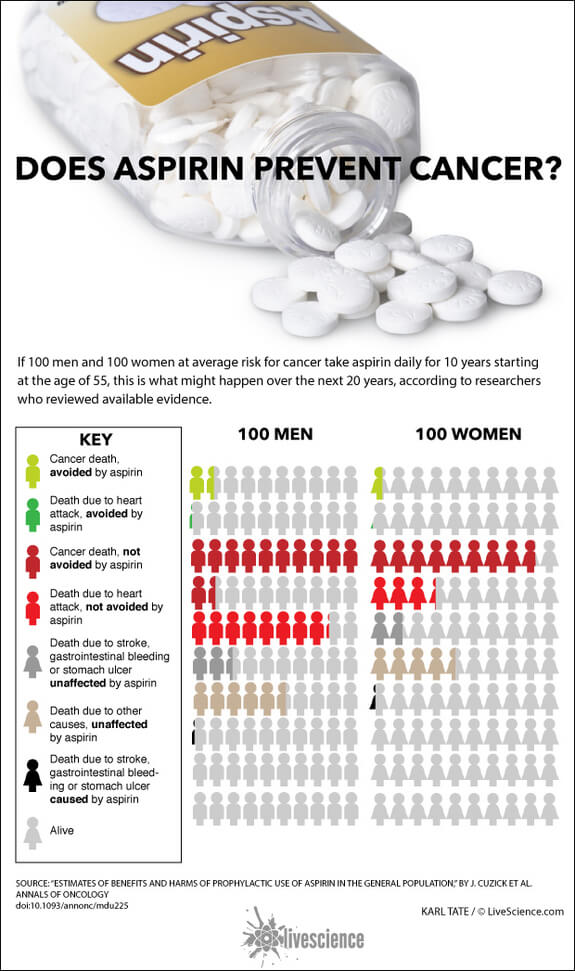
The first thing to notice is that the graphic requires several colors and shades—this immediately means that there isn’t a unitary or binary effect with aspirin — something differential is going on. If you look at the left-side box labeled ‘Key,’ you’ll see exactly what each color refers to in the tally on the right side. There are cases of cancer and heart attack both avoided and not avoided by taking aspirin, stroke, GI bleeding, and ulcers both unaffected and caused by aspirin, other deaths uninfluenced by aspirin, and of course those remaining alive.

Taking any medication brings with it side effects, and in many cases side effects are merely co-occurring physiological effects related to how the treatment is affecting the body. For example, taking pseudoephedrine (Sudafed etc.) for a runny nose includes potential side effects of increased heart rate, anxiety, and hypertension. But those are treatment effects because pseudophedrine’s ability to reduce hyperemia and edema and therefore influence a runny nose is directly because it acts on the adrenergic system which includes nervous system stimulation and constriction of blood vessels.
If we turn our attention back to the aspirin graphic — every treatment is a balance of risk-to-benefit (part of swinging this balance much more favorably to the ‘benefit’ side is the promise of precision and personalized medicine). What we’re actually looking at in this image then is the actual architecture of genetic differences playing out and underlying the patients who had been treated with aspirin. No treatment has a totally predictable set of outcomes, and realizing that not everyone will experience the same result helps with more informed decision-making.
If you take several studies like this and dissect them, you would see similar patterns of medication benefit, medication risks, and non-responders. Not every medication works for every person, and not every person gets a significant side effect from taking a medication. These differences in experience are results based largely on genetics. Of course, a medication may not help because of other reasons—unmeasured factors such as diet, activity level, smoking, and other lifestyle habits. Some of these factors can overwhelm the positive benefit of any treatment—but even some of these behaviors are connectable to genetics – the genetics of metabolism, addiction, and so forth. So if you think you’re not getting the same benefit from an over-the-counter medicine you’ve taken that others are getting, you just might be right.
Ben Locwin is a behavioral neuroscientist and astrophysicist with a masters in business, and a researcher on the genetics of human disease. BIO. Follow him on Twitter @BenLocwin.