Jim Fallon was disturbed by the brain scan before him. A neuroscientist for more than 20 years at the University of California, Irvine, Fallon knew how to look for abnormal traits in the human brain—traits that could explain mental illness, aberrant behavior and even a penchant for murder.
And this brain scan was showing the signs of a murderer. An area just behind the eyes called the orbital cortex, known for its role in ethical behavior, decision making and controlling impulses, wasn’t showing much activity. This scan showed the brain of somebody with deep problems.
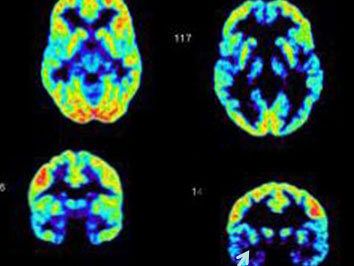
Except for one thing: the scan was of Jim Fallon’s own brain. And he never murdered anybody.
Fallon had found out from his mother that his family had a dark history of homicidal mayhem (including a genetic tie to the infamous Lizzie Borden). To what degree might this behavior be rooted in the genes? To test his hypothesis, he examined the brains and genes of many of his extended family members. According to a story on NPR:
He looked at 12 genes related to aggression and violence and zeroed in on the MAO-A gene (monoamine oxidase A). This gene, which has been the target of considerable research, is also known as the “warrior gene” because it regulates serotonin in the brain. Serotonin affects your mood—think Prozac—and many scientists believe that if you have a certain version of the warrior gene, your brain won’t respond to the calming effects of serotonin.
Everyone in his family has the low-aggression variant of the MAO-A gene, except for one person. “You see that? I’m 100 percent. I have the pattern, the risky pattern,” he says, then pauses. “In a sense, I’m a born killer.”
To Fallon, finding a break in the link between genes and violent behavior challenged a scientific assumption that what makes us normal and abnormal is grounded primarily in our genes and brain structures. To the rest of us, it showed that, at least in mental health, the definition of “normal” is a fragile one, at least.
Each time we see another gut-wrenching mass shooting by a lone gunman who either “was quiet” and “kept to himself” or showed signs of extreme sociopathy and mental illness, questions resurface: Could a normal person do these things or is such sociopathic behavior the result of a mind programmed by our genes? What is a normal mind?

Medical definition of normal
Categories of mental health have always been fuzzy. Psychiatrists struggle to draw clear distinctions between people that might be classified as “definitely insane” versus “pathological personalities.” Today, some mental health specialists have expressed concern with an overzealous effort to establish definitions of “normal behavior,” in workplaces, schools and other organizations. MRI scans, mental assessments, psychometric testing, and what some have called the “medicalization of behavior” have led many to narrow the definition of acceptable, “normal” thoughts and behavior. But as Fallon’s brain scan shows, what you see isn’t always what you get.
Things that don’t seem normal, but are
- Hearing voices, and talking back to them — while considered a key diagnostic criterion for schizophrenia, actually about 60 percent of people have conversations with a disembodied voice. But your control over the voices in your head may be the true difference between a disease state and health.
- Obsessive thoughts — the old saw that men think about sex every 7 seconds has no known scientific basis. But people do think intensively about pleasurable things, including sex, food, alcohol, shopping sleep or tobacco — many times every day, and still fall into the category of “normal.”
- Compulsive thoughts and behaviors — avoiding sidewalk cracks was a fun activity for the young, but among adults it may raise clinical eyebrows. But this concern may be misplaced, say some experts. Counting backwards and forwards, thinking of objects in multiples of a certain number and other behaviors may actually be a healthy way of establishing rituals, to bring order to confusion.
- That mysterious feeling of déjà vu — officially called paramnesia, it was originally defined as a memory disorder. It still is, but it’s not always considered pathological; instead, it may provide a way to bring back the memory of something that had been forgotten. The eerie feeling of familiarity, then, is a way to conjure up an old memory.
Where most specialists draw the line between normal and pathological is where any behavior interferes with everyday activities — are obsessive thoughts preventing someone from buying food or holding a job, for example. Or do inner voices tell someone to open fire with a shotgun, as another. But so far, the right balance between environment, genetics and brain function hasn’t been found. And since humans have vastly different styles of thinking, perhaps we’ll never have a true definition of what’s normal.
Andrew Porterfield is a writer, editor and communications consultant for academic institutions, companies and non-profits in the life sciences. He is based in Camarillo, California. Follow @AMPorterfield on Twitter.
For more background on the Genetic Literacy Project, read GLP on Wikipedia