GMO label fallout: Higher production costs, fewer choices, lower nutrition

Screen Shot at PM e

The GLP aggregated and excerpted this blog/article to reflect the diversity of news, opinion and analysis.

Campbell’s . . . called it “expensive” to comply with Vermont’s law. Maybe they won’t pass it on to consumers directly. They are a large company, and maybe they can cut corners elsewhere to make up the costs. Maybe the number or quality of ingredients will change. We’ll probably never know.
Screen Shot 2016-03-21 at 12.43.21 PM

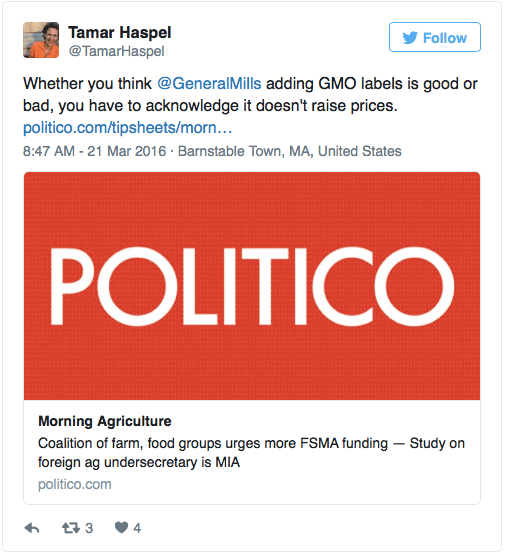
Maybe it doesn’t raise prices immediately. “General Mills has spent “millions of dollars [to change labels], which we are not passing on to the consumer,” a company spokeswoman told POLITICO Pro.” But if you think “millions of dollars” actually vanish in the system, you have a very naive grasp of the realities of running a business. This comes from somewhere. And I’m sure it’s not executive’s bonuses.

. . . .

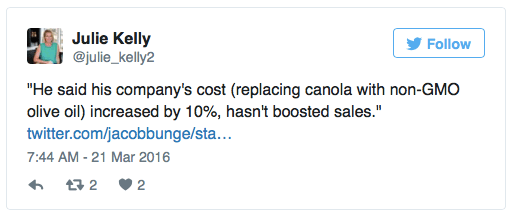
Big Food can shuffle their numbers around. What about small producers and smaller vendors?
Screen Shot 2016-03-21 at 12.45.38 PM

Screen Shot 2016-03-21 at 12.46.59 PM

Ok, you get a label. How informative is it?

Screen Shot 2016-03-21 at 12.48.34 PM

Is the food more nutritious? No. In fact, we know that swapping out to get Non-GMO Project certification can reduce nutrition.

Does it taste better? No. Kraft’s recent reformulation went unnoticed.

Will it improve consumer choice? Herr Foods, we saw above, is considering pulling out of Vermont. In the Wall St. Journal, “Blue Valley’s Ms. Sawyer said that in addition to cost, “sourcing new ingredients is so time-consuming.” Rather than add GMO labels or search for alternative ingredients, “I will probably just discontinue those flavors.”

More costs, fewer choices, no nutritional benefits. Inconsistent labels with many exemptions. More red tape, more lawyers. I have yet to hear of a single valid benefit to consumers on this.

Read full, original post: Anti-GMO chickens are coming home to roost.

Related Articles

Infographic: Global regulatory and health research agencies on whether glyphosate causes cancer

Infographic: Global regulatory and health research agencies on whether glyphosate causes cancer

Does glyphosate—the world's most heavily-used herbicide—pose serious harm to humans? Is it carcinogenic? Those issues are of both legal and ...

Most Popular

ChatGPT-Image-Mar-10-2026-01_39_01-PM
Viewpoint—“Miracle molecule” debunked: Why acemannan supplements don’t work
Screenshot-2026-10-06-at-11.13.59-AM
RFK Jr.’s plan to curb America’s appetite for ultra-processed foods and artificial dyes blocked by the White House
Screenshot-2026-09-22-at-12.26.15-PM
‘Forever chemical’ concerns: Separating hysteria from reasonable concern in the debate over PFAS danger
AI-Force-Uniform-Insignia-Close-Up
Trump wants an AI Force like Space Force, but that could make AI’s risks harder to manage
Concerned-Farmer-at-Golden-Hour
GAHA: The corporate-created “healthier America” movement challenging what it claims is MAHA misinformation about modern farming, chemicals, and food
AI Doctor with a Digital Neural Head
Utah becomes first state to empower AI to bypass doctors and prescribe certain drugs
Screenshot-2026-10-07-at-2.00.02-PM
9 wellness myths busted
Screenshot 2026-10-08 at 1.34
Hooked on kratom: The unregulated, natural, alcohol-free “social tonic” that is destroying lives 
Screenshot-2026-09-28-at-11.26.17-AM
Viewpoint: Wellness movement activists reposition nicotine from a killer addictive drug into a cure-all for brain ills
Screenshot-2026-10-06-at-2.36.47-PM
Is organic farming really more sustainable? 100 recent studies say ‘no’
Screenshot-2026-10-08-at-2.32.00-PM
Abortion rights opponents outraged after FDA says its “safety review” of the already-found-safe mifepristone abortion pill will continue into 2027
ChatGPT-Image-Sep-21-2026-11_21_39-AM
Viewpoint: Food cults: Online ‘nutrition communities’ can pose unique dangers
glp menu logo outlined

Get news on human & agricultural genetics and biotechnology delivered to your inbox.