


Big Think
Would humans re-evolve if we went extinct?
To recreate an extinct species exactly, evolution would have to reproduce not just its traits but its entire genetic code ...

Viewpoint: How AGI (artificial general intelligence) threatens to undermine what it means to be human
Predictions about the impacts of artificial general intelligence (AGI) often focus on societal disruptions, such as job displacement or the ...

7 widely-embraced science “facts” that are dead wrong and threaten our health and prosperity
1.) If something wasn’t established in a peer reviewed, double-blind study, it hasn’t been robustly established. ... 2.) Fluoridated drinking ...

Video: Should we recognize AI robots as human? Here’s why it’s not so farfetched.
Artificial intelligence already exhibits many human characteristics. Given our history of denying rights to certain humans, we should recognize that ...

Superintelligence: ‘Once AI learns how to master Artificial General Intelligence’, it will learn how to upgrade itself and blow right past us’
Right now, AI can’t tell the difference between a cat and a dog. AI needs thousands of pictures in order ...

‘We live at a time where cultural evolution can be very, very, very rapid, but our biological evolution seems relatively stunted.’
In modern times, our lives have changed tremendously by gaining control over nature. The advent of vaccines, antibiotics, antivirals, and ...
Part 3: Human beings have transformed the Earth unlike any other species
Although human beings arrived on Earth just ~300,000 years ago, we’ve transformed the entire planet completely ...
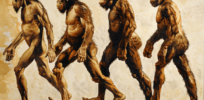
Part 2: Modern humans evolved just 300,000 years ago, the result of an intricate connection with every species on earth
The earliest primates gave rise to monkeys, great apes, hominids, and eventually, our own species itself: homo sapiens ...
Part 1: Mammals are newcomers on Earth. What was the world like when they thrived?
After life became complex and animals overran both land and sea, mammals didn’t arrive until relatively recently in natural history ...
Viewpoint: Dead-end drugs? First-generation breakthrough Alzheimer’s treatments are falling short of expectations
The quest to find effective treatments for Alzheimer’s disease has historically been a lost cause with failed drugs and dashed ...

Is technology-driven ‘exponential change’ overwhelming humanity’s genetically-inherited ability to adapt?
Human civilization has always survived periods of change. Will our rapidly evolving technological era be an exception to the rule? ...

‘Overly sanitized’ environments? Unraveling why diseases tied to chronic inflammation are spiking in the developed world
Research suggests that people raised in developed countries tend to have higher levels of chronic inflammation than those in developed ...

Video: Stone ring structures found in Neanderthal cave in France continue to fuel reassessment of our once scorned hominid cousins
We haven’t been very kind to Neanderthals since their remains were first unearthed in the 19th century, often characterizing them ...
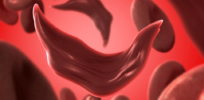
100,000 Americans, mostly Black, are victims of sickle cell anemia. CRISPR is on the cusp of treating it
Exa-cel, a new gene therapy treatment using CRISPR technology, shows promise in treating SCD by editing the patient's stem cells ...

Viewpoint: How genetics shapes human differences and why we shouldn’t avoid talking about this taboo
There’s a long history of people misusing genetics research to justify societal inequalities; many people have chosen to ignore it ...

Why can humans speak but monkeys can’t? It may be due to this one brain quirk
Speech is unique to humans, but most of the brain structures involved in speech production are also present in Old ...

‘It was like a psychedelic trip’: Neurosurgeon describes coma and near-death-experience
Both DMT and a near-death experience evoked feelings of transcending time and space and glimpsing the multiverse, while at the ...

Viewpoint: ‘We should acknowledge that there are faith-based myths running deep in science’s canon’
Science has fundamental limitations as a way of knowing and is not the only method of approaching the unattainable truth ...
Evidence of life on Mars? NASA may have accidentally destroyed it in the 1970s
Life may have been discovered on Mars almost 50 years ago, but it could have been unintentionally destroyed ...
Video: Everything you need to know about the evolution of the human brain, in 7 minutes
An evolutionary history of the human brain, in 7 minutes ...

The Fighting Hypothesis: An evolutionary explanation for fewer lefthanders — and why their share of the population could increase
A violent theory explains why most people are right-handed: Left-handed humans were likelier to get stabbed in the heart ...
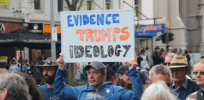
Viewpoint: Health quacks like Mehmet Oz and Joe Mercola — and many mainstream environmental groups — use fear to promote their ideological agendas
Concern trolling is basically when you pretend to care about an issue in order to undermine and derail any measures ...

Why human brains aren’t cut out for modern workplaces
The modern workplace was not designed with the human brain in mind. This disconnect can make it difficult for us ...
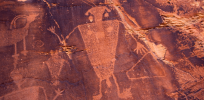
Are society’s biggest conflicts linked to our ‘inherent tribalism’?
Over the past several years, the conflicts we see around us — particularly political ones — are blamed on humanity’s ...
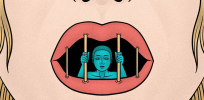
Psychologist Steven Pinker: ‘Language is a window to the human mind’
Language reveals that our long-term memory storage is sizable, but that we mostly remember in abstractions. It also shows that ...

10 most important science stories of the past year
As the year draws to a close, it’s time to look back at the groundbreaking advances that made news in ...

Do you know a second alphabet? Additional written languages give bilingual people’s brains a boost
New research suggests that the brain of a bilingual person who knows two alphabets is different from that of a ...
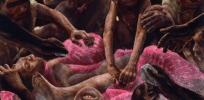
Ancient homo sapiens diets included grains, veggies… and other people? Cannibalism was the norm in early human societies
Our Paleolithic ancestors ate each other. We (Homo sapiens) did it. Neanderthals did it. Homo erectus and Homo antecessor did ...
