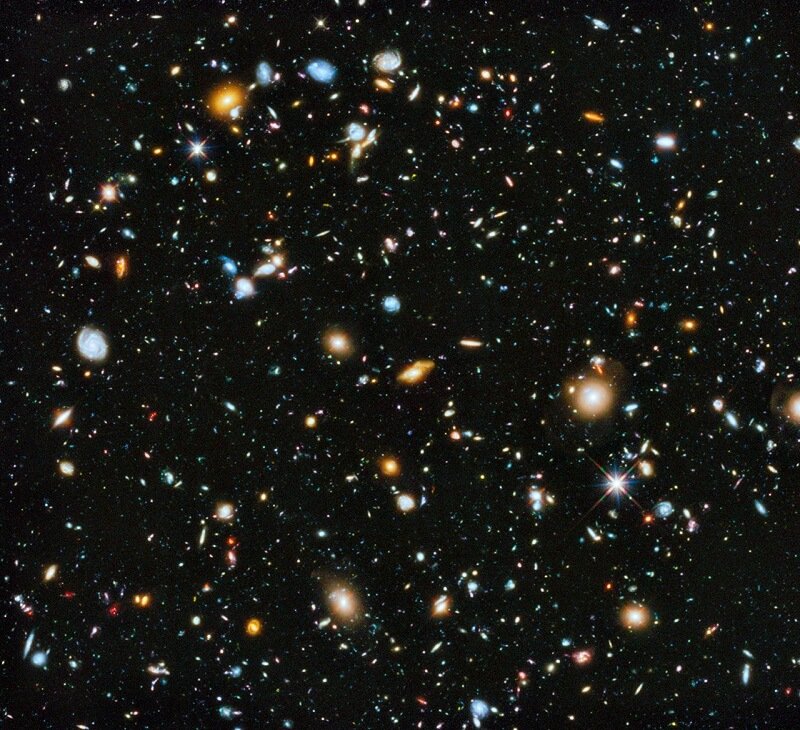
We spend a lot of time wondering what alien life will look like. Perhaps the classic big-heads-and-big-eyes, little green men? Or maybe something utterly terrifying and more than a bit phallic, like the Alien series’ iconic Xenomorph? Or something truly worthy of the word “alien,” something that defies description.
But when we imagine these things, even when we try to imagine the unimaginable, we’re probably still assuming that alien life is built on the same DNA code as life here on earth. But will it?
NASA has been making headlines lately thanks to their announcement at a panel earlier this month that they think it’s likely we’ll discover alien life sooner rather than later. The LA Times has a good report. At the meeting, planetary scientist Sara Seager from MIT said: “We believe we’re very, very close in terms of technology and science to actually finding the other Earth and our chance to find signs of life on another world.”
NASA’s Charles Bolden, also on the panel, went so far as to say that “most of my colleagues here today say it is improbable that in the limitless vastness of the universe we humans stand alone.”
Their optimism is based largely in the idea of a new telescope and current knowledge crossing a threshold to helping us find “another Earth.” If we find our planet’s functional twin, the logic goes, perhaps it will have generated life just as our own planet did.
But we have good reason to believe there may be ‘aliens’ on Earth already; creatures whose primary genetic material is RNA, not DNA. Carl Zimmer wrote a feature for Discover on the topic in 2009, based on the theory that life arose as RNA-based first and that some RNA-based life forms might still linger. And if we’re looking for life on our own planet and others, we use techniques aimed to find signs of the chemistry of DNA — not RNA. To extrapolate: If RNA-to-DNA is the typical pattern of the evolution of life in the wider universe, there’s a chance our conventional methods of looking for life will miss it.
This is to say nothing of the fact that we’ve created, in labs right here on earth, entirely novel bits of genetic material. Not quite DNA as we know it, but compatible with the language of life nonetheless. If we’re able to whip up new letters in the genetic alphabet, is it such a stretch to imagine — in the vastness of space — the vagaries of planetary chemistry hitting on another information-coding molecule like DNA that could serve as a base for an entirely (and truly) alien strain of life?





I’m as excited as any proper biology nerd at the prospect of finding another earth, one in which living things have developed in some loose parallel to life here, an entire new world of organisms to further reveal the mysteries of life and evolution. But the truly captivating idea, the one that makes my head spin, is that we might find something based on a completely different molecule than our much-beloved DNA.
Kenrick Vezina is Gene-ius Editor for the Genetic Literacy Project and a Science Writer, educator, and naturalist based in the Greater Boston area.
Additional Resources:
- Creating life as we don’t know it, Nautilus
- Hawking: Unintelligent life is likely on other planets, Associated Press
- Could silicon be the basis for alien life forms, just as carbon is on Earth?, Scientific American