Lizard’s genes for regeneration might help humans regrow tissue

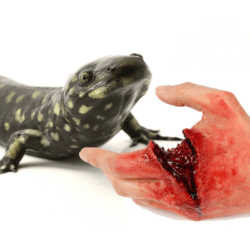
Scientists have unlocked the genetic mystery that allows a lizard to regrow its tail, bringing closer the possibility of treatments to help humans regenerate severed limbs or spinal cords.

Understanding how they shed and regrow their tails could lead to muscle and nerve regeneration in humans.

New research by academics in the U.S. has revealed the 
“recipe” the creatures use to form a new tail, which they say relies on a very specific combination of genetic ingredients.

The team from Arizona State University (ASU) used cutting-edge gene-sequencing technology to study the green anole lizard, Anolis carolinensis, which when caught by a predator, can shed its tail in order to escape.

They hope their findings will help lead to discoveries of new treatments for missing limbs, spinal cord injuries, birth defects and diseases such as arthritis.

“Using next-generation technologies to sequence all the genes expressed during regeneration, we have unlocked the mystery of what genes are needed to regrow the tail,” said lead author Kenro Kusumi, professor in ASU’s School of Life Sciences.

“By following the genetic recipe for regeneration that is found in lizards, and then harnessing those same genes in human cells, it may be possible to regrow new cartilage, muscle or even spinal cord in the future.”

Read the full, original story: How humans could grow new limbs like lizards

 

{{ reviewsTotal }}{{ options.labels.singularReviewCountLabel }}
{{ reviewsTotal }}{{ options.labels.pluralReviewCountLabel }}
{{ options.labels.newReviewButton }}
{{ userData.canReview.message }}

Related Articles

Infographic: Global regulatory and health research agencies on whether glyphosate causes cancer

Infographic: Global regulatory and health research agencies on whether glyphosate causes cancer

Does glyphosate—the world's most heavily-used herbicide—pose serious harm to humans? Is it carcinogenic? Those issues are of both legal and ...

Most Popular

Screenshot 2025-07-30 at 10.48
Can gene editing eliminate Down syndrome? Scientists have done it in lab-grown cells
ChatGPT-Image-Mar-10-2026-01_39_01-PM
Viewpoint—“Miracle molecule” debunked: Why acemannan supplements don’t work
Screenshot 2026-05-26 at 10.15
Viewpoint: Double standard—Why does the wellness industry get a free pass while Big Healthcare is treated as morally suspect?
ChatGPT-Image-May-26-2026-07_51_21-AM-2
Viewpoint: There are more than 1,000 chemicals in a cup of coffee—including many substances that can cause cancer. Why isn’t it banned?
Screenshot-2026-06-04-at-12.05.08-PM
Cases of brain inflammation surge as U.S. measles pandemic approaches 2000
ChatGPT Image May 26, 2026, 08_42_17 AM (1)
Viewpoint: Greenpeace and poison: How environmental advocacy groups rely on compliant (and often ignorant) journalists to spread disinformation and spark litigation
Screenshot-2026-05-28-at-1.36.28-PM
Viewpoint: Can mRNA research survive the Trump administration?
Picture1
Sounds we can’t hear — the hidden planetary signals behind science, fear, and misinformation

Sorry. No data so far.

glp menu logo outlined

Get news on human & agricultural genetics and biotechnology delivered to your inbox.