Technology-based agriculture in Africa could lower carbon pollution as farming expands

Hank Campbell, editor of Science 2.0, summarizes a new study that looks at land use and carbon footprint for agriculture in Africa across a range of scenarios.

We can now produce so much food that the world’s population has no realistic limits, and the Africa that once needed Live-Aid concerts to raise money to buy grain is so close to being able to fend for itself that environmentalists are raising alarms about Africa’s agricultural CO2  emissions.

There is a solution to both issues. It used to be that growing more food was a simple equation: more farms, less forests. That is not the case anymore. If the rest of the world accepted food science the way the United States does, a region the size of Amazonia could be reverted to nature with no decrease in yield.

But there is cultural pressure from First-World environmentalists to not allow modern science, such as genetic modification, in Africa. They claim if Africa frees its people from reliance on outside help it will amplify negative environmental effects, raising CO2 emissions and accelerating deforestation.

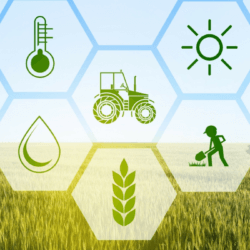
A recent study tested that idea. Thomas Hertel, Navin Ramankutty, and Uris Lantz Baldos found that African agricultural expansion could add up to 267,000,000 metric tons of global carbon emissions, which is equivalent to adding 56,000,000 cars in the 25-year period between 2025 and 2050. Without modern science, Africa would need to add 4.4 million acres of farmland to feed itself.

Organic farming is fine for California, but much of Africa does not have ideal soil, water, or climate. Science is the great equalizer. Without it, their crop-to-emissions ratio would be a negative compared to the American farms that take advantage of advanced crop science. If African food production improves because modern science is the norm, any negative effects from Africa feeding itself would diminish quickly.

Read the full, original article: A win-win for hungry Africans and environmentalists

{{ reviewsTotal }}{{ options.labels.singularReviewCountLabel }}
{{ reviewsTotal }}{{ options.labels.pluralReviewCountLabel }}
{{ options.labels.newReviewButton }}
{{ userData.canReview.message }}

Related Articles

Infographic: Global regulatory and health research agencies on whether glyphosate causes cancer

Infographic: Global regulatory and health research agencies on whether glyphosate causes cancer

Does glyphosate—the world's most heavily-used herbicide—pose serious harm to humans? Is it carcinogenic? Those issues are of both legal and ...

Most Popular

ChatGPT-Image-Mar-10-2026-01_39_01-PM
Viewpoint—“Miracle molecule” debunked: Why acemannan supplements don’t work
afb-a-b
As the EU loosens restrictions on agricultural gene editing, it remains years behind the rest of the world on equally-safe GMO foods
ChatGPT-Image-Jul-8-2026-12_32_48-PM
Viewpoint: SCOTUS strikes a blow against junk science in Bayer glyphosate case. Will it deter mass tort litigators?
Screenshot-2026-07-10-at-2.02.54-PM
Viewpoint: In abortion-restricting Florida, misinformation abounds when Republican congresswoman faces an ectopic pregnancy
ChatGPT-Image-Jul-7-2026-01_57_55-PM
Viewpoint: Europe’s rejection of air conditioning is the poster child for misunderstanding how to mitigate the impact of climate change
Screenshot-2026-07-10-at-3.25.10-PM
Using AI for health questions? Here are 4 tips for the most accurate answers.
Screenshot-2026-07-10-at-3.10.50-PM
Snake-oil cures throughout history
ChatGPT-Image-Jun-25-2026-12_23_17-PM
No, Bill Gates did not secretly engineer ticks to promote veganism
Screenshot-2026-07-10-at-12.55.21-PM
Cancer health facts are particularly susceptible to online misinformation
Screen-Shot-at-PM-pe-vra-kipgaprbdo-vd-ms-jpule-n-jqqaxf-l-e
Viewpoint: Will new breeding techniques help make European agriculture more competitive?
ChatGPT-Image-Jul-1-2026-03_33_49-PM
‘Alternative’ cancer treatments that could kill you
Screenshot-2026-07-08-at-11.25.14-AM
AI being mobilized to target misinformation about vaccines–on AI
glp menu logo outlined

Get news on human & agricultural genetics and biotechnology delivered to your inbox.