A new kind of sex? Strange micro-organism makes imperfect clones of itself

oxytricha sem
via Wired

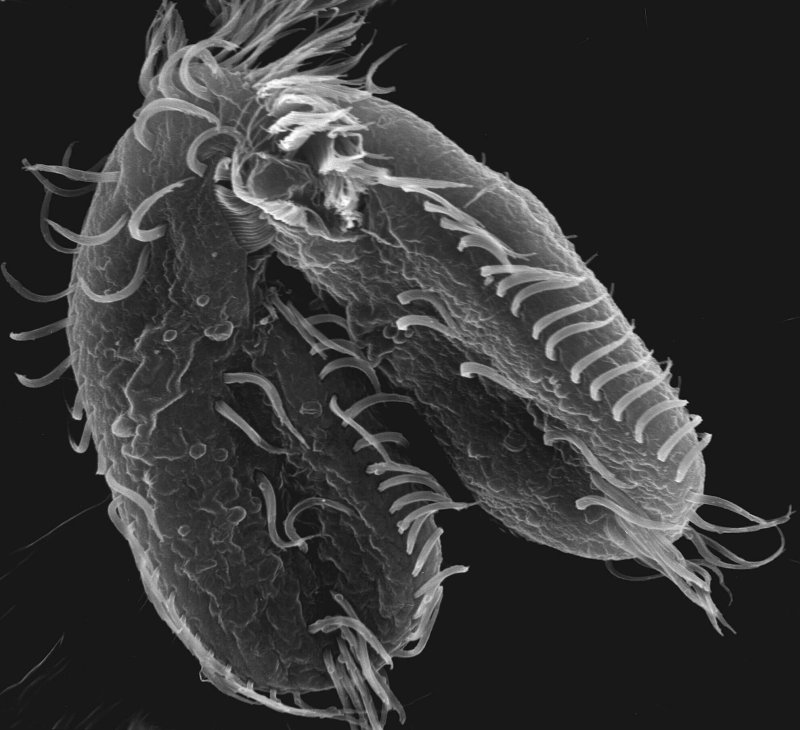
Oxytricha trifallax lives in ponds all over the world. Under an electron microscope it looks like a football adorned with tassels. The tiny fringes are the cilia it uses to move around and gobble up algae. What makes Oxytricha unusual, however, is the crazy things it does with its DNA.

Unlike humans and most other organisms on Earth, Oxytricha doesn’t have sex to increase its numbers. It has sex to reinvent itself.

When its food is plentiful, Oxytricha reproduces by making imperfect clones of itself, much like a new plant can grow from a cutting. “If they’re well fed, they won’t mate,” said Laura Landweber, a molecular biologist at Princeton University and lead author of a recent study on Oxytricha genetics. But when Oxytricha gets hungry or stressed, it goes looking for sex.

When two cells come together (as in the image above), the ultimate result is: two cells. “They’ve perfected the art of sex without reproduction,” Landweber said. The exterior of the two cells remains, but each cell swaps half of its genome with the other. “They’re entering into this pact where each one is going to be 50 percent transformed,” Landweber said. “They emerge with a rejuvenated genome.”

In size, Oxytricha’s genome is roughly comparable to ours. It has about 18,500 genes, compared to 20,000 or so for humans. But that’s one of the few things we have in common with this pond-dwelling protist.

Read the full, original story: This bizarre organism builds itself a new genome every time it has sex


{{ reviewsTotal }}{{ options.labels.singularReviewCountLabel }}
{{ reviewsTotal }}{{ options.labels.pluralReviewCountLabel }}
{{ options.labels.newReviewButton }}
{{ userData.canReview.message }}

Related Articles

Infographic: Global regulatory and health research agencies on whether glyphosate causes cancer

Infographic: Global regulatory and health research agencies on whether glyphosate causes cancer

Does glyphosate—the world's most heavily-used herbicide—pose serious harm to humans? Is it carcinogenic? Those issues are of both legal and ...

Most Popular

Screenshot-2026-04-13-at-1.39.26-PM
Viewpoint: ‘Safer for children?’ Stonyfield yogurt under fire for deceptive organic marketing
Screenshot-2026-04-22-at-10.46.29-AM
Viewpoint: How to counter science disinformation? Science journalist offers 12 practical tips
ChatGPT-Image-May-7-2026-12_16_37-PM-2
Viewpoint: Are cancer rates ‘skyrocketing’ as RFK, Jr. and MAHA claim? The evidence says mostly the opposite
Picture1-14
When superbugs threaten vulnerable children: Can AI help solve antibiotic resistance?
ChatGPT-Image-May-12-2026-08_39_41-PM
GLP podcast: Big Pharma, Big Ag, Big Food—health harming industries or life-saving innovators?
Screenshot-2026-04-23-at-11.00.36-AM
Regulators' dilemma: Thalidomide, Metformin, and the cost of getting drug approvals wrong
Picture1-1
Cooling the planet with balloons: Could a geoengineering gamble slow global warming?
png-pill-omega-Supp-fish-oil
Millions take omega-3 fish oil for brain health. New research suggests it may do the opposite.
bigstock opioids on chalkboard with rol
GLP podcast: 'Safe injection sites': enabling drug addiction or saving lives?
glp menu logo outlined

Get news on human & agricultural genetics and biotechnology delivered to your inbox.