Do patents limit GMO research and farmers choice? Only a little

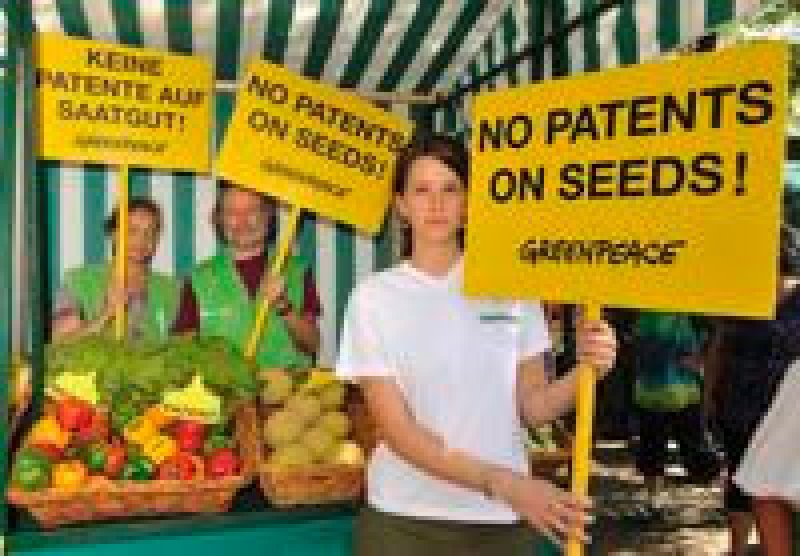
no gmo patent greenpeace protests in munich against the patent on broccoli
Muenchen, 20. 7. 2010 - Gegen die Patentierung von Saatgut, Pflanzen, Tieren und Lebensmitteln lehnt sich ein internationales Buendnis aus 300 Verbaenden und Organisationen vor dem Europaeischen Patentamt (EPA) in Muenchen auf. Anlass ist die erste Anhoerung zu einer Grundsatzentscheidung im europaeischen Patentwesen: Anhand eines Patentes auf Brokkoli, Tomaten und daraus hergestellte Lebensmittel will das Amt entscheiden, ob natuerliche Ressourcen weiterhin als "Erfindung" beansprucht werden koennen. Bereits patentiertes Obst und Gemuese wie Mais, Salat, Karotten und Melonen zeigt Greenpeace an einem Marktstand am EPA.

A 1980 Supreme Court decision that allowed patents to be granted to living things kicked off a controversy. The basic genetic materials of the things we eat have been around, and have been tinkered with, for millennia, and the idea that a new version of one of them could earn protection that would prevent farmers from saving seed and, perhaps, give the patent holder inordinate control over our food supply has raised a number of concerns. I’m going to tackle the ones that seem to worry people most.

Christopher Holman, a law professor at the University of Missouri at Kansas City, explains that there is a de facto — not a legal — protection for basic research on patented plants.

“As a practical matter, basic researchers are never sued for patent infringement,” he says. What’s basic? “Pure science that is meant to increase our scientific knowledge base,” says Holman. Given the imprecision of the definition, and the fact that the exception isn’t a legal one anyway, this strikes me as an eye-of-the-beholder situation.

Monsanto has agreements with more than 100 universities that allow academic scientists to do independent research with no oversight (although those agreements don’t cover plant breeding).

There’s no definitive research that can tell us the percentage of farmers who can’t get a seed they want. It does happen. It happened to Todd Leake, who grows soybeans in North Dakota.

“After GM soy became available, we weren’t able to access conventional soybean seed in the Northern Plains, except for some old varieties that didn’t have good disease resistance,” he says. Among the dozen or so farmers and the corn and soy growers’ associations I’ve talked to, Leake is the exception.

The story of Big Ag forcing GMOs down the throats of unsuspecting farmers, ensuring that those farmers not only pay through the nose but also can’t save seed and thus have to pay through the nose again next year, is largely fiction. And it’s a story that lots of farmers find really irritating, because it makes them out to be dupes or patsies.

Roundup-Ready corn and soy, which can be sprayed with the herbicide glyphosate (used to kill weeds) and show no ill effects, are widely planted because farmers want them. And Monsanto has made piles of money because it developed plants that the vast majority of farmers wanted to buy. Had patent protection not existed, those companies might have focused almost exclusively on the one megacrop that farmers can’t save seed for regardless: Corn, a hybrid, doesn’t breed true. Patents ensure that crops like soy, for which farmers can save seed, also get attention.

Read full, original post: Are patents the problem?

{{ reviewsTotal }}{{ options.labels.singularReviewCountLabel }}
{{ reviewsTotal }}{{ options.labels.pluralReviewCountLabel }}
{{ options.labels.newReviewButton }}
{{ userData.canReview.message }}

Related Articles

Infographic: Global regulatory and health research agencies on whether glyphosate causes cancer

Infographic: Global regulatory and health research agencies on whether glyphosate causes cancer

Does glyphosate—the world's most heavily-used herbicide—pose serious harm to humans? Is it carcinogenic? Those issues are of both legal and ...

Most Popular

Sampling_a_strawberry_32206461974
Viewpoint: Which is worse: Trace PFAS ‘forever chemicals’ on strawberries or the fear that scares people away from eating them?
Screenshot-2026-06-17-at-12.31.01-PM
Viewpoint: The dangerous influence of ‘woke’ post-modernism in science
ChatGPT-Image-Mar-10-2026-01_39_01-PM
Viewpoint—“Miracle molecule” debunked: Why acemannan supplements don’t work
covid-vaccine
Blocked by Kennedy’s CDC, validated by peer-reviewed scientists: Suppressed COVID vaccine study published in JAMA finds 50% risk cut
ChatGPT-Image-Jun-25-2026-12_23_17-PM
No, Bill Gates did not secretly engineer ticks to promote veganism
NYPICHPDPICT000011561063
Viewpoint: From magnetizing your head to taking useless supplements, the wellness craze has morphed into an obsession of the affluent
Podolay_1_transplantacia_srdca_1968
From printers to pigs: The precarious future of organ transplants
Screenshot-2026-06-25-at-4.08.41-PM
Even in blue states, hospitals have continued to drop gender-affirming care for youths
Screenshot-2026-06-25-at-11.18.03-AM
Viewpoint: Appreciating a simpler past without swallowing the misleading ‘nature is healthier and safer’ myth
Screenshot-2026-06-26-at-10.14.50-AM
Viewpoint: The facts behind the grifter-promoting wellness and anti-aging peptide craze: Don’t waste your money
ChatGPT-Image-Jun-19-2026-04_11_20-PM
Daubert for Dummies—Scientific Reliability in U.S. Courts: Daubert, Rule 702, and Made-for-Litigation Evidence
ChatGPT-Image-Jun-26-2026-11_34_33-AM
Viewpoint: RFK, Jr.’s vaccine subterfuge campaign now flies below the media radar
ChatGPT-Image-Jun-26-2026-01_21_33-PM
How the dubious, Trump-backed, addictive drug kratom could enrich cabinet secretary Markwayne Mullin
glp menu logo outlined

Get news on human & agricultural genetics and biotechnology delivered to your inbox.