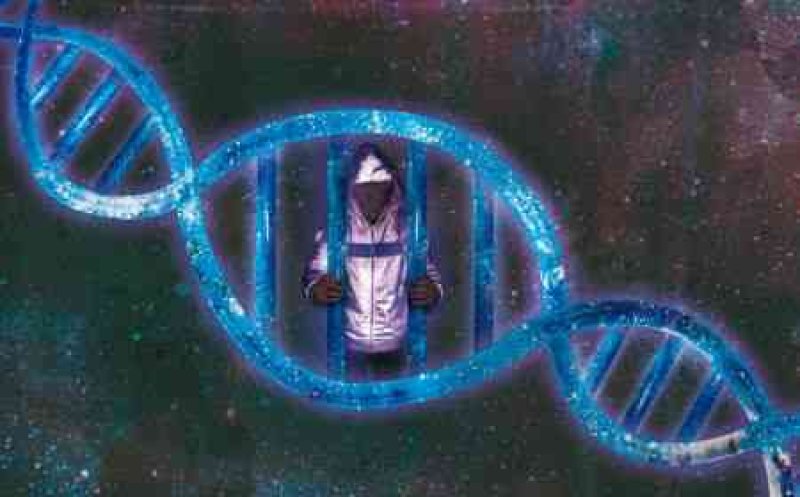
The idea that people who are likely to commit a crime can be identified in advance of any wrong doing has been the subject of science fiction. In recent years, however, genome wide association study (GWAS) and genetic discoveries relevant to the brain and mind have been examined for possible evidence showing how genes can predict antisocial behavior–whether there humans can inherit what has been called “warrior genes”.
In the most extreme example, author Barbara Oakley describes a “Machiavellian genotype”. In connection with this, she claims, “Those few [people] who are wired [to be unethical]…march to their own moral tune, no matter what they are taught.”
This is in her book titled Why Rome Fell, Hitler Rose, Enron Failed, and My Sister Stole My Mother’s Boyfriend. She’s not saying that an individual who steals her mother’s boyfriend is as bad as Hitler, but it is still a rather extreme claim. Citing growing evidence of a strong genetic basis for certain psychiatric conditions, Oakley means that bad people–those who are genetically bad in the context of her hypothesis–will always find some way to do some kind of bad deed in their lives. Then, the particular situation, and the experiences, can modulate the severity of the negative actions, accounting for the difference between, say, stealing one’s mom’s boyfriend, and masterminding a Holocaust. Is there any truth to this idea?
Numerous studies have shown that she might be on the study. In the latest, published in the journal Molecular Psychiatry in October, a genetic analysis of almost 900 offenders in Finland revealed two genes associated with violent crime. Those with the genes were 13 times more likely to have a history of repeated violent behavior. The authors of the study said at least 5-10% of all violent crime in Finland could be attributed to individuals with these genotypes.
But they stressed the genes could not be used to screen criminals. Even if an individual has a “high-risk combination” of these genes the majority will never commit a crime, the lead author of the work Jari Tiihonen of the Karolinska Institutet in Sweden said.
“Committing a severe, violent crime is extremely rare in the general population. So even though the relative risk would be increased, the absolute risk is very low,” he told the BBC.




GWAS analysis points in the same ambiguous direction. Applying genetic reality to psychiatric conditions, a review by the International Society of Psychiatric Genetics (ISPG) for a 2013 statement on the controversy emphasized that clear genetic markers are available for various disorder of brain development that have important psychiatric components. Down syndrome for instance, which includes mental retardation, is easily screened for based on straightforward genetics
But conditions that we might think could increase a person’s tendency toward anti-social behavior or criminal activity (under certain circumstances)–mood disorders, psychotic disorders and certain personality disorders– result from complex gene-gene and gene-environmental interactions. They involve many genes, not just one or two, with the genes interacting in often unpredictable ways. Individuals can test positive for one or more of the genes connected with a psychiatric disorder, yet never develop the condition.
Looking specifically at anti-social personality disorder, which certainly is associated with crime, a recent study has examined the most promising gene proposed thus far in connection with criminality. It’s called the monoamine oxidase A (MAOA) gene–one of the two genes isolated in the Finnish study. It seems to be useful as a research tool and tendency orange light, but that’s a long way from being able to conclude that there’s a genetic makeup for bad behavior.
Moreover, a very large, recent review of studies involving various proposed bad behavior genes has concluded, “Current evidence does not support the use of such genes to predict dangerousness”. So, while titles involving evil genes and similar ideas may be catchy, for now and the predictable future, they probably should remain in the science fiction section.
David Warmflash is an astrobiologist, physician, and science writer. Follow @CosmicEvolution to read what he is saying on Twitter.