Mimicking Climategate, anti-GMO activists fund legal attack on biotech academics

portland press herald

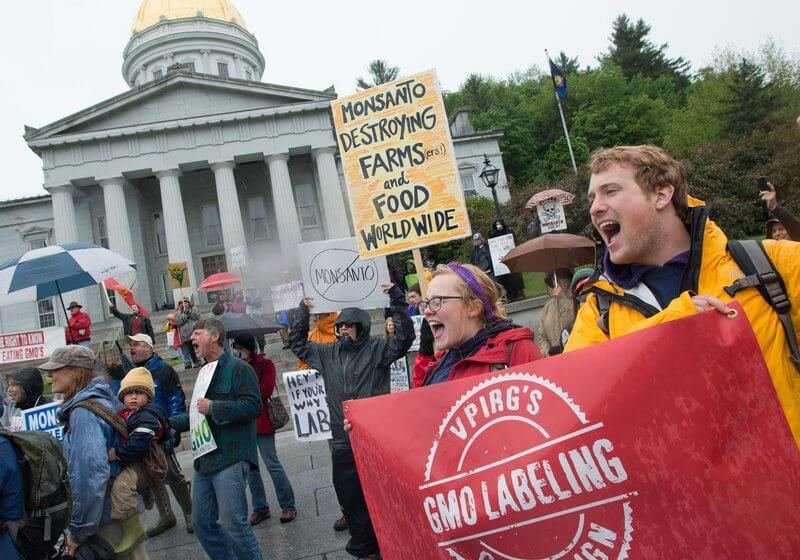
The fierce public relations war over genetically modified food has a new front. A nonprofit group opposed to GM products filed a flurry of freedom of information requests late last month with at least four U.S. universities, asking administrators to turn over any correspondence between a dozen academic researchers and a handful of agricultural companies, trade groups and PR firms.

The scientists—many of whom have publicly supported agricultural biotechnologies—are debating how best to respond, and at least one university has already rejected the request.
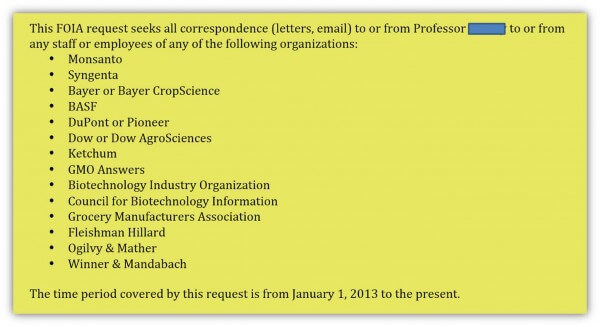
ag letter excerpt

“It seems like a fishing expedition to me,” says geneticist Alison Van Eenennaam of the University of California (UC), Davis, one of six UC researchers targeted by the requests. “I am very worried [the correspondence] is going to be used to sully the reputations of scientists.” The tactic is familiar in another controversial area, climate science, where researchers have faced an avalanche of document requests from climate change skeptics.

The group, U.S. Right to Know (USRTK) of Oakland, California [whose founders led the failed campaign in California to pass a GMO labeling law], says … It has targeted only researchers who have written articles posted on GMO Answers, a website backed by food and biotechnology firms, says Executive Director Gary Ruskin.

USRTK is … “especially looking to learn how these faculty members have been appropriated into the PR machine for the chemical-agro industry.” USRTK’s website says its sole major donor is the Organic Consumers Association, a nonprofit group based in Finland, Minnesota, which has donated $47,500. [Editors’s note: Read GLP’s profile of the Organic Consumers Association]

Read full, original storyAgricultural researchers rattled by demands for documents from group opposed to GM foods

{{ reviewsTotal }}{{ options.labels.singularReviewCountLabel }}
{{ reviewsTotal }}{{ options.labels.pluralReviewCountLabel }}
{{ options.labels.noReviewsLabel }}
{{ options.labels.newReviewButton }}
{{ userData.canReview.message }}

Related Articles

Infographic: Global regulatory and health research agencies on whether glyphosate causes cancer

Infographic: Global regulatory and health research agencies on whether glyphosate causes cancer

Does glyphosate—the world's most heavily-used herbicide—pose serious harm to humans? Is it carcinogenic? Those issues are of both legal and ...

Most Popular

ChatGPT-Image-Jul-10-2026-12_21_03-PM
Viewpoint: Is there new evidence that the animal deworming drug ivermectin decreases the risk of Covid and cancer? Don’t waste your money.
ChatGPT-Image-Mar-10-2026-01_39_01-PM
Viewpoint—“Miracle molecule” debunked: Why acemannan supplements don’t work
Screenshot-2026-07-09-at-1.09.25-PM
Anti-vaccine myths rattle health care
Screenshot-2026-07-30-at-3.07.42-PM
Controversy over WNBA star Sophie Cunningham’s comment opposing trans females in women’s sports reinvigorates the culture wars
Picture1
Hiroshima at 81: America’s new nuclear bomb, a buried Iranian target, and a question no one wants to ask
leeteam
How Kennedy and his family could pocket millions from Merck’s $50 million vaccine injury settlement that he oversaw
Screenshot-2026-07-30-at-2.30.35-PM
Climate scientists claim conservative activists are promoting ‘lies’ that Europe’s summer heatwaves are far from unusual
ChatGPT-Image-Jun-25-2026-12_23_17-PM
No, Bill Gates did not secretly engineer ticks to promote veganism
ChatGPT Image Jul 29, 2026, 05_50_04 PM
Fear, science, and the law: If talc powder is unlikely to cause cancer and J&J was winning in court, why did it pay more than $5.5 billion to settle?
ChatGPT Image Jul 29, 2026, 10_14_27 PM
After muzzling RFK, Jr. over autism-vaccine conspiracy theories, Trump defies aides to push scares again

Sorry. No data so far.

glp menu logo outlined

Get news on human & agricultural genetics and biotechnology delivered to your inbox.