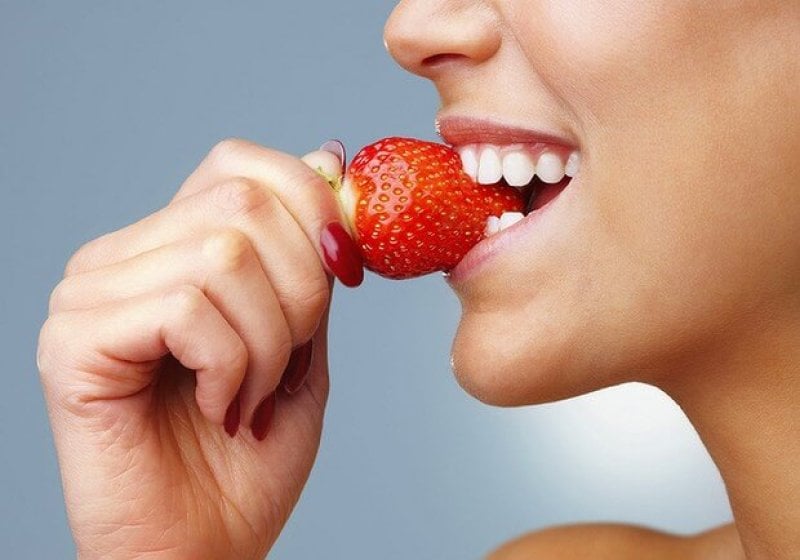
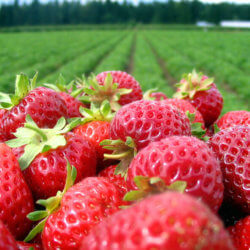
The big, red, underwhelming fruit in our supermarkets that we call strawberries today are a lesson in the perils of traditional breeding, according to Ferris Jabr at Scientific American. The story he tells also shows the potential of modern chemistry and genetics to supplement traditional breeding — without genetic modification — to help undo the damage.
University of Florida strawberry breeder Vance Whitaker and his team have used modern chemistry and genetic analysis to examine both heirloom and modern strawberries. They’re identifying precisely which chemicals give which flavors, and which genes influence production of which chemicals. Now, through DNA analysis of baby plants, they can get a sense of what their fruit will be like. They’re also able to look for other traits through DNA, including the hardiness that makes a good commercial fruit. They’re trying to find versions of the modern strawberry that have some of the genes that make heirloom strawberries so interesting.
Jabr summarizes the history of the modern strawberry:
By the 1500s, and perhaps much earlier, people were farming patches of strawberries and growing clumps in their gardens. When Europeans arrived on America’s shores, they discovered a native species known as Fragaria virginia that produced numerous small but scrumptious berries. Explorers brought this species to France in the 1600s. In the early 1700s, a French military engineer and spy named Amédée-François Frézier discovered an especially large-fruited strawberry species growing on the beaches of Chile. He delivered five specimens of Fragaria chiloensis to his home country, where it was grown in fields near Fragaria virginiana. As neighboring plants of the same genus are wont to do, the intercontinental pair mated. Their large, sweet offspring became the ancestors of modern strawberry cultivars: Fragaria × ananassa.
“It seems fitting,” concludes Jabr, “that one of the most sensual of all fruit is the child of a French love affair.”
The romance was quickly drained from the fruit, however, once breeders recognized the potential of the new cross. Succumbing to the needs of modern industrial agriculture, breeders kept crossing Fragaria x anassa plants to maximize yield, hardiness and luster. Somewhere along the way, breeders sacrificed the flavor and aroma that made the fruit so appealing in the first place.
A smattering of interesting cultivars still exists, however. These are heirloom strawberries, some of which are the size of dimes; some taste of pineapples or roses; and some, according to David Karp in Smithsonian, are so fragrant that “a few ripe berries can perfume a room.” (A fascinating aside from Jabr: these fragrant strawberries, known as “musk strawberries”, have a literary history. They appear in Jane Austen’s Emma at a picnic and are deemed “infinitely superior” to other strawberries.)
How do we get more tasteful strawberries into our supermarkets, then? The heirloom varieties themselves cannot be commercialized: they’re too susceptible to disease, their yields are too low.
One might think that bringing the richness and variety of these heirloom strawberries back into the supermarket strawberry fold would be as simple as breeding some of these less common varieties with the big red fruit we all know. Not so simple, writes Jabr: “Mating heirlooms with modern varieties to create a new kind of strawberry is impractical because the plants have different number of chromosomes and end up producing sterile offspring.”


By gathering this information about the chemical and genetic roots of what makes heirloom strawberries so interesting, Whitaker and his team are saving time and resources. There is no need to raise an inferior plant to adulthood to see what the genetic lottery produced by cross-breeding will give you.
The result of their efforts so far is a version of the modern strawberry called Florida Sensation, which the University of Florida recently released. It’s sweet, disease-resistant and hopefully just a first step in a supermarket fruit revolution.
Kenrick Vezina is a freelance science writer, educator, and amateur naturalist based in the Greater Boston area.
Additional Resources:
- “When is a ‘modified organism’ a GMO?” Ben Locwin | Genetic Literacy Project
- “‘Natural food’ fallacy: “Waiter, there’s a gene in my soup!” Jimmy Botella | TEDxTalks