They came, they saw, they conquered. But while the Romans, Vikings and Normans ruled Britain for many years, none left their genetic calling cards behind in the DNA of today’s mainland Caucasian population. That’s the message from the most comprehensive analysis yet of the genetic make-up of the white British population.
The only invaders that left a lasting legacy are the Anglo-Saxons. As well as giving us the English language, the Anglo-Saxons, whose influx began around AD 450, account for 10 to 40 per cent of the DNA in half of modern-day Britons.
The analysis also springs some surprises. There was no single Celtic population outside the Anglo-Saxon dominated areas, but instead a large number of genetically distinct populations. The DNA signatures of people in the neighbouring counties of Devon and Cornwall are more different than between northern England and Scotland. And there are also unexpectedly stark differences between inhabitants in the north and south of the Welsh county of Pembrokeshire.
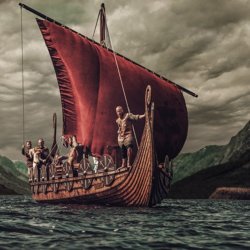
The only appreciable genetic input from the Vikings is in the Orkney Islands, which were part of Norway for 600 years. Viking DNA accounts for 25 percent of today’s Orcadian DNA.




The insights come from a study of DNA samples donated by 2039 Caucasian people from around the UK. Each was selected because all four of their grandparents were born within 80 kilometres of each other, allowing the researchers to infer their grandparents’ DNA and later link it to a location. Because the grandparents were born on average in 1885, the analysis enabled a genetic snapshot of Caucasian Britain prior to immigrations since then. “Any one person’s genome is a random sample of DNA from all four of their grandparents, so it’s a way to look back in time,” says Peter Donnelly of the Wellcome Trust Centre for Human Genetics in Oxford, UK.
Read full, original article: Ancient invaders transformed Britain, but not its DNA