Northern European hunter-gatherers resisted agricultural revolution

neolithic farmers

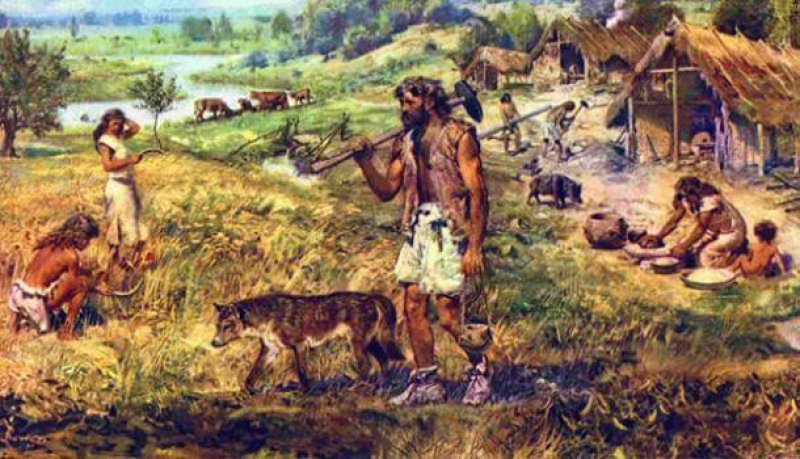
Crops and livestock have been a part of the human experience for thousands of years. But, for some of our Neolithic forebears, agriculture was at first a tough sell.

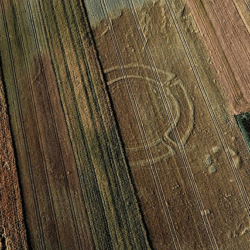
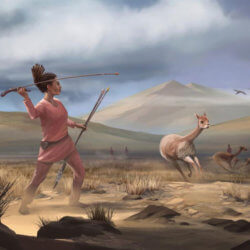
Farming began its spread across Europe over 10,000 years ago. But the transition wasn’t instantaneous: according to a new study, northern Europeans initially resisted the practice in favor of traditional hunter-gatherer lifestyles.

Researchers from the Center for International Research in the Humanities and Social Sciences (CIRHUS) – a collaboration between France’s National Center for Scientific Research (CNRS) and New York University – used bead ornaments to trace the cultural (and agricultural) attitudes of Neolithic Europe. Their findings were published in the open-access journal PLOS ONE.

The Neolithic era, which began around 10,200 B.C., refers to the last part of the Stone Age. In the previous era, the Mesolithic, human populations were almost exclusively hunter-gatherers. But as stone tools and other technologies improved, so began the spread of farming and the domestication of animals. Unfortunately for archaeologists, this transition was poorly documented. Nobody knows exactly how and where this agricultural lifestyle fanned out, particularly in Europe.
To find out, researchers looked to an inconspicuous source – ornamental beads and bracelets. CIRHUS researcher Solange Rigaud led an extensive analysis of 224 bead types found in over 400 European sites, both Mesolithic and Early Neolithic. They may only look like knickknacks, but Dr. Rigaud attests that they have profound cultural meaning. Body ornaments, she says, can express “symbolic codes,” ones that change as populations move, mix, and trade.

“We therefore consider personal ornaments as a reliable proxy for reconstructing cultural diversity and change in past societies,” Rigaud said.

Read full original article: Did Northern Europeans resist the rise of agriculture?

{{ reviewsTotal }}{{ options.labels.singularReviewCountLabel }}
{{ reviewsTotal }}{{ options.labels.pluralReviewCountLabel }}
{{ options.labels.newReviewButton }}
{{ userData.canReview.message }}

Related Articles

Infographic: Global regulatory and health research agencies on whether glyphosate causes cancer

Infographic: Global regulatory and health research agencies on whether glyphosate causes cancer

Does glyphosate—the world's most heavily-used herbicide—pose serious harm to humans? Is it carcinogenic? Those issues are of both legal and ...

Most Popular

Screenshot-2026-03-13-at-12.14.04-PM
The FDA wants to make many popular prescription drugs OTC—a great idea. Here’s why it’s unlikely to happen
Screenshot-2026-04-20-at-2.26.27-PM
Viewpoint — Food-fear world: The latest activist scientists campaign: Cancer-causing additives
Screenshot-2026-05-04-at-12.54.32-PM
How Utah became the country’s supplement capital  — and a haven for unregulated, ineffective and fake products
Screenshot-PM-24
Viewpoint: The herbicide glyphosate isn’t perfect. Banning it would be far worse.
Screenshot-2026-05-01-at-11.56.24-AM
‘Science moves forward when people are willing to think differently’: Memories of DNA maverick Craig Venter
images
The never-ending GMO debate: Pros and cons
Screenshot-2026-04-03-at-11.15.51-AM
Paraben panic: How a flawed study, media hype, and chemophobia convinced the public of the danger of one of the safest classes of preservatives
Screenshot-2026-04-30-at-2.19.37-PM
5 myths about summer dehydration that could damage your health — or even kill you
bigstock opioids on chalkboard with rol
GLP podcast: 'Safe injection sites': enabling drug addiction or saving lives?
79d03212-2508-45d0-b427-8e9743ff6432
Viewpoint: The Casey Means hustle—Wellness woo opportunism dressed up as medical wisdom
ChatGPT-Image-May-1-2026-02_20_13-PM
How RFK, Jr.’s false vaccine claims are holding up $600 million to fight diseases in poor countries
glp menu logo outlined

Get news on human & agricultural genetics and biotechnology delivered to your inbox.