Are humans genetically unique?

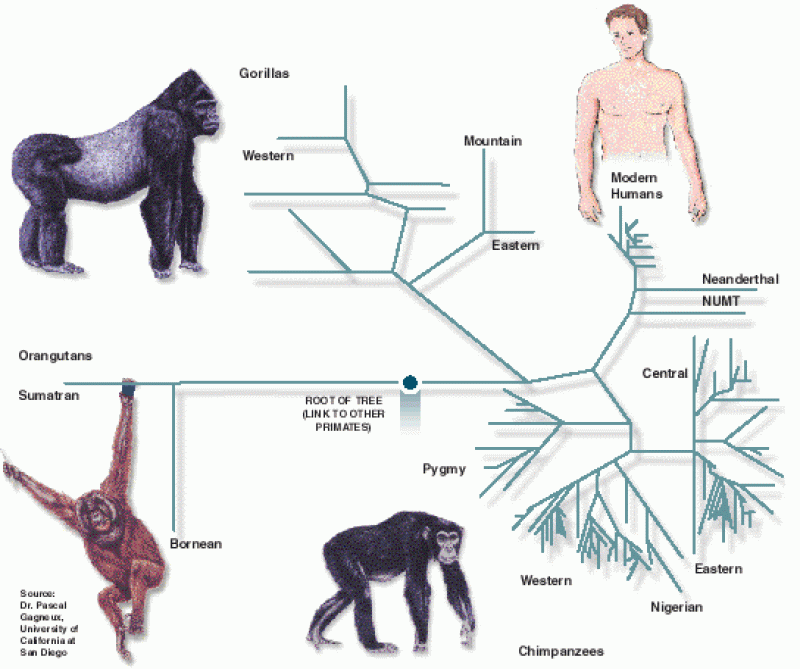
family tree

A new paper in Science reports high (20-40 percent) derived frequencies for an allele which seems correlated with higher rates of aneuploidy. Anueploidy is bad, because often it results in nonviable offspring (individuals with Down syndrome have a viable anueploidy). The strange thing about this region of the genome is that it looks like modern humans have harbored this variant since the divergence from Neandertals. But, it has not gone to fixation. Its frequency in the intermediate range all this time, segregating in pretty much all populations from what it looks like, suggests balancing selection.

Most of the paper is focused on medical genetics and the genome-wide association. The evolutionary aspect is interesting, but struck me as something of an afterthought. I made some chit-chat with the first author at the Bay Area Population Genomics meeting last December, and he didn’t let on that he had any good idea for why this allele was persisting. So I doubt that the group is wedded to the idea that miscarriage is a strategy for masking paternity and encouraging male investment. I’ve asked around people who work in behavioral ecology and they’re skeptical too. There’s a mystery here, and it’s kind of a big deal in my opinion, but there’s not much clarity.

On Twitter, Vincent Lynch pointed out that the locus in question, PLK4, has been implicated in testes development. So one possible answer that crops up is that it is some form of sexually anatongistic selection. Meanwhile, Greg Cochran posits that we’re seeing some sort of meiotic drive, where there is selection pressure operating on the level of the genome itself (e.g., “selfish genetic elements” type dynamics). These are both plausible to me, and suggest that there needn’t be an explanation rooted in our human uniqueness to answer this particular genomic mystery.

Read full, original article: Human uniqueness is not unique


{{ reviewsTotal }}{{ options.labels.singularReviewCountLabel }}
{{ reviewsTotal }}{{ options.labels.pluralReviewCountLabel }}
{{ options.labels.noReviewsLabel }}
{{ options.labels.newReviewButton }}
{{ userData.canReview.message }}

Related Articles

Infographic: Global regulatory and health research agencies on whether glyphosate causes cancer

Infographic: Global regulatory and health research agencies on whether glyphosate causes cancer

Does glyphosate—the world's most heavily-used herbicide—pose serious harm to humans? Is it carcinogenic? Those issues are of both legal and ...

Most Popular

ChatGPT-Image-Jul-17-2026-12_42_10-PM
Viewpoint: RFK, Jr. is setting up a panel to compensate people who claim they were injured by a COVID vaccine–no proof needed 
Screenshot-2026-07-17-at-12.55.22-PM
Viewpoint: Is bagged salad a dangerous science experiment? Challenging an online misinformation campaign
Screenshot-2026-07-01-at-2.49.48-PM
Dr. TikTok and male fertility: Viral claims tout GLP-1 drugs as fertility boosters. What does the science say?
ChatGPT-Image-Mar-10-2026-01_39_01-PM
Viewpoint—“Miracle molecule” debunked: Why acemannan supplements don’t work
ChatGPT-Image-Jul-6-2026-02_25_26-PM
40 million Americans take glucosamine. If you have memory loss, it could accelerate cognitive decline.
reverse-aging
Rapamycin: Here’s the skinny on the anti-aging pill that increases the lifespan—of mice by 10%
UK scientists support loosening restrictions limiting embryo research
Are we edging closer to precisely, and safely, editing human embryos?
vitamin k refuse genai
More and more babies are developing uncontrollable bleeding—linked directly to vaccine deniers' rejection of vitamin K shots
Screenshot 2026-07-11 094410
Growing animal muscle and fat cells inside rice grains and calling it beef: One of numerous genetically engineered products shaking up our ecosystem
px-Minced-beef-meat-cow-cattle
Can we trust Trump’s USDA to accurately report farm data? Beef export numbers suggest ‘no’.
ChatGPT-Image-Jul-9-2026-02_39_22-PM
Viewpoint: Polyphenols or NAD+ supplements to combat aging: No, Gwenyth Paltrow and followers, don’t waste your money.
ma art page image
‘It’s time to have a conversation’: Once adamantly opposed to human gene editing, UK’s The Guardian acknowledges likely benefits
ChatGPT-Image-Jun-17-2026-03_29_08-PM
Viewpoint: What’s the impact of the U.S. abandoning support for global health?
afb-a-b
As the EU loosens restrictions on agricultural gene editing, it remains years behind the rest of the world on equally-safe GMO foods
glp menu logo outlined

Get news on human & agricultural genetics and biotechnology delivered to your inbox.