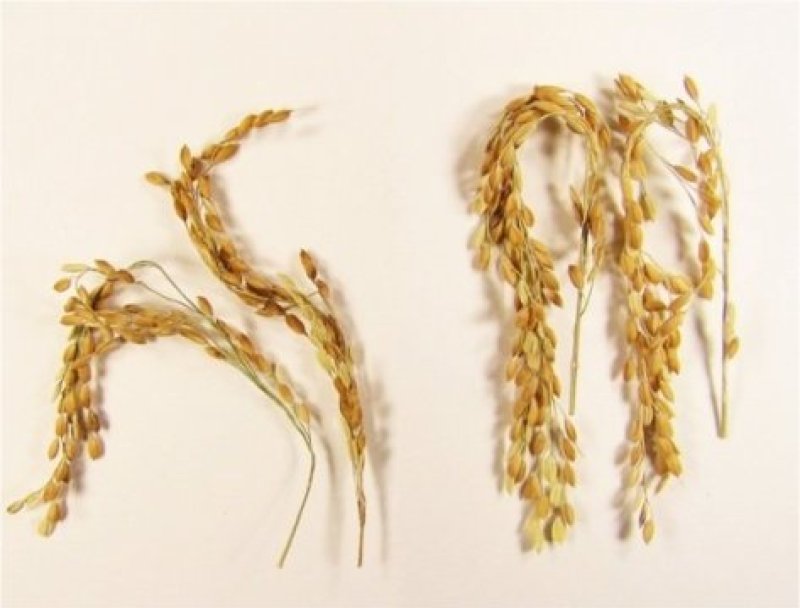
Not all climate-change mitigation involves changing human habits. In a paper in Nature, scientists unveiled a new genetically modified rice plant that reduces emissions of methane, a greenhouse gas 20 times more powerful than carbon dioxide. But the rice is at least 10 or 20 years from being available to farmers.
The new rice differs by only a single gene, borrowed from barley. The gene makes the rice produce less methane and yield 43 percent more grain per plant. “For three years of field trials it worked very well,” says Chuanxin Sun of the Swedish University of Agricultural Sciences, senior author on the paper. It was especially effective during the summer, he says, when it cut methane emissions to 0.3 percent to 10 percent of the control rice plants’ emissions. The new rice reduced emissions less dramatically in autumn, because of lower temperatures, but still cut methane emissions in half.
Sun’s team inserted a gene from barley into the rice to make it store more carbon—that is, starch and sugar—in its stems and grains, and less in its roots.

After larger-scale trials and more precise measurements of exact methane emissions and yield of the genetically modified rice, Sun says, the next step is to use traditional breeding to make a rice variety that’s “basically the same scientifically” as the genetically modified rice, including the same gene. “Right now of course it’s a GMO issue, and we cannot deliver this variety directly to farmers. We have to use traditional breeding methods and breed the new, society-acceptable variety for farmers.” This will take an additional five to 10 years.
The GLP aggregated and excerpted this blog/article to reflect the diversity of news, opinion and analysis. Read full, original post: New GMO Rice for Higher Yield, Less Global Warming