


The GLP aggregated and excerpted this blog/article to reflect the diversity of news, opinion and analysis.
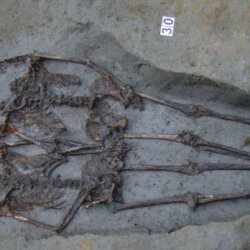
In the Proceedings of the National Academy of Sciences, the researchers reported that they had recovered DNA from two skeletons of an infant and a fetus who lived in Alaska 11,500 years ago. The genetic material is not only among the oldest ever found in the Americas, but also the first ancient DNA discovered in Beringia, the region around the Bering Strait where many researchers believe Asians first settled before spreading through North and South America.
They succeeded in recovering mitochondrial DNA from both bone samples. But to their surprise, the genes were markedly different. The infant and the fetus did not share the same mother or even maternal grandmother.
The researchers can only speculate how an infant and a fetus from different mothers ended up in the same grave. They might have had the same father, or they might have belonged to different families who suffered terrible losses at the same time.
But the significance of the DNA found at Upward Sun River extends far beyond the story of two children. It sheds light on how people first moved into the Americas.
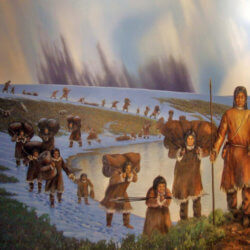



In 2007, Ripan Malhi of the University of Illinois and his colleagues proposed a model for this migration, known as the Beringian Standstill. Early Siberians expanded east into Beringia about 25,000 years ago, they proposed, and stayed there for about 10,000 years.
Humans were able to thrive in Beringia because even at the height of the last ice age, the region was not covered by glaciers. It was mainly tundra and shrub land, with scattered stands of trees.
Read full, original post: DNA of Ancient Children Offers Clues on How People Settled the Americas






















