MRI of mother and child captures biggest questions in neuroscience

dec g phenom web resize x q crop
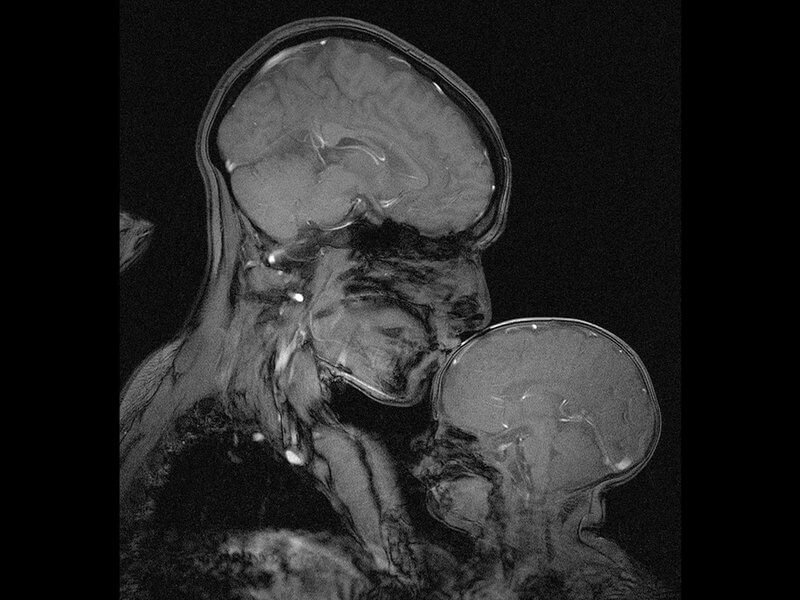
Scientists reconfigured a magnetic resonance scanner to capture a woman and her baby. (Rebecca Saxe and Atsushi Takahashi / Department of Brain and Cognitive Sciences, MIT / Athinoula A. Martinos Imaging Center at the McGovern Institute for Brain Research, MIT) via Smithsonian

The GLP aggregated and excerpted this blog/article to reflect the diversity of news, opinion and analysis.

A mother and her child are curled up together inside the tube of a 3 Tesla magnetic resonance imaging scanner in April 2015. The scanner bangs and beeps, shudders and screeches. The baby is finally sleeping, pressed firmly against his mother’s chest, and so is still enough for the MRI to see inside his head. A single MR image, like this one, takes several minutes to capture. Moving just a millimeter leaves a blur on the screen. The mother and baby must hold their pose, as if for a daguerreotype.

This particular MR image was not made for diagnostic purposes, nor even really for science. No one, to my knowledge, had ever made an MR image of a mother and child. We made this one because we wanted to see it.

Here is a depiction of one of the hardest problems in neuroscience: How will changes in the brain, that specific little organ, accomplish the unfolding of a whole human mind?

Read full, original post: Why I Captured This MRI of a Mother and Child

{{ reviewsTotal }}{{ options.labels.singularReviewCountLabel }}
{{ reviewsTotal }}{{ options.labels.pluralReviewCountLabel }}
{{ options.labels.newReviewButton }}
{{ userData.canReview.message }}

Related Articles

Infographic: Global regulatory and health research agencies on whether glyphosate causes cancer

Infographic: Global regulatory and health research agencies on whether glyphosate causes cancer

Does glyphosate—the world's most heavily-used herbicide—pose serious harm to humans? Is it carcinogenic? Those issues are of both legal and ...

Most Popular

d-b
Blocked arteries, kidney stones, nausea, constipation, fatigue: Long list of health problems caused by too much vitamin D 
Screenshot-PM-24
Viewpoint: The herbicide glyphosate isn’t perfect. Banning it would be far worse.
79d03212-2508-45d0-b427-8e9743ff6432
Viewpoint: The Casey Means hustle—Wellness woo opportunism dressed up as medical wisdom
ChatGPT-Image-Mar-27-2026-11_27_05-AM
The myths of “process”: What science says about the “dangers’ of synthetic products and ultra-processed foods
ChatGPT-Image-Mar-10-2026-01_39_01-PM
Viewpoint—“Miracle molecule” debunked: Why acemannan supplements don’t work
ChatGPT-Image-Apr-30-2026-12_21_05-PM-2
The tech billionaires behind the immortality movement
ChatGPT-Image-Apr-30-2026-05_00_48-PM
Wellness grifter physician turned wellness influencer out as surgeon general nominee

Sorry. No data so far.

glp menu logo outlined

Get news on human & agricultural genetics and biotechnology delivered to your inbox.