
Regenerative medicine boosted by 3D bioprinting breaching new grounds

D printed bionic c
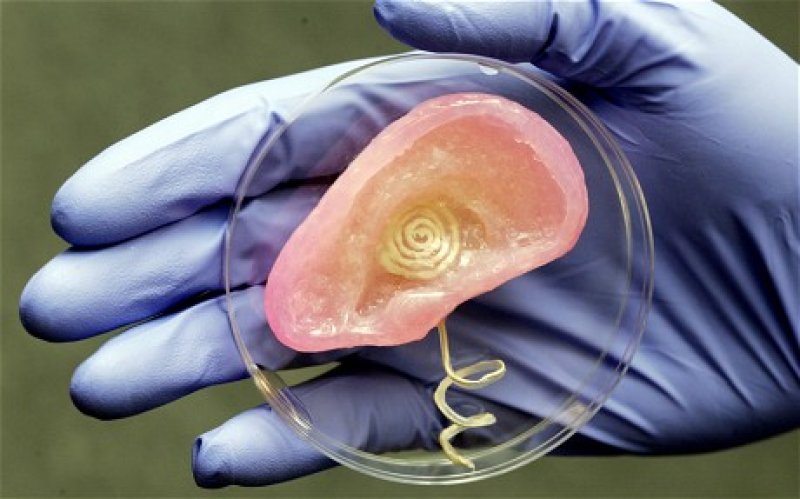
3D printed ear created at Princeton University, 2013

The GLP aggregated and excerpted this blog/article to reflect the diversity of news, opinion and analysis.

Maybe 3D printing is not new, but it seems to be transforming science, especially in the field of regenerative medicine.

Specifically, it addresses the need for tissues and organs suitable for transplantation — which would be the answer to countless prayers. Until that goal is realized, the development of this technology has far-reaching applications not only in medicine but in research, drug discovery, and toxicology as well.

In London, a two-year old girl recently received a kidney transplant from her father and the surgery was a success, thanks to the ability of surgeons to reproduce a model of her father’s kidney and her abdomen using a 3D printer. The model of the donor father’s kidney was recreated in the exact dimensions and density of his real kidney, which allowed the surgeons to better plan and practice the operation with increased safety and efficacy.


Three-dimensional printing, known in the manufacturing industry as “additive manufacturing,” has been around for over two decades. It is an additive process where successive layers of material are distributed to form 3D shapes. In contrast to non-biological printing, 3D bioprinting involves multiple complexities such as choice of materials, cell types, growth and differentiation factors, and technical challenges related to sensitivities of living cells and the construction of tissues.

Read full, original post: 3D Bioprinting Could Speed Organ Transplant Process

Related Articles

Infographic: Global regulatory and health research agencies on whether glyphosate causes cancer

Infographic: Global regulatory and health research agencies on whether glyphosate causes cancer

Does glyphosate—the world's most heavily-used herbicide—pose serious harm to humans? Is it carcinogenic? Those issues are of both legal and ...

Most Popular

ChatGPT-Image-Mar-10-2026-01_39_01-PM
Viewpoint—“Miracle molecule” debunked: Why acemannan supplements don’t work
newborn baby spit up gerd
Vaccine-preventable congenital infections are a leading driver of autism
Screenshot-2026-10-14-at-11.45.36-AM
Viewpoint: RFK Jr.’s stacked FDA advisory council endorses multicancer screening test from ethically- questionable company that would increase false positives and waste billions of dollars
Misinformation-Shatters-the-Clockwork-Mind
Viewpoint: The price Americans pay for science denialism
Screenshot-2026-10-08-at-10.41.33-AM
Viewpoint: Wellness patches: Most vitamin supplements are useless and sometimes even dangerous, but this craze is even worse
Screenshot-2026-10-15-at-12.13.33-PM
Ahead of the midterms, Meta has paid at least 29 anti-LGBTQ accounts for their posts
Screenshot-2026-10-14-at-12.47.21-PM
Viewpoint: Are these Trump-conservative GOP doctor-politicians violating their medical oath?
Pride and Patriotism in the Breeze
Retreat from identity labels: Does the sharply declining number of young teens identifying as gay and bisexual reflect an ideological shift?
Crossed-Out-Calendar-with-Milk-Carton
Viewpoint: The shocking consequences after a year of Robert F. Kennedy Jr.'s distortions, deceptions, and flat-out falsehoods
Prescription Capsules Scattered on Twenty-Dollar Bills
Facts & Fallacies podcast: America's health care system is broken. A doctor explains how to fix it, Part 2
Cross and Syringe Standoff
Viewpoint: Hijacking Jesus: How anti-vaccine fanatics are exploiting religious exemptions and killing children
Screenshot-2026-10-07-at-1.03.15-PM
Anti-vaxxers’ double whammy: Exaggerated vaccine fears have fueled measles outbreaks and preventable deaths—and left survivors more vulnerable to other infections for years
glp menu logo outlined

Get news on human & agricultural genetics and biotechnology delivered to your inbox.





















