Thousands of studies over 3 decades may have used contaminated or misidentified cell lines

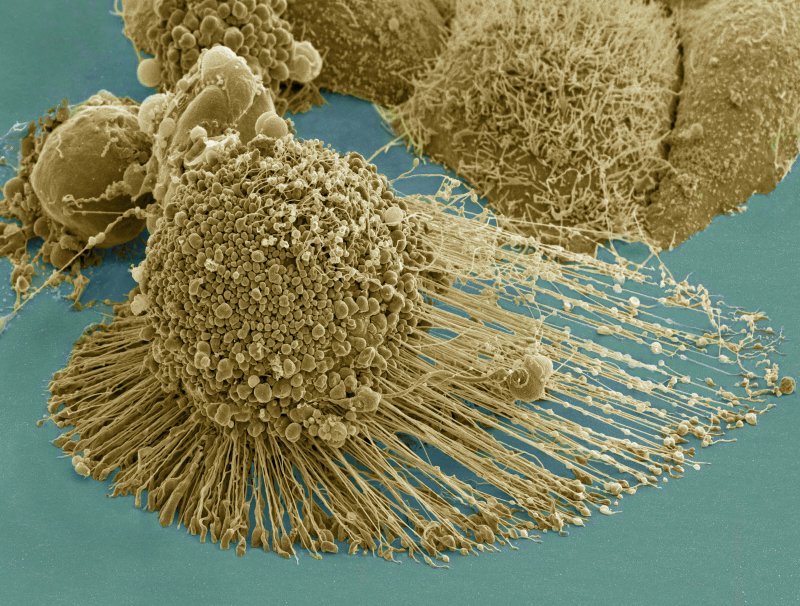
HeLa IV

The GLP aggregated and excerpted this blog/article to reflect the diversity of news, opinion and analysis.

The problem is this: Recent estimates suggest that between 20 percent and 36 percent of cell lines scientists use are contaminated or misidentified — passing off as human tissue cells that in fact come from pigs, rats, or mice, or in which the desired human cell is tainted with unknown others. But despite knowing about the issue for at least 35 years, the vast majority of journals have yet to put any kind of disclaimer on the thousands of studies affected.

Christopher Korch, a geneticist at the University of Colorado, has studied the issue. According to Korch, nearly 5,800 articles in 1,182 journals may have confused HeLa [a common cervical cancer cell line] for HEp-2 [a common epithelial cell lin]; another 1,336 articles in 271 journals may have mixed up HeLa with INT 407. Together, the 7,000-plus papers have been cited roughly 214,000 times, Science reported last year.

All told, more than 400 cell lines either lack evidence of origin or have become cross-contaminated with human or other animal cells at some point in their laboratory lineage.

Read full, original post: Thousands of studies used the wrong cells, and journals are doing nothing

Related Articles

Infographic: Global regulatory and health research agencies on whether glyphosate causes cancer

Infographic: Global regulatory and health research agencies on whether glyphosate causes cancer

Does glyphosate—the world's most heavily-used herbicide—pose serious harm to humans? Is it carcinogenic? Those issues are of both legal and ...

Most Popular

ChatGPT-Image-Sep-23-2026-02_36_39-PM
Viewpoint: After firing the entire National Science Board, Trump reshapes funding initiatives. Here’s the good and the bad.
ChatGPT-Image-Mar-10-2026-01_39_01-PM
Viewpoint—“Miracle molecule” debunked: Why acemannan supplements don’t work
ChatGPT-Image-Sep-10-2026-10_36_07-AM
Viewpoint: Even lousy scientific articles can shield authors when they hype dubious health claims and products
ChatGPT-Image-Sep-30-2026-01_38_36-PM
Viewpoint: Died “with measles” vs. died “from measles”: RFK, Jr.’s dangerously subversive word games
sorghum farmers in kenya FARMERS TREND
Here are all the ways CRISPR gene editing is transforming Africa’s staple crops—and there’s a lot more innovation to come
ChatGPT-Image-Sep-30-2026-01_11_07-PM
How U.S. teamed with Russia to block global human AI weapons oversight
glp menu logo outlined

Get news on human & agricultural genetics and biotechnology delivered to your inbox.