Endangered species listing for bumble bee could intensify neonicotinoid debate

Screen Shot at AM
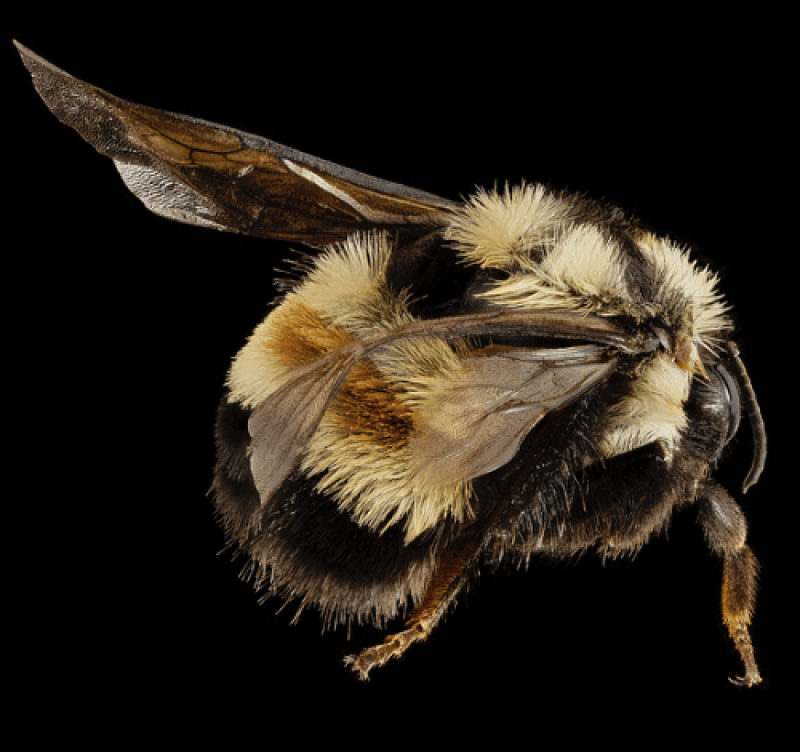
Rusty patched bumble bee. Photo by USGS/Flickr

The U.S. Fish and Wildlife Service on [Sept. 21] proposed listing the rusty patched bumble bee… for federal protection as an endangered species.

…[T]he rusty patched bumble bee is the first in the continental United States formally proposed for listing under the U.S. Endangered Species Act.

…[T]he rusty patched bumble bee… has plunged in abundance and distribution by more than 90 percent since the late 1990s, according to the Fish and Wildlife Service.

The agency attributes the decline to a number of factors, including disease, pesticides, climate change and habitat loss.

Bumble bees… are essential pollinators of wildflowers and about a third of U.S. crops… said Sarina Jepsen of the Xerces Society for Invertebrate Conservation, which petitioned the government for protection of the insect.

. . . .

Jepsen said protections proposed for the rusty patched bumble bee will intensify the debate over the degree to which so-called neonicotinoid pesticides, routinely used in agriculture and applied to plants and trees in gardens and parks, have contributed to the decline of native bees.

. . . .

The public comment period initiated by [the] proposed listing runs through Nov. 21, 2016, after which the agency could revise its proposal or finalize a decision.

The GLP aggregated and excerpted this blog/article to reflect the diversity of news, opinion and analysis. Read full, original post: Rusty patched bumble bee proposed for U.S. endangered species status

{{ reviewsTotal }}{{ options.labels.singularReviewCountLabel }}
{{ reviewsTotal }}{{ options.labels.pluralReviewCountLabel }}
{{ options.labels.newReviewButton }}
{{ userData.canReview.message }}

Related Articles

Infographic: Global regulatory and health research agencies on whether glyphosate causes cancer

Infographic: Global regulatory and health research agencies on whether glyphosate causes cancer

Does glyphosate—the world's most heavily-used herbicide—pose serious harm to humans? Is it carcinogenic? Those issues are of both legal and ...

Most Popular

Screenshot-2026-05-01-at-1.29.41-PM
Viewpoint: What happens when whole grains meet modern food manufacturing? Labels don’t tell the whole story.
S
As vaccine rejectionism spreads, measles may be taking a more dangerous turn
ChatGPT-Image-Mar-27-2026-11_47_30-AM-2
FDA’s expedited drug reviews are hailed in some quarters but other approval practices are problematic
Screenshot 2026-05-06 at 2.56
Singularity crisis ahead? Can super babies save us from rogue AI geniuses?
Screenshot-2026-04-20-at-2.26.27-PM
Viewpoint — Food-fear world: The latest activist scientists campaign: Cancer-causing additives
Farmers can talk to plants
Farmers are a major source of misinformation—about farming
Screenshot-2026-04-30-at-2.19.37-PM
5 myths about summer dehydration that could damage your health — or even kill you
Screenshot-2026-05-06-at-2.07.43-PM
Manufacturing a conspiracy: The timeline of how  the White House embraced the fringe claim that scientists are being mysteriously murdered
Screenshot-2026-03-13-at-12.14.04-PM
The FDA wants to make many popular prescription drugs OTC—a great idea. Here’s why it’s unlikely to happen
Screenshot 2026-05-06 at 2.19
Vaccine shootout at the CDC 
glp menu logo outlined

Get news on human & agricultural genetics and biotechnology delivered to your inbox.