Europeans left disastrous DNA mark on indigenous Americans

Screen Shot at PM

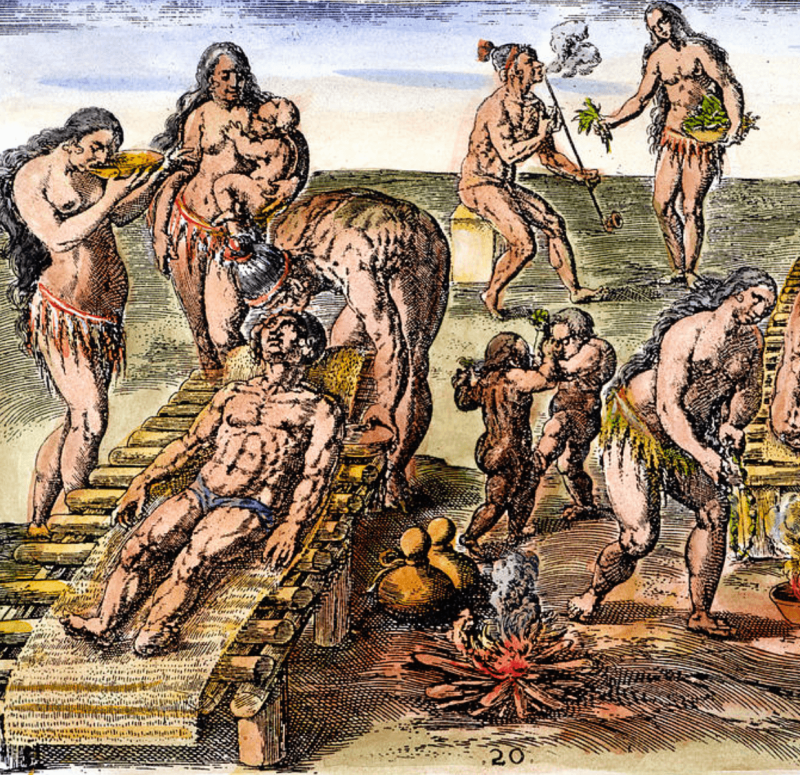
Of the many devastations Europeans wreaked upon the indigenous people of the “New World,” disease left perhaps the worst impact…But that’s not all: Researchers report Europeans’ arrival left a genetic mark—one that might help us to understand why diseases like small pox had such a disastrous effect.

John Lindo and a team of biologists, archaeologists, and anthropologists [wondered] if Native Americans had a particular genetic weakness when it comes to European diseases. Specifically, could their immune systems have been so strongly adapted to local maladies that they were unprepared to fight off novel pathogens?

In short, yes, Lindo and his team report, at least when it comes to the [Coast Tsimshian people].

The researchers found…a pattern [revealing positive selection] in a gene called HLA-DQA1, part of a family of genes that can help fight off small pox, measles, and tuberculosis.

In other words, the same genes that kept Tsimshian people healthy before European diseases arrived also helped get them sick.

“[T]he selection pressure shift could correlate to the European-borne epidemics of the 1800s, suffered in the Northwest Coast region,” the authors write.

The GLP aggregated and excerpted this blog/article to reflect the diversity of news, opinion, and analysis. Read full, original post: How Native American Genes Tell the Story of Europeans’ Arrival

{{ reviewsTotal }}{{ options.labels.singularReviewCountLabel }}
{{ reviewsTotal }}{{ options.labels.pluralReviewCountLabel }}
{{ options.labels.newReviewButton }}
{{ userData.canReview.message }}

Related Articles

Infographic: Global regulatory and health research agencies on whether glyphosate causes cancer

Infographic: Global regulatory and health research agencies on whether glyphosate causes cancer

Does glyphosate—the world's most heavily-used herbicide—pose serious harm to humans? Is it carcinogenic? Those issues are of both legal and ...

Most Popular

Picture1-5
Science Disinformation Gap: The transatlantic battle over social media and censorship
Screenshot-2026-04-23-at-11.00.36-AM
Regulators' dilemma: Thalidomide, Metformin, and the cost of getting drug approvals wrong
ChatGPT-Image-May-12-2026-08_39_41-PM
GLP podcast: Big Pharma, Big Ag, Big Food—health harming industries or life-saving innovators?
Screenshot-2026-05-12-at-9.58.31-PM
'He seems fine': Marty Makary out as FDA commissioner
ChatGPT Image May 10, 2026, 08_16_59 PM 2
Overmedicalization? RFK Jr.’s antidepressant crackdown raises conflict questions over his fee stake in Wisner Baum, the tort firm built on suing drug makers
Screenshot-2026-05-12-at-10.05.11-AM
Pro-vaccine “hero” vs. an anti-vax “villain”: ‘Bad Vaxx’ video stirs MAHA backlash
Picture1-1
Cooling the planet with balloons: Could a geoengineering gamble slow global warming?
ChatGPT-Image-Apr-13-2026-02_20_22-PM
Viewpoint: Misinformation infodemic? Why assessing evidence is so challenging 
Screenshot-2026-05-01-at-1.29.41-PM
Viewpoint: What happens when whole grains meet modern food manufacturing? Labels don’t tell the whole story.
S
As vaccine rejectionism spreads, measles may be taking a more dangerous turn
ChatGPT Image May 12, 2026, 10_19_00 AM 2
Viewpoint— 'Muscular governance': How authoritarianism is surging corporate-linked energy misinformation
Screenshot-2026-05-11-104424
Hantavirus outbreak research: Trump administration shut down study last year on rodent-to-human transmission
glp menu logo outlined

Get news on human & agricultural genetics and biotechnology delivered to your inbox.