When German police investigators were facing one of the worst serial killers in the country’s recent history, they offered a 300,000 Euro reward for anything leading to the capture and conviction of the “Phantom of Heilbronn.” This woman had apparently killed six people in Germany and Austria between 1993 and 2008, and was involved in robberies, burglaries and assaults, but nobody had ever seen her. The only evidence — and the German police’s only hope — was DNA left behind at the scene. More than 15 crime scenes had her matching DNA.
The German investigators, like many other police departments, felt assured that if they could get a DNA match on a real person, they’d have their culprit. For DNA was considered nearly completely infallible. After all, the U.S. National Research Council had declared that “the reliability and validity of properly collected and analyzed DNA data should not be in doubt.” This reputation was being held up in courtroom testimony and appeals court decisions not just in the United States, but worldwide.
And the Germans got their suspect. The problem was, the “phantom” wasn’t a criminal at all, but a female worker in a crime lab. Her DNA contaminated the cotton swabs used by investigators to gather samples at the six murder scenes as well as other crime scenes.
The “phantom” case is not an isolated incident. Since DNA has taken over fingerprints or hair analysis as the most “scientific” method of crime scene forensics, a number of blunders involving mishandling of DNA have contaminated not only DNA samples, but also the reliability of criminal investigations:
- In Houston, the police department was forced to shut down its DNA and serology crime lab sections completely, after it was revealed that the lab had botched the processing of DNA samples.Two men who were falsely convicted based on botched lab work were released from prison after subsequent DNA testing proved their innocence. The lab eventually reopened, but in 2014 it was transferred from the police department to a civilian board after a laboratory technician resigned for allegedly falsifying a worksheet, failing to recalibrate a machine and tampering with government records.
- The FBI, after an investigation of its DNA forensics lab, discovered in 2002 that staff biologist Jacqueline Blake had not conducted the proper negative controls when performing a polymerase chain reaction (PCR) test on DNA samples. These controls are necessary to rule out contamination from technicians or any other laboratory processes. She nonetheless filled out her paperwork indicating that she had performed the negative controls. Her shortcuts, according to the FBI Inspector General, necessitated the removal of 29 DNA samples from the bureau’s national DNA database, delayed delivery of DNA reports crucial to some criminal cases, and eliminated DNA evidence from other cases.
- In 2013, DNA found on the fingernails of a murder victim in San Jose, California, was run through DNA databases. A “hit” (aka, a DNA profile that matched the crime scene sample) led police to 26-year-old Lukas Anderson, who was charged with murder. But Anderson couldn’t have done it: paramedics had transported him to the hospital for extreme drunkenness, and he was in the hospital at the time of the murder. What really happened? Anderson’s DNA had been transferred from the paramedics, who were dispatched to the murder scene shortly after dropping off Anderson at the hospital.
“DNA tests are not now and have never been infallible,” William C. Thompson, a criminology professor at the University of California, Irvine, and an expert in DNA evidence, wrote recently:
“Errors in DNA testing occur regularly. DNA evidence has caused false incriminations and false convictions, and will continue to do so. Although DNA tests incriminate the correct person in the great majority of cases, the risk of false incrimination is high enough to deserve serious consideration in debates about expansion of DNA databases.”
What are the problems?
The polymerase chain reaction, the backbone of DNA-based evidence, is a very sensitive procedure. By biochemically amplifying the amount of DNA in any sample, it can provide a readable stretch of genetic material. Since DNA is widely believed to be unique to each person, then it only follows that it can be useful for determining identity—or a connection to a crime.

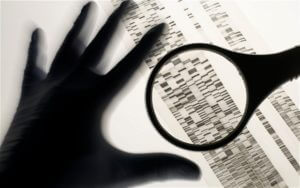



But PCR doesn’t just amplify the DNA in the sample. It will amplify any other DNA, as well. This includes DNA from technicians, crime scene investigators, or workers who prepare cotton swabs. This calls for very precise procedures in the laboratory, which can be time-consuming, delaying the delivery of DNA reports.
Another issue with DNA, is the assumption of its uniqueness. Osagie Obasogie, a professor at Hastings College of Law in San Francisco, points to a popular claim by prosecutors—that the odds of a coincidental DNA match with national databases is more than 1-in-a-million. That number should be more like one in three, according to studies by the FBI and the National Research Council. That “one in a million” figure compares the suspect’s DNA with the size of the population of the United States. A more correct comparison should be with the samples in the database, Obasogie said.
Finally, a scientific technique is only as good as the scientists and technicians using it. If there is an encouragement to take shortcuts, sidestep procedures, falsify data, or fudge claims of reliability, then there are going to be problems with the laboratory results, no matter what the technique. In fact, the FBI’s recent revelations that its hair analysis technicians misrepresented the impact of their analyses underscore that fact.
The mirage of infallible DNA evidence
To be sure, DNA has revolutionized how crimes are solved. On the defense side of the courtroom, groups, particularly the Innocence Project, have successfully used DNA analysis to exonerate convicted criminals, some of them on who had been sentenced to death solely on DNA evidence. But, if DNA evidence continues, as it has since its inception, to be mishandled or misrepresented, then that makes its reliability as elusive as the Phantom of Heilbronn.
Andrew Porterfield is a writer, editor and communications consultant for academic institutions, companies and non-profits in the life sciences. He is based in Camarillo, California. Follow @AMPorterfield on Twitter.