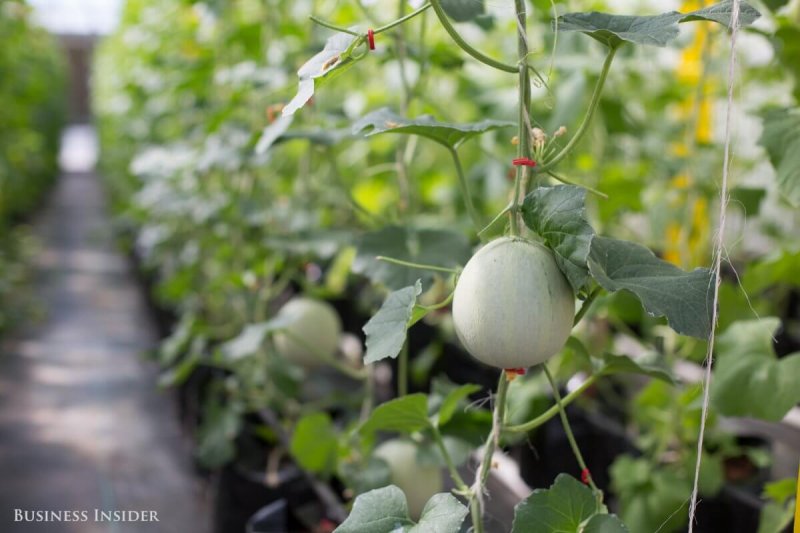
Monsanto is changing the way people eat — Using traditional breeding to make better fruits and vegetables

the companys first challenge in making a sweeter winter cantaloupe for example is figuring out which genes in the melon are responsible for brix a measure of sweetness
Globally, Monsanto breeds 18 crops, including tomatoes, melons, onions, carrots, broccoli, and lettuce, and has over 2,000 fruit and vegetable varieties.

Monsanto is no one-trick GMO pony. Founded in 1901, the agricultural biotech company has fueled innovations in herbicides, pesticides, and ever-controversial genetically modified crops (GMOs).

But it may come as a surprise, even to people who are familiar with the $49 billion global giant, that Monsanto is also the world’s largest supplier of vegetable seeds.

Most corn and soybeans grown in the US contain the company’s patented seed traits. These days, Monsanto’s bread-and-butter GMO business is supplemented by its work on non-GMO vegetables, which cleared $801 million in net sales in the company’s 2016 fiscal year.

On a sprawling campus in Woodland, California, Monsanto chips away at making a juicier melon, a more shelf-stable onion, a tomato that doesn’t go limp in shipment, and other foods made using traditional breeding techniques augmented by high-tech tools.

Though its vegetable division isn’t as profitable as its two key GMO crops (pesticide-resistant corn and soybeans), the company invested $100 million into vegetable research and development in 2016….

Globally, Monsanto breeds 18 crops, including tomatoes, melons, onions, carrots, broccoli, and lettuce, and has over 2,000 varieties across its vegetable portfolio.

The GLP aggregated and excerpted this blog/article to reflect the diversity of news, opinion, and analysis. Read full, original post: Inside the little-known Monsanto campus where scientists are changing the way you eat

For more background on the Genetic Literacy Project, read GLP on Wikipedia

{{ reviewsTotal }}{{ options.labels.singularReviewCountLabel }}
{{ reviewsTotal }}{{ options.labels.pluralReviewCountLabel }}
{{ options.labels.newReviewButton }}
{{ userData.canReview.message }}

Related Articles

Infographic: Global regulatory and health research agencies on whether glyphosate causes cancer

Infographic: Global regulatory and health research agencies on whether glyphosate causes cancer

Does glyphosate—the world's most heavily-used herbicide—pose serious harm to humans? Is it carcinogenic? Those issues are of both legal and ...

Most Popular

Screen Shot at AM
Facts & Fallacies Podcast: Right-wing politics bad for your health? Separating speculation from science
ChatGPT-Image-Jun-13-2026-11_51_39-AM
Viewpoint: COVID lab leak? Misguided backers of the lab leak theory refuse to give up
ChatGPT Image Jun 3, 2026, 03_54_37 PM
Viewpoint: “Turn on, tune in, drop out”—Kennedy embraces the Timothy Leary psychedelic revolution
drug look like ozempic
Six key health insights from taking weight-loss drugs
Screenshot-2026-06-14-at-9.14.26-AM
‘Humanitarian catastrophe’: Trump’s USAID shutdown could help drive nearly 23 million deaths — including 5.4 million children — by 2030, Lancet study warns
ChatGPT-Image-Jun-14-2026-09_41_44-AM-2
Viewpoint—‘The gleeful efficiency of an arsonist’: Administration’s health and science research cuts are ‘sabotaging’ America’s future
ChatGPT-Image-Jun-11-2026-01_15_03-PM
Selective Pressure, Selective Silence
ChatGPT-Image-Jun-15-2026-11_00_13-AM-2
Glucosamine alert: Alzheimer’s progresses faster among those taking the popular supplement
ChatGPT-Image-Mar-10-2026-01_39_01-PM
Viewpoint—“Miracle molecule” debunked: Why acemannan supplements don’t work
ChatGPT Image Jun 3, 2026, 03_14_43 PM
Viewpoint: How Earthjustice became the poster child for the abuse of special interest activist funding
ChatGPT Image Jun 12, 2026, 02_32_14 PM
‘Have you asked your doctor?’: AMA launches campaign to counter health misinformation
Screenshot-2026-06-14-at-9.53.54-AM
Is the World Cup a perfect storm for the spread of infectious diseases?

Screenshot-2026-06-05-at-2.12.30-PM
Some plants can poison you. So how did humans figure out what is safe to eat?
Screenshot-2026-06-11-at-3.40.06-PM
'Toxin' detox: A gastroenterologist weighs in on $71 billion health trend
glp menu logo outlined

Get news on human & agricultural genetics and biotechnology delivered to your inbox.