
Is human sexuality determined by testosterone’s effect on the brain?

Screen Shot at AM
[Early experiments have shown] that the Y chromosome is essential for the formation of a testis, and it is the testosterone from this testis that acts on the brain…Amazingly, giving testosterone to little new-born females resulted in their sexual behavior being much more like that of males when they grew up.  And the opposite was also true: Removing the testes of new-born males resulted in female-like patterns of behavior.

Human sexuality, of course, is made up of several components, though they overlap.

But does testosterone play a role in the development of human sexuality? Testosterone acts on the brain (and other organs) by activating a complex protein, the androgen receptor. If a mutation in the latter occurs, the brain may not respond to testosterone: It’s as if it didn’t exist.

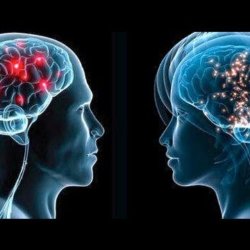
Recent experimental evidence also points to real differences in male and female rodent brains…The hypothalamus of female rodents has greater levels of methylation than males: that is, more genes are suppressed. Giving such females testosterone post-natally reduces this: in other words, some of the methylation markers are removed, releasing those genes to become active. Such females behave more like males. Furthermore, giving a drug to little males that prevents de-methylation results in them behaving more like females.

[Read the full study here]

The GLP aggregated and excerpted this blog/article to reflect the diversity of news, opinion, and analysis. Read full, original post: How the Brain Determines Sexuality

{{ reviewsTotal }}{{ options.labels.singularReviewCountLabel }}
{{ reviewsTotal }}{{ options.labels.pluralReviewCountLabel }}
{{ options.labels.noReviewsLabel }}
{{ options.labels.newReviewButton }}
{{ userData.canReview.message }}

Related Articles

Infographic: Global regulatory and health research agencies on whether glyphosate causes cancer

Infographic: Global regulatory and health research agencies on whether glyphosate causes cancer

Does glyphosate—the world's most heavily-used herbicide—pose serious harm to humans? Is it carcinogenic? Those issues are of both legal and ...

Most Popular

ChatGPT-Image-Mar-10-2026-01_39_01-PM
Viewpoint—“Miracle molecule” debunked: Why acemannan supplements don’t work
Screenshot 2026-07-11 094410
Growing animal muscle and fat cells inside rice grains and calling it beef: One of numerous genetically engineered products shaking up our ecosystem
file-f-d-d-
Facts & Fallacies Podcast: Europe's AC debacle underscores fatal flaw in green activism
Screenshot-2026-07-16-at-11.32.12-AM
Viewpoint: Trump appoints climate change hoax promoter to head influential government policy project
Screenshot 2026-07-16 at 8.49
Pete Hegseth’s bizarre Viagra commercial as Trump administration endorses ‘hormone replacement therapy’
Screenshot 2025-09-17 at 12.41
Misinformation alert: No, glyphosate use in Canadian forests is not spurring more wildfires
ChatGPT-Image-Jun-25-2026-12_23_17-PM
No, Bill Gates did not secretly engineer ticks to promote veganism
Screenshot-2026-07-16-at-6.02.54-PM
Wellness grifters overwhelm information channels in the developing world, and the problem is escalating
ChatGPT-Image-Jul-9-2026-02_39_22-PM
Viewpoint: Polyphenols or NAD+ supplements to combat aging: No, Gwenyth Paltrow and followers, don’t waste your money.
Screenshot-2026-07-16-at-12.08.38-PM
Viewpoint: With trust in doctors and mainstream medicine collapsing, medical professionals need a new communications strategy
Screenshot-2026-07-08-at-9.36.03-AM
Viewpoint: Long-contained diseases are on the rise in the U.S. Are Trump cuts to blame?

Sorry. No data so far.

glp menu logo outlined

Get news on human & agricultural genetics and biotechnology delivered to your inbox.