Could vertical farming revolutionize agriculture?

plenty vertical farm e

Plenty is no ordinary farm.

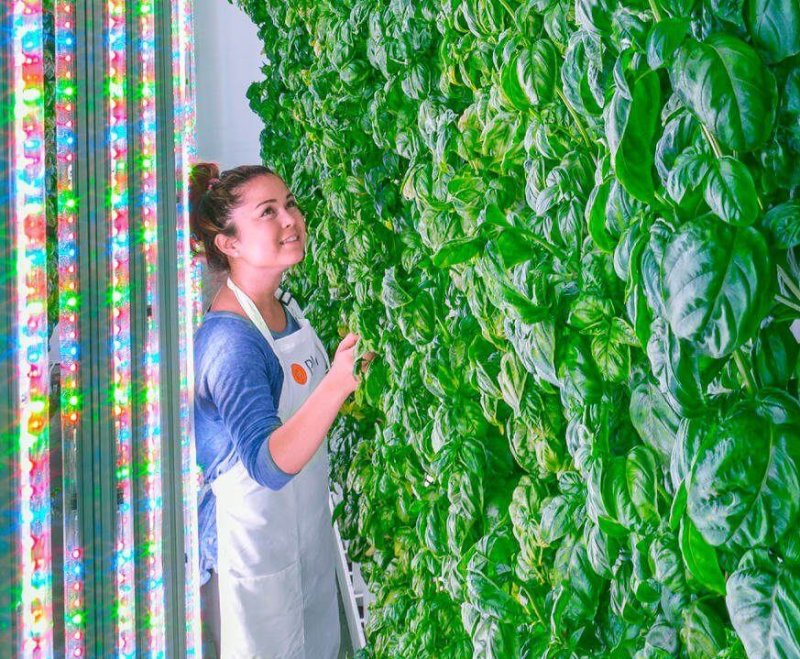
Instead of growing greens outdoors, the farm grows its food on glowing, LED-lit 20-foot-tall towers inside a former electronics distribution center in South San Francisco. The towers don’t require pesticides or even natural sunlight.

The technique is called indoor vertical farming, a type of agriculture in which food grows on trays or hanging modules in a climate-controlled, indoor facility. The process could one day upend the world of agriculture, because it means certain types of food could be produced year round, anywhere, in a small space.

Some experts say the funding could help the indoor farming industry as a whole. Dickson Despommier, a professor of microbiology and public health at Columbia University, told [Business Insider]  the investment will make indoor agriculture even more commonplace, and encourage other [venture capitalists] to fund vertical farm companies.

Vertical farming has attracted increasing interest from venture capitalists in recent years. Founded in 2004, vertical farming company AeroFarms is growing dozens of varieties of greens in nine warehouses (the largest at 69,000 square feet) in New Jersey, and has raised $95.8 million to date. Another startup, called Bowery, has raised $20 million since its early 2017 launch.

The GLP aggregated and excerpted this article to reflect the diversity of news, opinion and analysis. Read full, original post: Investors are sinking hundreds of millions into a technology that could revolutionize the way we eat


{{ reviewsTotal }}{{ options.labels.singularReviewCountLabel }}
{{ reviewsTotal }}{{ options.labels.pluralReviewCountLabel }}
{{ options.labels.noReviewsLabel }}
{{ options.labels.newReviewButton }}
{{ userData.canReview.message }}

Related Articles

Infographic: Global regulatory and health research agencies on whether glyphosate causes cancer

Infographic: Global regulatory and health research agencies on whether glyphosate causes cancer

Does glyphosate—the world's most heavily-used herbicide—pose serious harm to humans? Is it carcinogenic? Those issues are of both legal and ...

Most Popular

ChatGPT-Image-Mar-10-2026-01_39_01-PM
Viewpoint—“Miracle molecule” debunked: Why acemannan supplements don’t work
Screenshot 2025-09-17 at 12.41
Misinformation alert: No, glyphosate use in Canadian forests is not spurring more wildfires
Screenshot 2026-07-11 094410
Growing animal muscle and fat cells inside rice grains and calling it beef: One of numerous genetically engineered products shaking up our ecosystem
file-f-d-d-
Facts & Fallacies Podcast: Europe's AC debacle underscores fatal flaw in green activism
ChatGPT-Image-Jul-9-2026-02_39_22-PM
Viewpoint: Polyphenols or NAD+ supplements to combat aging: No, Gwenyth Paltrow and followers, don’t waste your money.
ChatGPT-Image-Jul-8-2026-12_32_48-PM
Viewpoint: SCOTUS strikes a blow against junk science in Bayer glyphosate case. Will it deter mass tort litigators?
ChatGPT-Image-Jun-25-2026-12_23_17-PM
No, Bill Gates did not secretly engineer ticks to promote veganism
ChatGPT-Image-Jul-7-2026-01_57_55-PM
Viewpoint: Europe’s rejection of air conditioning is the poster child for misunderstanding how to mitigate the impact of climate change
afb-a-b
As the EU loosens restrictions on agricultural gene editing, it remains years behind the rest of the world on equally-safe GMO foods
ChatGPT-Image-Jul-1-2026-03_33_49-PM
‘Alternative’ cancer treatments that could kill you
Screenshot 2026-07-16 at 8.49
Pete Hegseth’s bizarre Viagra commercial as Trump administration endorses ‘hormone replacement therapy’

Sorry. No data so far.

glp menu logo outlined

Get news on human & agricultural genetics and biotechnology delivered to your inbox.