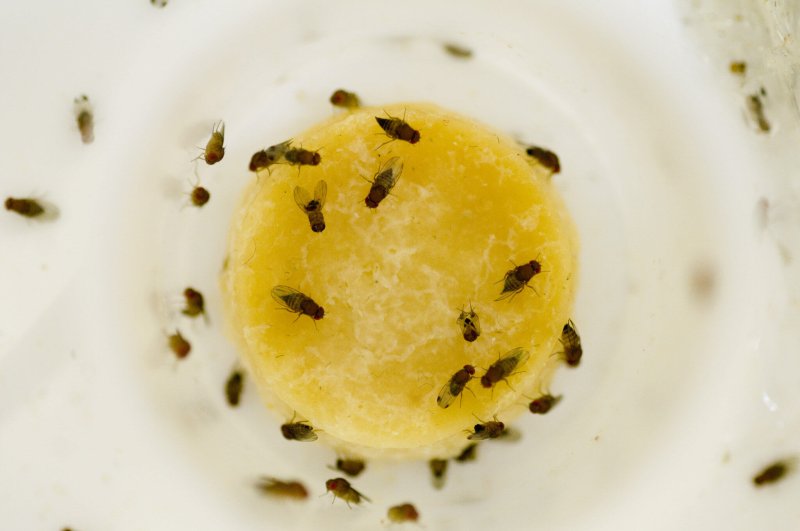
Instead of shooing them away, one Western University researcher is getting up close and personal with fruit flies to determine why we like our personal space.
Anne Simon, who’s an assistant professor in Biology, discovered that varying levels of a chemical found in humans can affect a person’s responses to social interactions. Dopamine is a neurotransmitter associated with sending pleasure signals to the brain, often processing what may be deemed as rewards such as an encounter with food or sex – and social interactions. Simon’s team manipulated dopamine through food and genetic testing in fruit flies, which share similar genetic information with humans, to study their responses.
…
Researchers tested the reaction of flies under extreme dopamine levels. The team discovered that in male flies, too little dopamine results in separation and too much dopamine results in congregation. Female flies wanted to congregate in both scenarios – disregarding the amount of dopamine.

…
“Dopamine is going to be important for different functions,” she said. “It’s going to be helping different parts of the brain communicate and we want to understand which part of the brain is important for social interactions specifically.”
The GLP aggregated and excerpted this blog/article to reflect the diversity of news, opinion, and analysis. Read full, original post: How fruit flies are helping improve social interactions