Fungicides may be to blame for US bumblebee declines, study finds

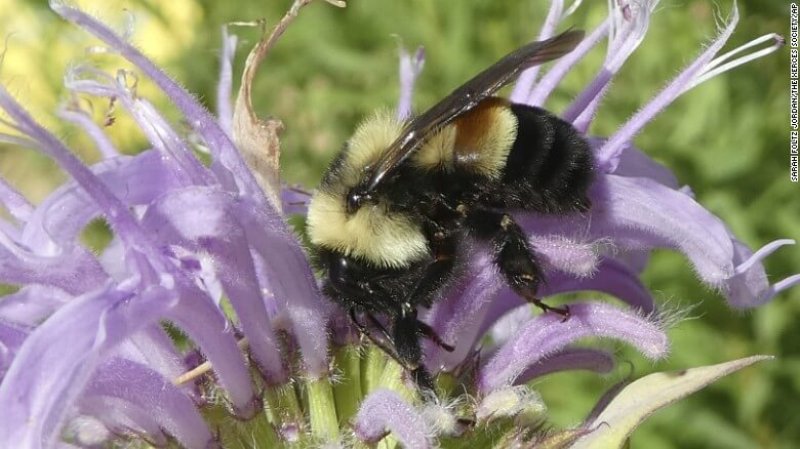
rusty patched bumble bee exlarge

When a Cornell-led team of scientists analyzed two dozen environmental factors to understand bumblebee population declines and range contractions, they expected to find stressors like changes in land use, geography or insecticides.

Instead, they found a shocker: fungicides, commonly thought to have no impact.

“Insecticides work; they kill insects. Fungicides have been largely overlooked because they are not targeted for insects, but fungicides may not be quite as benign – toward bumblebees – as we once thought. This surprised us,” said Scott McArt, assistant professor of entomology and the lead author on a new study published Nov. 15 in the journal Proceedings of the Royal Society B.

While science has studied insecticides, such as neonicotinoids, that attack bugs’ central nervous systems, this new work shows how fungicides – particularly chlorothalonil, a general-use fungicide often found in bumblebee and honeybee hives – may negatively affect bee health, said McArt….

[T]he scientists discovered what they call “landscape-scale” connections between fungicide usage, pathogen prevalence and declines of endangered United States bumblebees.

As farms use both insecticides and fungicides, the scientists worry about synergy. “While most fungicides are relatively nontoxic to bees, many are known to interact synergistically with insecticides, greatly increasing their toxicity to the bees,” McArt said.

[Editor’s note: Read the full study (behind paywall)]

The GLP aggregated and excerpted this article to reflect the diversity of news, opinion and analysis. Read full, original post: In bee decline, fungicides emerge as improbable villain

{{ reviewsTotal }}{{ options.labels.singularReviewCountLabel }}
{{ reviewsTotal }}{{ options.labels.pluralReviewCountLabel }}
{{ options.labels.newReviewButton }}
{{ userData.canReview.message }}

Related Articles

Infographic: Global regulatory and health research agencies on whether glyphosate causes cancer

Infographic: Global regulatory and health research agencies on whether glyphosate causes cancer

Does glyphosate—the world's most heavily-used herbicide—pose serious harm to humans? Is it carcinogenic? Those issues are of both legal and ...

Most Popular

ChatGPT-Image-Mar-10-2026-01_39_01-PM
Viewpoint—“Miracle molecule” debunked: Why acemannan supplements don’t work
ChatGPT-Image-Jul-8-2026-12_32_48-PM
Viewpoint: SCOTUS strikes a blow against junk science in Bayer glyphosate case. Will it deter mass tort litigators?

ChatGPT-Image-Jul-7-2026-01_57_55-PM
Viewpoint: Europe’s rejection of air conditioning is the poster child for misunderstanding how to mitigate the impact of climate change
ChatGPT-Image-Jul-1-2026-12_37_08-PM
Viewpoint: Trump poised to politicize all U.S.-supported science research
Screen-Shot-at-PM-pe-vra-kipgaprbdo-vd-ms-jpule-n-jqqaxf-l-e
Viewpoint: Will new breeding techniques help make European agriculture more competitive?
Screenshot-2026-07-08-at-11.25.14-AM
AI being mobilized to target misinformation about vaccines–on AI
Screenshot-2026-07-08-at-2.14.27-PM
Belief in unproven dietary regimes, vitamins, and crank therapies is putting patients’ health in danger and increasing the risk of getting cancer
ChatGPT-Image-Jun-25-2026-12_23_17-PM
No, Bill Gates did not secretly engineer ticks to promote veganism
ChatGPT-Image-Jul-10-2026-09_12_58-AM
X rolls out direct messages to users who interact with misinformation
ChatGPT-Image-Jul-1-2026-03_33_49-PM
‘Alternative’ cancer treatments that could kill you
ChatGPT-Image-Jul-7-2026-12_01_35-PM
Viewpoint: 21 worthless wellness trends inspired by RFK, Jr.’s ill-informed MAHA followers that can harm or even kill you.
ChatGPT-Image-Jun-30-2026-10_27_31-AM
Viewpoint: Europe clears the way for gene-edited crops — but fear-driven restrictions still slow their full potential
DtAieAIkCZy-uchn-oqg
Viewpoint: In the science misinformed grifter game plan, the organic-food-is-healthier myth might be the worst.
glp menu logo outlined

Get news on human & agricultural genetics and biotechnology delivered to your inbox.