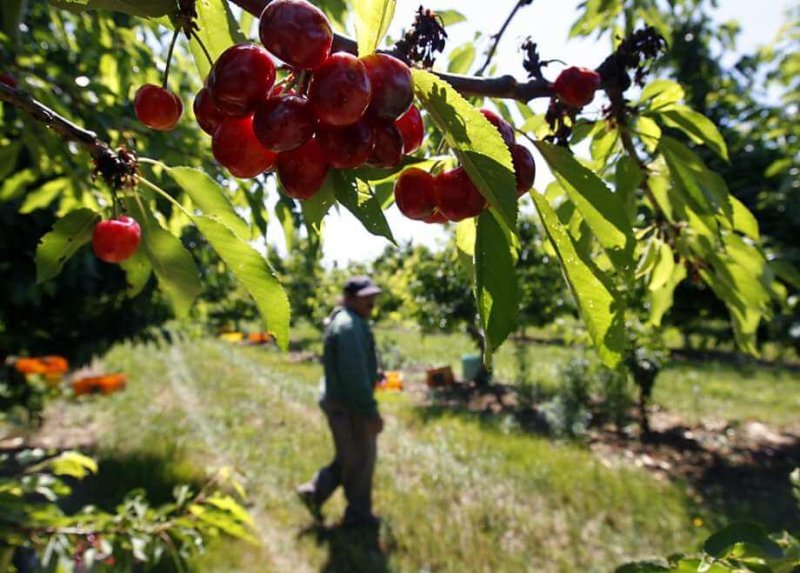
California cherry farmers look to ‘gene drive’ technology to kill invasive fruit flies

x

Since it first appeared in Northern California in 2008, the spotted-wing drosophila, a type of fruit fly native to Asia, has become the bane of the state’s cherry farms because of the razor-edged “ovipositor” on its tail.

Rather than lay eggs in rotting berries, as domestic flies do, the invasive species punches holes in fruit that’s still ripening, spoiling it. The costs to U.S. agriculture: about $700 million a year.

California’s cherry growers think they may have a way to get rid of the flies cheaply. To do it, they are counting on a technology developed by geneticists: a “gene drive” that can spread DNA alterations among wild flies, potentially killing them off.

Gene-drive technology is among the most widely debated—and feared—inventions of modern biology. Opponents call it a genetic “atom bomb” and want it banned. Others see the possibility of unprecedented public health interventions, like eradicating the mosquitoes that spread malaria.

Now, for the first time, commercial uses are on the table. With funding from the California Cherry Board, scientists at the University of California, Riverside, have installed a gene drive in the invasive pest, the first time the technology has been established in a commercially important species.

Read full, original post: Farmers Seek to Deploy Powerful Gene Drive

{{ reviewsTotal }}{{ options.labels.singularReviewCountLabel }}
{{ reviewsTotal }}{{ options.labels.pluralReviewCountLabel }}
{{ options.labels.newReviewButton }}
{{ userData.canReview.message }}

Related Articles

Infographic: Global regulatory and health research agencies on whether glyphosate causes cancer

Infographic: Global regulatory and health research agencies on whether glyphosate causes cancer

Does glyphosate—the world's most heavily-used herbicide—pose serious harm to humans? Is it carcinogenic? Those issues are of both legal and ...

Most Popular

ChatGPT-Image-Jun-9-2026-01_11_37-PM
Turmeric supplements: More risks than benefits
Screen Shot at AM
Facts & Fallacies Podcast: Right-wing politics bad for your health? Separating speculation from science
newborn infant baby mother
Facts & Fallacies Podcast: The truth about vitamin K shots
Screenshot-2026-06-16-at-10.02.22-PM
Viewpoint: ‘Industrial food’ primer—Challenging the dangerous delusions of the alternative food movement
ChatGPT Image Jun 16, 2026, 12_03_37 PM
Kennedy accused of trying to ‘bully’ science journal that retracted study linking vaccines to infant deaths
ChatGPT-Image-Jun-3-2026-04_29_13-PM
Viewpoint: While unvaccinated children are dying overseas, Congress challenges Trump and Kennedy’s block on aid
ChatGPT-Image-Jun-15-2026-11_00_13-AM-2
Glucosamine alert: Alzheimer’s progresses faster among those taking the popular supplement
ChatGPT-Image-Jun-15-2026-12_13_41-PM
Viewpoint: Behind the effort to re-purpose the tobacco attack strategy to fight ultra-processed foods
Screenshot-2026-06-16-at-12.33.01-PM
Who’s responsible when AI lies? Google challenging court ruling that search results are not protected from legal liability
Screenshot-2026-06-16-at-11.23.32-AM
In a rebuke to RFK, Jr.’s anti-vax crusade, journal retracts study claiming hepatitis B vaccine–autism link
Screenshot-2026-06-16-at-12.46.54-PM
Viewpoint: “Dead Wrong”—Understanding healthcare’s misinformation epidemic
Screenshot-2026-06-05-at-2.12.30-PM
Some plants can poison you. So how did humans figure out what is safe to eat?
Screenshot-2026-06-14-at-9.53.54-AM
Is the World Cup a perfect storm for the spread of infectious diseases?
glp menu logo outlined

Get news on human & agricultural genetics and biotechnology delivered to your inbox.