Milk without cows: Commercialization of synthetic dairy products in the works

Screen Shot at AM e

Berkeley-based Perfect Day – which is creating ‘vegan’ dairy proteins without cows – is in talks with food industry partners about scaling up production in order to introduce dairy ingredients that vegans, vegetarians and dairy lovers alike can enjoy in products “in every aisle of the grocery store.”

Perfect Day is one of a new breed of companies in the ‘cellular agriculture’ business – using genetically engineered yeasts that have been ‘programmed’ to produce proteins or other ingredients found in plants or animals – on an industrial scale, without raising animals, and with less impact on the environment.

So how are the proteins produced?

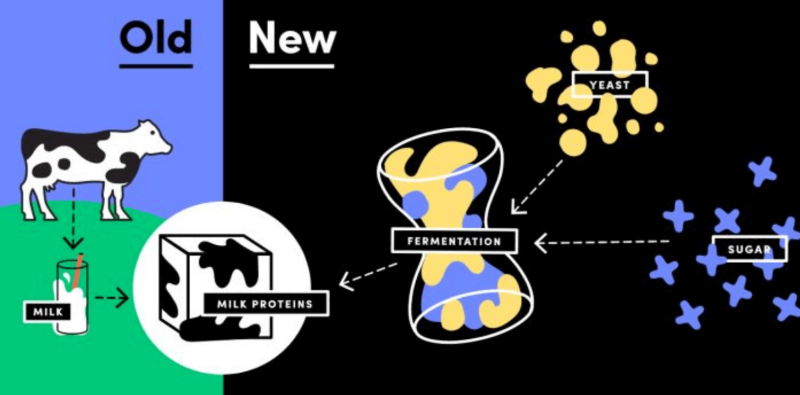
In a nutshell, Perfect Day takes food grade yeast, and adds DNA sequences (which can be 3D printed using DNA synthetic biology techniques) which effectively instruct that yeast to produce the proteins found in milk – predominantly casein, but also lactoglobulin and lactoalbumin, the two proteins that form the bulk of whey protein in milk. It then throws them into big fermentation tanks with corn sugar and other nutrients to feed on and sits back while they get to work.

When the microbes have done their work at the bio-refnery, Perfect Day’s dairy proteins – which have the same organoleptic properties as their animal-based counterparts – are harvested via a mechanical process and can be used in everything from ice cream to branded fluid milk, protein powders and shakes, yogurt, pizza and any other product containing dairy proteins….

Read full, original post: Perfect Day in talks with food industry partners to commercialize animal-free dairy ingredients

{{ reviewsTotal }}{{ options.labels.singularReviewCountLabel }}
{{ reviewsTotal }}{{ options.labels.pluralReviewCountLabel }}
{{ options.labels.newReviewButton }}
{{ userData.canReview.message }}

Related Articles

Infographic: Global regulatory and health research agencies on whether glyphosate causes cancer

Infographic: Global regulatory and health research agencies on whether glyphosate causes cancer

Does glyphosate—the world's most heavily-used herbicide—pose serious harm to humans? Is it carcinogenic? Those issues are of both legal and ...

Most Popular

Picture1-5
Science Disinformation Gap: The transatlantic battle over social media and censorship
Screenshot-2026-04-23-at-11.00.36-AM
Regulators' dilemma: Thalidomide, Metformin, and the cost of getting drug approvals wrong
ChatGPT-Image-May-12-2026-08_39_41-PM
GLP podcast: Big Pharma, Big Ag, Big Food—health harming industries or life-saving innovators?
ChatGPT Image May 10, 2026, 08_16_59 PM 2
Overmedicalization? RFK Jr.’s antidepressant crackdown raises conflict questions over his fee stake in Wisner Baum, the tort firm built on suing drug makers
Screenshot-2026-05-12-at-9.58.31-PM
'He seems fine': Marty Makary out as FDA commissioner
Picture1-1
Cooling the planet with balloons: Could a geoengineering gamble slow global warming?
Screenshot-2026-05-12-at-10.05.11-AM
Pro-vaccine “hero” vs. an anti-vax “villain”: ‘Bad Vaxx’ video stirs MAHA backlash
Screenshot-2026-05-11-104424
Hantavirus outbreak research: Trump administration shut down study last year on rodent-to-human transmission
Screenshot-2026-05-01-at-1.29.41-PM
Viewpoint: What happens when whole grains meet modern food manufacturing? Labels don’t tell the whole story.
ChatGPT Image May 12, 2026, 10_19_00 AM 2
Viewpoint— 'Muscular governance': How authoritarianism is surging corporate-linked energy misinformation
S
As vaccine rejectionism spreads, measles may be taking a more dangerous turn
Picture1-14
When superbugs threaten vulnerable children: Can AI help solve antibiotic resistance?
ChatGPT-Image-Apr-13-2026-02_20_22-PM
Viewpoint: Misinformation infodemic? Why assessing evidence is so challenging 
glp menu logo outlined

Get news on human & agricultural genetics and biotechnology delivered to your inbox.