When does life begin? Here are 17 points in time to consider

fetus
[Editor’s note: This article originally ran in 2013, but is being republished to encourage public discussion following the recent proclamation by the US Department of Health and Human Services that ‘life begins at conception’.]

I rerun this most-read post about when human life begins every time that the discussion resurges, which is usually in the shadow of proposed restrictions on women’s reproductive rights. Strong feelings always seem to trump biological facts. Confusion among politicians appears to be apparent concerning when certain events begin or structures appear; whether to track development from fertilization (conception) or the last menstrual period; and even the distinction between an embryo and a fetus. A 4 or 6 week prenatal human is not a fetus — the difference is not arbitrary, it has biological meaning.

From October 3, 2013

I’m the author of several college-level textbooks, on human genetics, human anatomy and physiology, and intro biology. I’ve been in this business for decades.

Life science textbooks from traditional publishers don’t explicitly state when life begins, because that is a question not only of biology, but of philosophy, politics, psychology, religion, technology, and emotions. Rather, textbooks list the characteristics of life, leaving interpretation to the reader. But I can see where the disingenuous idea comes from that textbooks define life as beginning at conception — it requires a leap off the page. Consider a report from the Association of Pro-life Physicians. After a 5-point list of life’s characteristics from “a scientific textbook,” this group’s analysis concludes with “According to this elementary definition of life, life begins at fertilization, when a sperm unites with an oocyte.”

xBeing a biologist, a textbook author, and a mother, I’ve thought a great deal about the question of when a human life begins. So here are my selections of times at which a biologist might argue a human organism is alive. I’ll save my opinion for the end.

1. Life is a continuum. Gametes (sperm and oocyte) link generations.

2. The germline. As oocytes and sperm form, their imprints – epigenetic changes from the parents’ genomes – are lifted.

3. The fertilized ovum. Of the hundreds of sperm surviving the swim upstream to the oocyte, one jettisons its tail and nuzzles inside the much larger cell, which becomes an ovum, completing its own meiosis. A fertilized ovum = conception.

4. Pronuclei merge, within 12 hours. After fertilization, the packets of DNA from male and female — the pronuclei — approach, merge, and the intermingling chromosomes pair and part, as the first mitotic division looms. A new human genome forms. Following that first division, some genes from the new genome are accessed to make proteins, but maternal transcripts still dominate development.

5. Cleavage. Divisions ensue. The cells of an 8-celled embryo (day 3) have not yet committed to becoming part of the embryo “proper” (one with layers) or the supportive membranes. Such a cell can still, on its own, develop. An 8-celled embryo whose cells are teased apart could lead to an octamom situation.

A human fertilized ovum. (Spike Walker, Wellcome Images)

6. Day 5. The new genome takes over as maternal transcripts are depleted. The inner cell mass (icm) separates from the hollow ball of cells and takes up residence on the interior surface. It will become the embryo proper, distinguishing itself from the remaining part of the ball fated to become the extra-embryonic membranes. The icm is what all the fuss about human embryonic stem (hES) cells is about — the stem cells aren’t the icm cells, but are cultured from them.

7. End of the first week. The embryo implants in the uterine lining.

8. Day 16. The gastrula. Tissue layers form, first the ectoderm and endoderm, then the sandwich filling, the mesoderm. Each layer gives rise to specific body parts.

9. Day 14. The primitive streak forms, classically the first sign of a nervous system and when some nations set the deadline for no longer using human embryos in experiments.

10. Day 18. The heart beats.

A day 5 human embryo, at upper left. (David Becher, Wellcome Images)

11. Day 28. The neural tube closes, within which the notochord, preliminary to the spinal cord, will form, while the bulge at the top will come to house the brain. If the tube doesn’t close completely, a neural tube defect (anencephaly, spina bifida, and a few others) results.

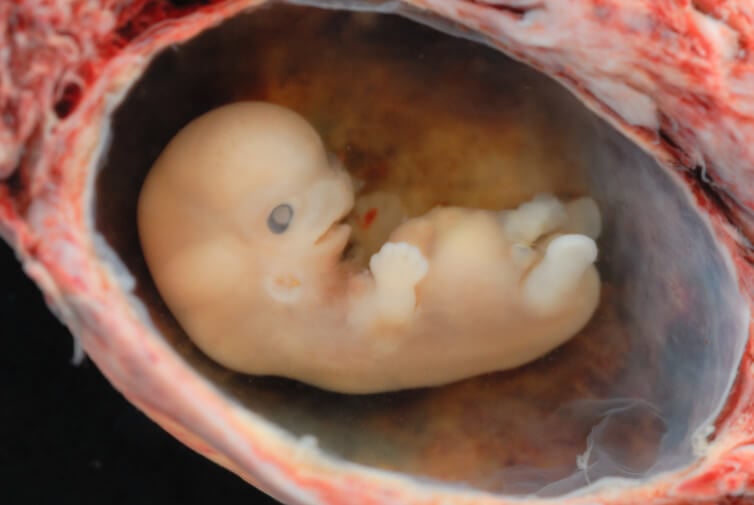
12. End of week 8. The embryo becomes a fetus, all structures present in rudimentary form. Attention anti-choice advocates: before this the prenatal human is not a fetus.

13. Week 14 or thereabouts. “Quickening,” the flutter a woman feels in her abdomen that will progress to squirms and kicks from within.

14. Week 21.  A fetus has a (very slim) chance of becoming a premature baby if delivered.

15. Birth.

16. Puberty. The Darwinian definition of what matters on a population and species level, when reproduction becomes possible.

x
A human embryo on the brink of  becoming a fetus.

17. Acceptance into medical school. I don’t know where this came from, a joke about Jewish mothers, but in some circles it might now apply to acceptance into preschool. Or when one’s grown offspring leave home.

My answer? #14. The ability to survive outside the body of another sets a practical, technological limit on defining when a sustainable human life begins. That limit may of course change.

Having a functional genome, tissue layers, a notochord, a beating heart … none of these matter if the organism cannot survive where humans survive. Technology has taken us to the ends of the prenatal spectrum, yet not provided too much for the middle, other than fetal surgeries for a handful of conditions. We can collect and select gametes, now thanks to patent no. 8543339. We collect and select very early embryos in pre-implantation genetic diagnosis, allowing those without a specific disease to continue development. And although the gestational age at which a premature infant can survive has crept younger, it hasn’t by much, not since I starting thinking about these things back when I was a stage #16.

Until an artificial uterus becomes a reality, technology defines, for me, when a human life begins.

Ricki Lewis has a PhD in genetics and is a genetics counselor, science writer and author of Human Genetics: The Basics. Follow her at her website or Twitter @rickilewis.

A version of this article was originally published on the PLOS website as When Does a Human Life Begin? 17 Timepoints and has been republished here with permission.

Viewpoint: ‘Clean eating’ is pseudoscience

clean eating salad

[Editor’s note: Dr. Steven Novella is an academic clinical neurologist at Yale University School of Medicine.]

Eating “clean” is the latest fad diet pseudoscience. A recent article in The Guardian goes over the many aspects of this movement in great detail, and is worth a read. My only complaint is that the author, Bee Wilson, buys into misinformation about the medical profession and nutrition.

Wilson claims that the medical profession was unhelpful when it came to nutrition. I disagree – the medical profession was at the forefront of nutritional research and advice. The problem was that the science-based answers were not what everyone wanted to hear.

At its core the clean eating movement is part of the more general phenomenon of antiscience. There has always been a conflict between academics and genuine experts, and marketing and popular culture. The two don’t always play well together (not to suggest equivalency).

[F]or most people, the scientific answer to healthy eating is not complex. Eat more vegetables. Eat a varied diet. Exercise regularly. Adjust your caloric intake to achieve a healthy weight. If you do that you are 90% of the way there. The rest are details, most of which will be taken care of if you eat a varied diet and plenty of vegetables.

The GLP aggregated and excerpted this blog/article to reflect the diversity of news, opinion, and analysis. Read full, original post: Clean Eating Antiscience

Bayer to allow public access to pesticide safety information

Screen Shot at AM

[Editor’s note: Adrian Percy is the Global Head of Research and Development for Crop Science, a Division of Bayer.]

After many years involved in conducting research to evaluate the safety of our products, I’m still surprised that there are many people who not only don’t appreciate the incredible accomplishments of modern agriculture, but who also believe that its products and practices threaten people, wildlife and the environment. Where I see miraculous innovations that will help sustainably feed the world, they see a profit-driven industry with no regard to safety. Why do we view the world through such different lenses?

Much of this is due to a lack of trust. I recently explained how the general public has lost confidence in many of the institutions it once held in high regard. Conflicting accounts about the safety of food or technologies permeate social media, making it difficult for people to separate fact from fiction, especially when scientists themselves disagree over the same issues. Mistrust is amplified when the public doubts the integrity of privately-funded research studies, or if they think the industry is hiding something from them. In the mind of many consumers, what you don’t know may indeed hurt you.

Screen Shot at AM
Adrian Percy

That’s why I’m pleased to announce that Bayer plans to allow public access to safety-relevant crop protection study information. By sharing what was once confidential information, we hope to connect the public with our scientific community in a way that builds trust and shows our desire to create transparency.

Most people have no idea that, on average, about 1,200 registration studies are required before a new active ingredient product can be approved for use on crops, or that only one out of every 100,000 candidates screened will ever be commercialized. … The entire new product development process, from discovery to sale, averages 13 years to complete.

[I]f seeing is believing, we think you’ll be pleased with what you see.

The GLP aggregated and excerpted this blog/article to reflect the diversity of news, opinion, and analysis. Read full, original post: Demystifying Science – Seeing is Believing

Bipartisan group of 79 congressmen urge EPA, FDA to streamline agricultural biotech regulations

Depositphotos original x

In a letter to three federal agency heads on Tuesday, a group of 79 bipartisan members of the United States House of Representatives expressed concern about the direction being taken to regulate agriculture biotechnology.

In particular, in the letter to Scott Pruitt, administrator of the U.S. Environmental Protection Agency, Secretary of Agriculture Sonny Perdue and Scott Gotlieb, commissioner of the U.S. Food and Drug Administration, the lawmakers pointed to two regulations currently being re-drafted.

On Jan. 19, 2017, USDA’s Animal Plant and Health Inspection Service published a draft revision to its so-called Part 340 biotechnology regulations. Also, the FDA proposed expansion of the scope of guidance for industry to regulate gene-editing techniques.

The lawmakers urge the agencies to continue to work with stakeholders to improve the proposals.

American Farm Bureau Federation President Zippy Duvall said in a statement in response that farmers and ranchers need proper federal direction to continue to make technological gains.

Duvall urged the department and agency leaders to coordinate and advance timely reviews of advances in biotechnology and biology-based tools including gene editing. He said policies and strategies should embrace the review of innovation, domestically and internationally, through the president’s Interagency Task Force on Agriculture and Rural Prosperity.

The GLP aggregated and excerpted this blog/article to reflect the diversity of news, opinion, and analysis. Read full, original post: Lawmakers Urge Consistent Approach to Federal Regulation of Biotechnology

‘Ecological Armageddon’? Three-quarters of flying insects in Germany vanished in 25 years, study claims

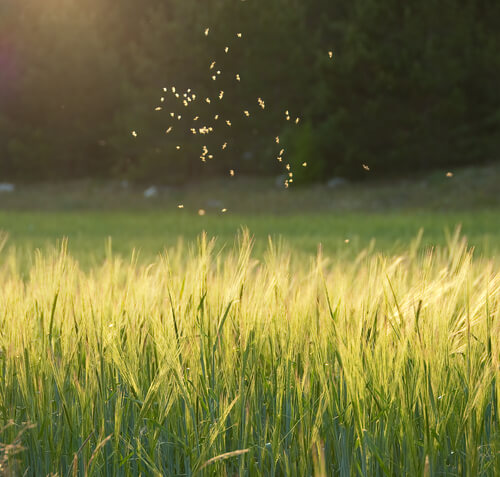
insects midges over meadow anton shutterstock

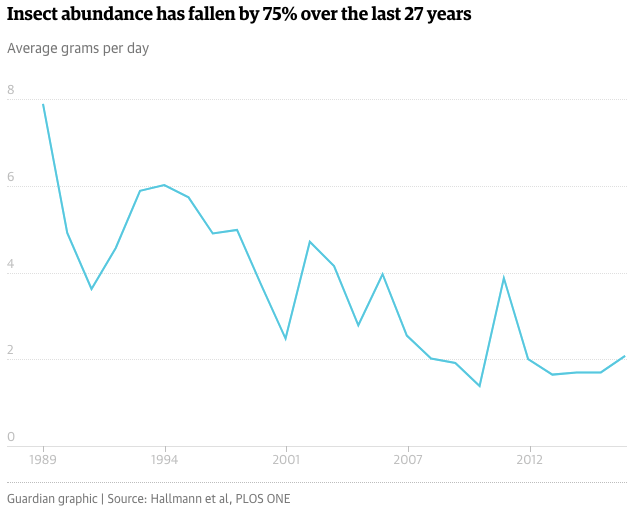
The abundance of flying insects has plunged by three-quarters over the past 25 years, according to a new study….

Insects are an integral part of life on Earth as both pollinators and prey for other wildlife and it was known that some species such as butterflies were declining. But the newly revealed scale of the losses to all insects has prompted warnings that the world is “on course for ecological Armageddon”, with profound impacts on human society.

The new data was gathered in nature reserves across Germany but has implications for all landscapes dominated by agriculture, the researchers said.

The cause of the huge decline is as yet unclear, although the destruction of wild areas and widespread use of pesticides are the most likely factors and climate change may play a role. The scientists were able to rule out weather and changes to landscape in the reserves as causes, but data on pesticide levels has not been collected.

The research, published in the journal Plos One, is based on the work of dozens of amateur entomologists across Germany….

Screen Shot at AM

The GLP aggregated and excerpted this blog/article to reflect the diversity of news, opinion, and analysis. Read full, original post: Warning of ‘ecological Armageddon’ after dramatic plunge in insect numbers

Why we shouldn’t be afraid of human gene editing

[Editor’s note: Dave Gammon is an associate professor of biology at Elon University.]

Many feel a visceral dread that scientists have awakened a monster – Move over, Frankenstein; designer babies are the future! To others the news triggers a raw fascination that humanity will now make a great leap forward – Scientists can stamp out all remaining human diseases, and we will inherit the keys to immortality!

Some human embryos possess a mutated version of the gene [MYBPC3 that controls heart muscle development]. Mutant sequences differ by just a handful of letters – like a long essay with a few spelling errors. Whoever inherits the mutant sequence develops abnormally thick heart muscles – a condition that forms the leading cause of death among young athletes.

Researchers also succeeded in modifying just the targeted MYBPC3 gene without any “collateral damage” to other genes. In addition to last week’s study, CRISPR research on human embryos is taking place in the U.K., Sweden, and China.

If you are one of those reacting with revulsion, you should ask yourself not only, “What might result?” but also “What is likely to result?” The history of technology is replete with discoveries that initially sparked fear and terror, but ended up becoming routine components of human society.

The GLP aggregated and excerpted this blog/article to reflect the diversity of news, opinion, and analysis. Read full, original post: Learn the science before judging human genetic modification

Could artificial intelligence, machine learning help detect sepsis early?

blood cultures x

Driven by the nation’s aging population, the rise of drug-resistant bacteria, and the growth of medical interventions, sepsis has become one of the most common reasons for hospitalization in the U.S.

[M]any health research organizations have begun to implement various screening tools that can send an alert or alarm to a clinician or nurse when a patient meets certain criteria that classify them as high risk.

[A] computer algorithm they developed could sift through patients’ records and predict septic shock—the deadliest version of sepsis—in 85% of cases, usually more than a day before onset. Two-thirds of the time the system predicted sepsis before it inflicted any damage. That’s 60% better detection performance compared to current screening tests without raising the rate of false alerts.

Targeted Real-time Early Warning System, or TREWS, aims to deploy these machine-learning methods inside hospitals to help save lives.

The researchers realized early on that AI algorithms that leverage so-called Bayesian techniques in probability and statistics might do the trick because “they are fundamentally suited to dealing with uncertainty,” [researcher Suchi] Saria says. Bayesian machine learning allows researchers to encode in models their prior beliefs about what those models should look like and how they should behave. Then, as additional information comes in, they can update those beliefs.

The GLP aggregated and excerpted this blog/article to reflect the diversity of news, opinion, and analysis. Read full, original post: Using Artificial Intelligence to Spot Hospitals’ Silent Killer

IARC bombshell: WHO cancer agency ‘edited out’ draft findings glyphosate non-carcinogenic

IARC ques x

The World Health Organization’s cancer agency dismissed and edited findings from a draft of its review of the weedkiller glyphosate that were at odds with its final conclusion that the chemical probably causes cancer.

Documents seen by Reuters show how a draft of a key section of the International Agency for Research on Cancer’s (IARC) assessment of glyphosate – a report that has prompted international disputes and multi-million-dollar lawsuits – underwent significant changes and deletions before the report was finalised and made public.

[Editor’s note: Read the GLP’s profile of the IARC.] 

The edits identified by Reuters occurred in the chapter of IARC’s review focusing on animal studies. This chapter was important in IARC’s assessment of glyphosate, since it was in animal studies that IARC decided there was “sufficient” evidence of carcinogenicity.

One effect of the changes to the draft, reviewed by Reuters in a comparison with the published report, was the removal of multiple scientists’ conclusions that their studies had found no link between glyphosate and cancer in laboratory animals.

Reuters found 10 significant changes that were made between the draft chapter on animal studies and the published version of IARC’s glyphosate assessment. In each case, a negative conclusion about glyphosate leading to tumors was either deleted or replaced with a neutral or positive one. Reuters was unable to determine who made the changes. 

The GLP aggregated and excerpted this blog/article to reflect the diversity of news, opinion, and analysis. Read full, original post: In Glyphosate Review, WHO Cancer Agency Edited Out ‘Non-Carcinogenic’ Findings

Nigeria to commercialize GMO cowpeas and cotton by 2018

pic

The National Agriculture Seed Council (NASC) has commenced sensitisation of Nigerian seed companies in preparation for the commercialisation of Genetically Modified Bacillus thuringiensis (Bt) cowpea and cotton by 2018.

A sensitisation workshop … was staged to educate seed companies that are expected to play a major role in the distribution of genetically engineered seeds when the nation finally commercialises it next year.

According to [director-general of NASC, Dr Philip Ojo], “GM seeds are a significant step forward in the production of agricultural crops. GM seeds are seeds that have been modified to contain specific characteristics such as resistance to herbicides or resistance to pests. But the method of modification used with GM seeds varies from the conventional method in an important respect: the genes have not been modified over generations of cross-fertilization but rather inserted directly into the DNA of the seed.”

Earlier in his remarks, the communication officer of [African Seed Trade Association], Aghan Daniel, noted that Africa still remained a minor player in the global seed trade, accounting for less than 2 percent, saying modern biotechnology provides Africa with tools for trait improvements in crop germplasm for increased grain yields in ways compatible to human and environmental welfare.

The GLP aggregated and excerpted this blog/article to reflect the diversity of news, opinion, and analysis. Read full, original post: Nigeria Prepares For Commercialisation Of BT Cowpea, Cotton

Viewpoint: How genetics challenges the ‘folk notion’ of distinct races

Screen Shot at AM

Speaking from the BBC studio in London where he hosts the weekly radio program Inside Science, [geneticist Adam] Rutherford explains how the development of farming changed human biology; why the most important story our genes tell is that we are all family, despite race or tribe.

In many ways, genetics makes a mockery of race. The characteristics of normal human variation we use to determine broad social categories of race—such as black, Asian, or white—are mostly things like skin color, morphological features, or hair texture, and those are all biologically encoded.

But when we look at the full genomes from people all over the world, those differences represent a tiny fraction of the differences between people. There is, for instance, more genetic diversity within Africa than in the rest of the world put together.

It says something about us that we look for simple answers to complex questions. Inevitably, people have turned to the relatively new science of genetics to try to explain otherwise unfathomable human behaviors, such as spree killing or murder.

There is a genetic basis to human behaviors. But there is also an environmental component. We used to say nature versus nurture. But we might say nature via nurture.

The GLP aggregated and excerpted this blog/article to reflect the diversity of news, opinion, and analysis. Read full, original post: Why Race Is Not a Thing, According to Genetics

Why the quest for artificial intelligence almost died in infancy

ai e

It feels as if we’re riding the wave of a novel technological era, but the current rise in neural networks is actually a renaissance of sorts.

It may be hard to believe, but artificial intelligence researchers were already beginning to see the promise in neural networks during World War II in their mathematical models. But by the 1970s, the field was ready to give up on them entirely.

[I]n 1959, ADALINE arrived via researchers at Stanford University, and was at the time the biggest artificial brain. But it, too, could only handle a few processes at a time and was meant as a demonstration of machine learning rather than being set to a specific task.

“Unfortunately, these earlier successes caused people to exaggerate the potential of neural networks, particularly in light of the limitation in the electronics then available,” [professor Eyal Reingold] wrote in a history of artificial intelligence.

ADALINE and its primitive cousins may have faded from public perception as machine learning has come into its own over the past decade. But this revolution, decades in the making, wasn’t hampered by these neural networks. Instead, they were somehow both too primitive and too advanced for their time, but their time has certainly come.

The GLP aggregated and excerpted this blog/article to reflect the diversity of news, opinion, and analysis. Read full, original post: We Almost Gave Up On Building Artificial Brains

Does ‘mindfulness’ make you healthier? Scientific data ‘woefully lacking’

FreeActivation Header

The concept of mindfulness involves focusing on your present situation and state of mind. This can mean awareness of your surroundings, emotions and breathing—or, more simply, enjoying each bite of a really good sandwich. Research in recent decades has linked mindfulness practices to a staggering collection of possible health benefits.

Yet many psychologists, neuroscientists and meditation experts are afraid that hype is outpacing the science. In an article released this week in Perspectives on Psychological Science, 15 prominent psychologists and cognitive scientists caution that despite its popularity and supposed benefits, scientific data on mindfulness is woefully lacking. Many of the studies on mindfulness and meditation, the authors wrote, are poorly designed—compromised by inconsistent definitions of what mindfulness actually is, and often void of a control group to rule out the placebo effect.

The new paper cites a 2015 review published in American Psychologist reporting that only around 9 percent of research into mindfulness-based interventions has been tested in clinical trials that included a control group. The authors also point to multiple large placebo-controlled meta-analyses concluding that mindfulness practices have often produced unimpressive results. A 2014 review of 47 meditation trials, collectively including over 3,500 participants, found essentially no evidence for benefits related to enhancing attention, curtailing substance abuse, aiding sleep or controlling weight.

The GLP aggregated and excerpted this blog/article to reflect the diversity of news, opinion, and analysis. Read full, original post: Where’s the Proof That Mindfulness Meditation Works?

Born to exercise? ‘Fitness’ genes may help lower breast cancer risk

Repeated studies have shown that physical inactivity, and the occurrence of obesity to which it is linked, increases the risk for many chronic diseases, including breast and other cancers.

In fact, the evidence is so compelling that the lifestyle guidelines of most health agencies, both in the United States and abroad, include a recommendation for obesity prevention via maintenance of an appropriate body weight for height and a physically active lifestyle.

However, what if the science behind these recommendations were only about half the story? What if your fitness were influenced not only by your activity level but also by your genes? And, focusing specifically on breast cancer, what if one’s risk of getting breast cancer were influenced by one’s inherited capacity for fitness?

A team of investigators, including me, explored these questions in a recently published study and found a surprisingly large role for genetics in fitness and breast cancer.

Fit as you can be?

A woman exercising is likely lowering her risk of breast cancer, but a study suggests that inherent fitness is also a factor. Aslysun/Shutterstock.com

We frequently associate a physically active lifestyle and maintenance of an appropriate weight for a given height (measured as body mass index) with fitness, which is sometimes referred to as cardio-respiratory fitness. And individuals with high fitness generally fare better not only in having a lower risk for chronic diseases like cancer. Even when they are diagnosed and treated, they have a more favorable prognosis for recovery.

However, what has generally been overlooked is that aerobic fitness, broadly defined as the ability to transport oxygen and nutrients to the muscles, has a heritable component. That explains why individuals engaged in the same training program have a wide range of improvement in their fitness in response to the same amount of exercise.

This inherited capacity for fitness led us to consider whether this capacity affects breast cancer risk.

The conversation xOur question, while simple, would be problematic to study in people because it requires a lifetime of sedentary behavior, which is contrary to medical advice for health and well-being. So, the team decided to investigate this question in the laboratory. We worked to isolate the effects of inherent fitness and then studied how they affected breast cancer rates.

The fitness model was developed by selecting rats over multiple generations with low or high running activity on a treadmill. Those rats that ran the farthest before tiring were mated with one another and those rats that tired of running early likewise were bred together. This procedure was repeated for many generations, ultimately resulting in pups with large differences in inherited fitness.

To study the effects of these differences in inherent fitness, we took female pups born to mothers with high or low fitness and maintained the pups so that we could assess primarily the effects of fitness related to genetics, not to exercise. Before reaching sexual maturity, the pups were exposed to a chemical that triggers the development of breast cancer.

The animals were then monitored for the occurrence of palpable tumors throughout their lives and for tumors too small to detect without the use of a magnifying glass at the time of their death. What we found was striking.

Born fit, and born unfit

Rats born with low fitness were four times more likely to develop breast cancer, and the difference appeared to be linked to cellular signaling.
Jakub Stepien/Shutterstock.com

Rats born with low fitness were four times more likely to develop breast cancer, whereas rats born with high fitness not only had fewer cancers but the cancers occurred later in their lives and were smaller in size.

These effects were traced, at least in part, to a network of sensors that occur in essentially every cell in the body.

This system, referred to as mammalian target of rapamycin, senses the availability of energy and of various nutrients within the cell. When energy and nutrient availability is high, the system is active and promotes the ability of a cell to proliferate; excessive cell division is a hallmark of cancer.

We found that this signaling activity in cells in the breast was high in rats born with low fitness, whereas it was reduced in rats with high inherent fitness.

Efforts to identify hormones or growth factors in the blood that explained this difference were not successful, suggesting that the responses are coming from deep within the cell.

Next steps: Moving from lab to clinic

A growing number of studies in women have shown a link between exercise and breast cancer risk, and these findings seem to indicate that aerobic fitness alters the inner workings of cells to confer its protective effects.

However, our study suggests that there is an inborn component to protection that affects one’s exercise performance as well as their risk for breast cancer.

Many questions have been raised by this research. Recognizing that our experiment was done in rodents and that rodents are not people, the stage is set for extending these observations from the laboratory to the clinic.

The ConversationA great amount of work also remains to be done using the rats with low and high inherent fitness. Current studies are focused on how to reduce breast cancer risk in rats born with low fitness. Key questions revolve around identifying the amount and type of exercise needed to break the link between low inherent fitness and the development of breast cancer, since most of us have the ability to raise our innate fitness capacity with exercise.

Henry J. Thompson is the director of the Cancer Prevention Laboratory at Colorado State University.

This article was originally published on The Conversation as How inherited fitness may affect breast cancer risk and has been republished here with permission.
‘GMO’ petunias: Ridiculousness exposed and explained

petunia

A few months ago, a Finnish plant biologist from Helsinki University was wandering around the town, when he noticed some orange petunias in flowerpots in a public square. He was curious, because there is no natural variety of petunia with that color. A 20-year-old story of a gene recombination experiment came to his mind. He bought the same plants in a shop, analyzed them and discovered that they were “descendants” from the outcome of an old experiment: one way or another, those seed had become available on the market, probably for years.

Once the story went public, a rush to locate and destroy the “GMO” seeds and flowers was sparked off by regulation agencies from Finland to the UK, from Australia to the USA and other countries.

Here’s the transcript of a dialogue between a Rational Alien, who is visiting the Earth, and a State Officer of a country where “GMOs” are legally persecuted.

Rational Alien – Beautiful flowers you have in that box, officer. Are you taking them to the market?
State Officer – No. I have just seized them from that shop. They are going to be destroyed.
R.A. – Oh, I see. They must be poisonous or something?
S.O. – Well, not at all. But they are “GMO”.
R.A. – Pardon me?
S.O. – It’s an acronym for “Genetically Modified Organisms”.
R.A. – Mmm… Forgive me, I am perplexed: your scientists have known for decades that any living thing – any organism – is genetically modified by definition!
S.O. – That’s the scientific point of view. But, according to the law, these blossoms are different – illegal, that is. They must not exist.
R.A. – Allow me a question: what’s the rationale for such rule?
S.O. – They are transgenic, because a gene from maize was added to them, to create the orange color.
R.A. – Er… and so what? It is well known that genes may “jump” from an organism to another, when different species happen to mix along lineages: if the outcome has no negative effect on safety or the environment (www.evira.fi/en/plants/current-issues/2017/evira-removes-genetically-modified-orange-petunias-from-sale/, www.aphis.usda.gov/aphis/ourfocus/biotechnology/brs-news-and-information/unauthorized_petunia), but it creates a new lovely plant…
S.O. – That may be true: but in this case the foreign DNA has been tracked, ascertaining that it was inserted intentionally; this operation makes the result – the flowers – illegal.
R.A. –  I am afraid that the same pseudo-concept of “foreign” DNA is quite dubious. But: what if the source of the gene that dictates the orange color came from another variety of petunias? Would the resulting product be damned?
S.O. – It depends: if the gene had been infused via hybridization, or polyploidy induction, or tissue culture, or a number of accepted breeding techniques; or if the DNA had been tweaked via chemical or radiation “bombing”, many officers in many countries of the world would not be chasing these flowers and seeds in thousands of shops and breeders’ stores. Instead, since the very same phenotypic effect has been obtained via a “GMO” technique – I have here a list of prohibited methods – then stores can’t sell them and people shouldn’t plant them!
R.A. – …
S.O. – Sir, please, don’t look at me like I’m an idiot: I am just doing my job! You come from a rational planet, I know that earthly customs may appear weird…
R.A. – Excuse me, just to understand: I learnt that mankind lives in a world of limited resources, and even more so as far as society’s struggle against crime is concerned. Wouldn’t be more… er… rational to divert the taxpayers’ money that is now wasted running after the “GMO” blunder to the accomplishment of important tasks – e.g. food safety and environment protection?
S.O. – Between us: personally, I agree. But law is law, and I am obliged to enforce it.
R.A. – I read an ancient Roman motto: Summum ius, summa iniuria. In plain English: a slavish application of the law is damaging. Fortunately, in this case, the only injured subjects are these innocent buds…
S.O. – No comment.
R.A. – I have also to say that your media neglect to inform the public correctly: for example, it seems inappropriate to ask an anti-biotech guy for a comment, not a biologist or a geneticist – in the “Science” section of a newspaper! (www.telegraph.co.uk/science/2017/05/09/gm-petunias-could-harm-wildlife-britains-gardens-warn-campaigners)
S.O. – You know, too often journalists don’t look for knowledgeable sources… have you ever heard of “post-truth” or “alternative facts”?
R.A. – IMHO, balanced reports should tell the story of this “petuniastic” storm in a tea-spoon, pointing out that such a prejudicial commotion doesn’t make sense!
S.O. – Too often, it does not work like that on this planet: any occasion to babble about “GMO invasion” and bullshit like that is promptly exploited (www.dailymail.co.uk/sciencetech/article-4528436/Advice-gardenders-facing-GM-invasion.html): sensationalism and fearmongering sell!
R.A. – Many times in your history – so I read – some dissenters chose to defy unjust laws through acts of civil disobedience: wouldn’t it be nice if a few people declare publicly that they are going to save seeds of these flowers, or even sow them in public demonstrations?
S.O. – Let me whisper it to you: that’s just what I imagined to do: save some seeds… just to experience the thrill of being an outlaw! But then I came back to reason… well, so to speak… I will fulfil my duty!
R.A. – Thank for your time, officer: now I’ll let you proceed with the eradication of these Flowers of Evil…
S.O. – I did not know that Aliens could be ironic: I thought you were cold, rational entities.
R.A. – We normally are, yes. But sometimes Homo sapiens forces us to use irony as the only possible reaction to their lunacy…

If anybody owns forbidden petunias, please see an educational video on how to destroy them:

This satirical article has been endorsed by the following scientists:

Ammann, Klaus – U. Bern
Burachik, Moisés – U. Buenos Aires
Charles, Trevor – U. Waterloo
Chassy, Bruce – U. Illinois
Costantino, Paolo – U. Roma La Sapienza
DeGregori, Thomas R. – U. Houston
Defez, Roberto – Institute of Biosciences and Bioresources, Naples
Fedoroff, Nina – Penn State U.
Giddings, Val – PhD, PrometheusAB, Inc.
Guruswamy, Lakshman – U. Colorado Boulder
Jany, Klaus-Dieter – Wadi Intl U.
McHughen, Alan – U.C. Riverside
Milanesi, Gabriele – U. Milano
Miller, Henry – Stanford U.
Morandini, Piero – U. Milano
Niederhuth, Chad – U. Georgia
Parrott, Wayne – U. Georgia
Prakash, C. S. – U. Arizona
Roberts, Richard J. – New England Biolabs (1993 Nobel laureate)
Sági, László – Hungarian Academy of Sciences
Teeri, Teemu – U. Helsinki
Twardowski, Tomasz – Polish Academy of Sciences
Wager, Rob – U. Vancouver Island
Winkler, Matt – Asuragen

Giovanni Tagliabue is an independent researcher based in Italy who studies the philosophy of life sciences and political science.

Monsanto, DowDuPont execs discuss transformative impact of gene-editing and data science on farming

Tegnologie technology tech laptop farmer rekenaar

To find out more about the potential of [new gene-editing and data science technologies], The Wall Street Journal’s Dennis Berman spoke with Hugh Grant, chairman and chief executive of Monsanto Co., and James C. Collins Jr., chief operating officer of the agriculture division at DowDuPont.

BERMAN: What about Crispr [gene editing] is new and potentially exciting for you?

COLLINS: I think the real aspect of Crispr is the fact that technology that we’ve known for hundreds of years, some of our oldest technology, is actually now our newest technology. It will allow us to do the same kind of things that we’ve always been able to do. The breeding work that we do every day, much faster. We can do in six months now what used to take us six or seven years.

GRANT: Like gene editing, data science is going to touch broad swaths of our life. What we are seeing is more efficient, more specific, accurate applications of fertilizer, a much deeper understanding of disease in plants and addressing disease at a much earlier stage.

Screen Shot at PM

The GLP aggregated and excerpted this article to reflect the diversity of news, opinion and analysis. Read full, original post: How Data Science and Gene Editing Will Transform Farming

One-fourth of cow genome descendant from snakes and lizards, study shows

A E

There are genes known as retrotransposons that can copy themselves and paste the duplicates in other parts of our DNA, creating large tracts of repetitive gobbledygook. Around half of the human genome consists of these jumping genes. And a quarter of a cow’s DNA consists of one particular jumping gene, known as BovB. It, and its descendants, have bloated out the cow genome with thousands of copies of themselves.

This jumping gene seems to have entered the cow genome from the unlikeliest of sources: snakes and lizards.

Retrotransposons typically jump around within a single genome, but sometimes they can travel further afield. Through means that scientists still don’t fully understand, they can leave the DNA of one species and enter that of another.

David Adelson, from the University of Adelaide, charted the gene’s travels in 2013 by comparing the subtly different versions of BovB in dozens of animals. That was when his team showed that BovB in cows and other cud-chewing mammals is most similar to the versions in pythons and vipers—and likely descended from them. Now, Adelson’s colleague Atma Ivancevic has extended the search for BovB to more than 500 animal species. And her results show that the gene’s travels are even more erratic than anyone thought.

The GLP aggregated and excerpted this article to reflect the diversity of news, opinion and analysis. Read full, original post: How a Quarter of Cow DNA Came From Reptiles

John Deere acquires precision ag technology that could reduce pesticide use by 90 percent

Screen Shot at PM

Tractor giant John Deere just spent $305 million to acquire a startup that makes robots capable of identifying unwanted plants, and shooting them with deadly, high-precision squirts of herbicide.

John Deere, established in 1837 to manufacture hand tools, announced it had acquired Blue River Technology, founded in 2011….

Pesticides and other chemicals are traditionally applied blindly across a whole field or crop. Blue River’s systems are agricultural sharpshooters that direct chemicals only where they are needed.

The startup’s robots are towed behind a regular tractor like conventional spraying equipment. But they have cameras on board that use machine-learning software to distinguish between crops and weeds, and automated sprayers to target unwanted plants.

This season Blue River tested a second system for cotton farmers, ahead of a planned commercial launch in 2018. That system can target weeds with squirts of herbicide no larger than a postage stamp. Willy Pell, director of new technology at Blue River, says the system has shown it can reduce herbicide use by 90 percent.

The GLP aggregated and excerpted this blog/article to reflect the diversity of news, opinion, and analysis. Read full, original post: Why John Deere just spent $305 million on a lettuce-farming robot

Will EPA’s new restrictions on dicamba herbicide quell drift problems?

MONSANTO articleLarge

On the back of drift complaints, the filing of class-action lawsuits and, most recently, new EPA requirements for dicamba-tolerant crops, Monsanto continues to push an education-heavy approach to solve problems with the technology.

The company would also clearly like to see Mid-South farmers, battle-scarred in a lengthy fight with pigweeds, hop on its wagon while claiming self-preservation. It remains to be seen whether Monsanto is able to bring aboard a growing group of increasingly vocal Arkansas farmers petitioning state regulators for, among other things, a 2018 spraying cut-off date later than the proposed April 15.

“We’re pleased and excited that this technology will be available for growers throughout the (2018) growing season,” said [Scott Partridge, Monsanto vice president of global strategies]. “Based on what we submitted voluntarily to the EPA, the requests we made with them, the EPA worked diligently with states and academics to come to a place where they’ve approved our voluntary submission of a label to make this a restricted-use pesticide.”

“If someone is thinking of applying and the weather conditions aren’t right, that’ll encourage them not to apply. If someone is thinking they may apply an old dicamba formulation and they have to write that down, it’ll be a violation of their state law.”

The GLP aggregated and excerpted this article to reflect the diversity of news, opinion and analysis. Read full, original post: Monsanto: education key under new EPA dicamba requirements

Understanding honeybee deaths: Close to 100% of Massachusetts’ hives infected by viruses

maxresdefault

The honey bee population is on the decline, and bee experts want to know why, so the State Department of Agricultural Resources is doing their part, funding testing in [labs] at UMass Amherst.

The state travels to different hives statewide and collects hundreds of sick, dying, or already dead bees. These bees are brought there to the medical zoology lab.

“What I do is I’ll immediately throw them in this negative 80-degree freezer. This helps preserve the RNA, which is what we’re actually testing.”

They will dissect, tube, crush up, and extract.

They test for 8 different viruses, anything from infected larvae to deformed wings, and after testing nearly 700 honey bees so far, often 4 hives at a time, the results were a little unexpected.

“We found that 3 of those viruses are extremely common, with close to 100% of those hives being infected,” said UMass Lab Tech Timothy Daly.

Thankfully, the other 5 viruses are extremely rare, but it has posed some concerns for the honey bee population.

So how are these viruses getting into these hives? And why?

Right now there is no definitive answer. One professor believes some of these viruses could have come from overseas, or they say it could be that certain viruses also adapt better in certain climates.

The GLP aggregated and excerpted this article to reflect the diversity of news, opinion and analysis. Read full, original post: UMass Amherst testing for declining honey bee population