New generation of GMO crops could dramatically boost biofuel production

ovowebsitessuite carousel

Plant biomass contains considerable calorific value but most of it makes up robust cell walls, an unappetising evolutionary advantage that helped grasses to survive foragers and prosper for more than 60 million years.

The trouble is that this robustness still makes them less digestible in the rumen of cows and sheep and difficult to process in bioenergy refineries for ethanol fuel.

But now a multinational team of researchers, from the UK, Brazil and the US, has pinpointed a gene involved in the stiffening of cell walls whose suppression increased the release of sugars by up to 60%.

In the team’s genetically modified plants, a transgene suppresses the endogenous gene responsible for feruloylation to around 20% of its normal activity. In this way, the biomass produced is less feruloylated than it would otherwise be in an unmodified plant.
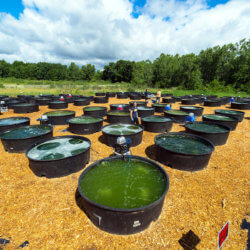

The findings are undoubtedly a boon in Brazil, where a burgeoning bioenergy industry produces ethanol from the non-food leftovers of other grass crops, such as maize stover and sugarcane residues, and from sugar cane grown as a dedicated energy crop. Increased efficiency of bioethanol production will help it to replace fossil fuel and reduce greenhouse gas emissions.

[Editor’s note: Read the full study]

Read full, original post: Less chewing the cud, more greening the fuel

{{ reviewsTotal }}{{ options.labels.singularReviewCountLabel }}
{{ reviewsTotal }}{{ options.labels.pluralReviewCountLabel }}
{{ options.labels.newReviewButton }}
{{ userData.canReview.message }}

Related Articles

Infographic: Global regulatory and health research agencies on whether glyphosate causes cancer

Infographic: Global regulatory and health research agencies on whether glyphosate causes cancer

Does glyphosate—the world's most heavily-used herbicide—pose serious harm to humans? Is it carcinogenic? Those issues are of both legal and ...

Most Popular

Screenshot-PM-24
Viewpoint: The herbicide glyphosate isn’t perfect. Banning it would be far worse.
d-b
Blocked arteries, kidney stones, nausea, constipation, fatigue: Long list of health problems caused by too much vitamin D 
79d03212-2508-45d0-b427-8e9743ff6432
Viewpoint: The Casey Means hustle—Wellness woo opportunism dressed up as medical wisdom
ChatGPT-Image-Mar-10-2026-01_39_01-PM
Viewpoint—“Miracle molecule” debunked: Why acemannan supplements don’t work
ChatGPT-Image-Apr-30-2026-12_21_05-PM-2
The tech billionaires behind the immortality movement
ChatGPT-Image-Mar-27-2026-11_27_05-AM
The myths of “process”: What science says about the “dangers’ of synthetic products and ultra-processed foods
ChatGPT-Image-Apr-30-2026-05_00_48-PM
Wellness grifter physician turned wellness influencer out as surgeon general nominee
Screenshot-2026-04-30-at-12.49.48-PM
‘Alarming’: Nicotine’s wellness rebranding

Sorry. No data so far.

glp menu logo outlined

Get news on human & agricultural genetics and biotechnology delivered to your inbox.