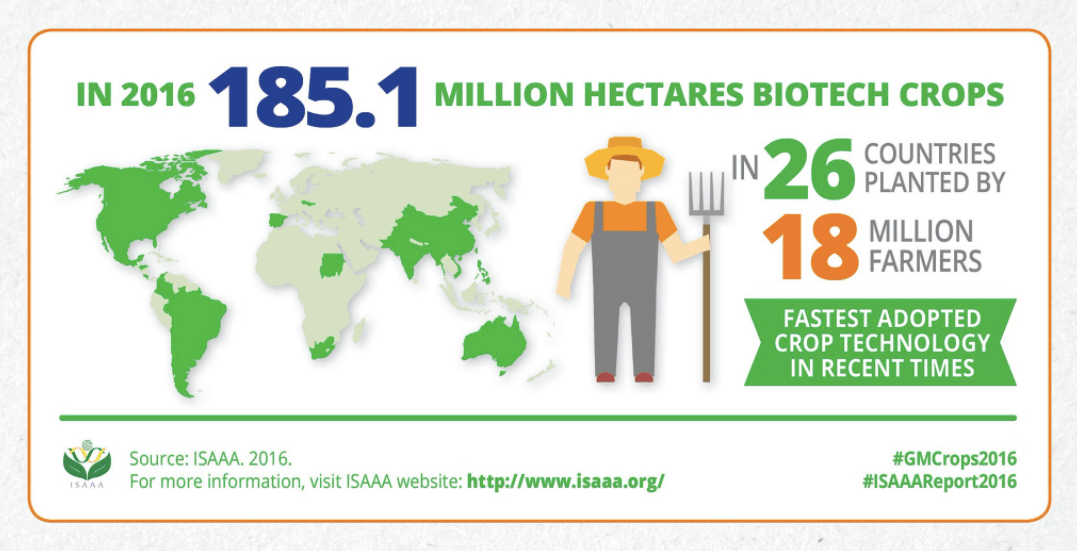
The total represented an increase of 5.4 million hectares (13.3 million acres), or 3 percent, over 2015, according to a paper published in GMO Crops & Food by Rhodora R. Aldemita and Randy A. Hautea of the International Service for the Acquisition of Agri-Biotech Applications (ISAAA).
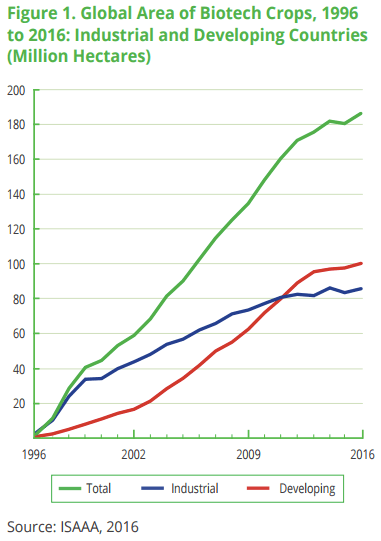
“This is the highest area of biotech crop adoption since its first year of commercialization in 1996, which was just 1.7 million hectares (4.2 million acres),” wrote Hautea, ISAAA’s global coordinator, in the organization’s annual report. “Thus, there has been a ~110-fold increase over a period of 21 years, making biotech crops the fastest adopted crop technology in recent times.”
Biotech crops were planted in 26 countries, including 19 developing nations. Brazil, the US, Canada, South Africa, Australia, Bolivia, Philippines, Spain, Vietnam, Bangladesh, Colombia, Honduras, Chile, Sudan, Slovakia, and Costa Rica all increased the amount of land cultivated in GE crops, while China, India, Argentina, Paraguay, Uruguay, Mexico, Portugal, and Czech Republic decreased the area in production. Pakistan and Myanmar reported no change in the amount of biotech crop planted.
The researchers attributed the increases and decreases in biotech crop area to the acceptance and commercialization of new products, increased demand for meat and livestock feeds, ethanol consumption, weather conditions, global market prices, disease/pest pressure and biotech enabling policies adopted by governments.
The US is the top producer of biotech crops, followed by Brazil, where 93.4 percent of the soybean, maize and cotton crops are biotech. The country is also developing GE varieties of beans, sugarcane, potatoes, papaya, rice, and citrus.
Argentina is the third-largest producer, growing soybean, maize and cotton. It has recently approved a virus-resistant potato developed by an Argentinian scientist. Researchers there are also working on drought-resistant wheat and herbicide tolerant sugar cane.




Canada is the fourth largest producer, growing GE canola, soybean, maize, and sugar beet. It recently approved the commercialization of the non-browning Arctic apple, the four-traited InnateTM potatoes and new herbicide tolerant stacked soybean. Consumers there also can purchase the fast-growing AquaBounty salmon.
In the Philippines, the adoption of GE maize increased 65 percent over the previous year, with small-holder farmers choosing herbicide and drought tolerant varieties. Confined field trials continue there on Bt eggplant, virus-resistant papaya, Bt cotton and Golden Rice.
In the European Union, just four nations planted biotech crops, led by Spain and followed by Portugal, Slovakia and Czechia. Though insect-resistant maize is the only GE crop approved for cultivation in the EU, the amount of land in production with that crop increased by 17 percent from 2015 to 2016.
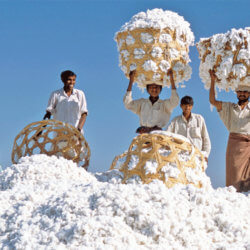
India remains the world’s top cotton-producer, and 96 percent of it is genetically engineered with the Bt insect-resistant trait. However, for the first time in 14 years a slight drop was recorded in the amount of land cultivated in Bt cotton. Field trials have been approved for chickpea, rice, cotton, maize, sugarcane and Bt brinjal, but the adoption of GE mustard has been stalled due to opposition by activists.
“The biotech farmers in various countries, who commonly profess that growing biotech crops have helped them send their children to school, acquire a home for their families, and live a healthier life with less pesticides, will continue to be our inspiration to make our best efforts in knowledge sharing, engagement, and support to technology development,” Hautea wrote.
Joan Conrow is a journalist in Hawaii, where she writes about agriculture, the environment and politics, often for the Cornell Alliance for Science. Follow her on Twitter @joanconrow.
A version of this article appeared at the Cornell Alliance for Science as “GMO crops hit record high production level” and has been republished here with permission.