23andMe adds 120 geographic regions to make genetic ancestry results more precise

hero jacquie tablet a b d d

If you’ve ever taken an ancestry DNA test, you probably already know that the results aren’t exactly precise. Sometimes you wind up with completely different results than you expected.

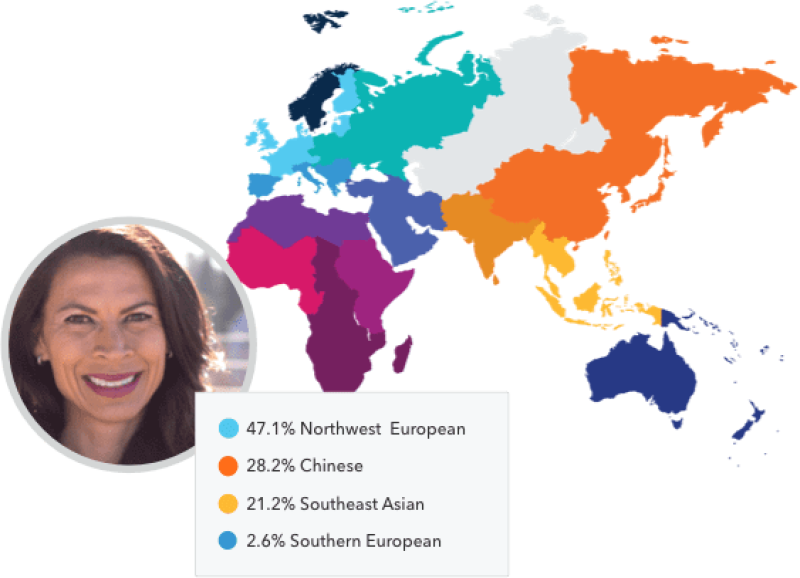
On [February 28], though, 23andMe announced an update to its service that should give customers more specific insight into where they are from. Rather than telling a customer that they are, say, “Scandinavian,” that customer might find that they are specifically part Norwegian. All told, the company has added 120 new geographic regions to the results of its test.

When I took 23andMe’s test last year, as part of a story I did on the accuracy of ancestry tests, the test was surprising because it told me I was only 3 percent Scandinavian and 5.5 percent Middle Eastern, even though I expected numbers much higher in those areas based on my family history.

With the update, the picture 23andMe painted of my ancestry was closer to the one painted by family genealogy. It was also more specific. It was able to tell me not just that I was Scandinavian and Middle Eastern, but that I’m Norwegian and Syrian.

The update to 23andMe’s test is a good example of how rapidly genetic technology is improving, and how with technological advances and larger data sets, consumer DNA testing stands to get a lot more precise.

Read full, original post: 23andMe’s Ancestry DNA Test Just Got a Lot More Precise

Related Articles

Infographic: Global regulatory and health research agencies on whether glyphosate causes cancer

Infographic: Global regulatory and health research agencies on whether glyphosate causes cancer

Does glyphosate—the world's most heavily-used herbicide—pose serious harm to humans? Is it carcinogenic? Those issues are of both legal and ...

Most Popular

ChatGPT-Image-Sep-17-2026-12_28_43-PM
Vitamin D, omega-3 fish oil and glucosamine supplements could cause brain damage 
ChatGPT-Image-Mar-10-2026-01_39_01-PM
Viewpoint—“Miracle molecule” debunked: Why acemannan supplements don’t work
ChatGPT-Image-Sep-17-2026-10_17_15-AM
Viewpoint: Why are the less intelligent more likely to be conservative—and smarter people more socially liberal?
Screenshot-2026-09-10-at-12.20.19-PM
'Jet fuel didn't melt the steel': 9/11 conspiracy theories debunked
Screenshot-2026-08-12-at-11.31.46-AM
AI is helping develop new vaccines
Screenshot-2026-09-16-at-12.07.47-PM
The heated debate over trans athletes in the WNBA
ChatGPT-Image-Sep-9-2026-02_48_24-PM
Viewpoint: Trump-RFK Jr. report on “Gender Ideology & Left-wing Ideology’ targets LGBTQ community—and science
Screenshot-2026-09-17-at-10.24.54-AM
Viewpoint: Dubious environmental fears: Why the AI buildout is critical to America’s ecological future
Screenshot 2026-09-11 at 12.39
Child-monitoring apps: When the cure is worse than the harm—and how the technology could be tweaked
ChatGPT-Image-Sep-15-2026-12_15_00-PM
Viewpoint: Women, depression and empathy: Explaining the gender gap in views about child-murderer Lindsay Clancy
Screenshot-2026-09-11-at-2.26.23-PM
Newly approved GMO chestnut trees planted across from the White House are stirring debate
Screenshot-2026-09-10-at-11.50.46-AM
Did COVID vaccines kill 2,500 service members? RFK Jr. hires an investigator who compares vaccine promoters to Nazi doctors
glp menu logo outlined

Get news on human & agricultural genetics and biotechnology delivered to your inbox.