Wheat gene discovery could give breeders new tool to boost crop yields

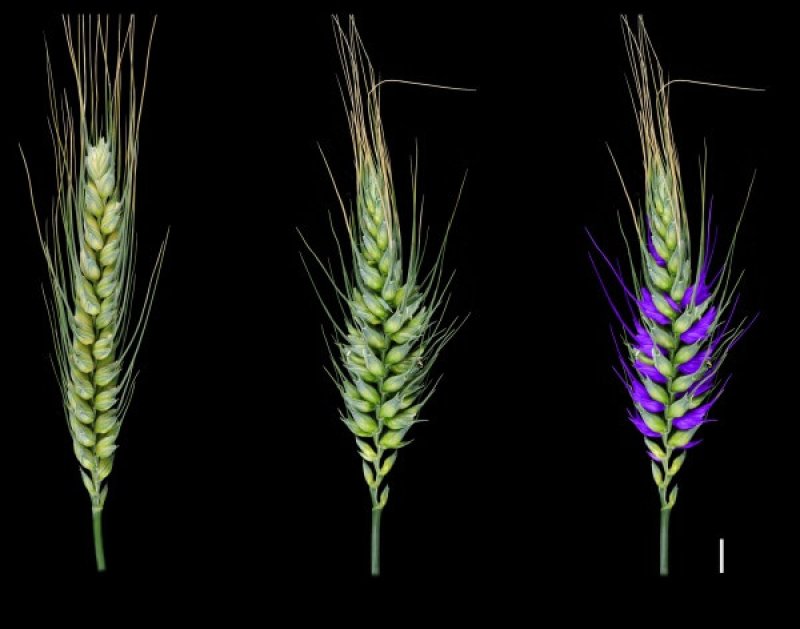
Paired spikelets in wheat Credit CSIRO WS
Floral architecture in wheat. Highlighted in purple are the additional spikelets that form part of the paired spikelets. (Image credit: CSIRO)

A new study has isolated a gene controlling shape and size of spikelets in wheat in a breakthrough which could help breeders deliver yield increases in one of the world’s most important crops. 

The team from the John Innes Centre say the underlying genetic mechanism they have found is also relevant to inflorescence (floral) architecture in a number of other major cereals including corn, barley and rice. 

The genetic identification of an agronomically-relevant trait represents a significant milestone in research on wheat; a crop with a notoriously complex genome.  

The findings, published today in the journal The Plant Cell, give breeders a new tool to accelerate the global quest to improve wheat. The study also highlights a range of next generation techniques available for fundamental research into wheatthe world’s most abundantly produced crop. 

The study revealed that a gene called TEOSINTE BRANCHED1 (TB1) regulates wheat inflorescence architecture, promoting paired spikelets via a mechanism which delays flowering and reduces the expression of genes that control the development of lateral branches called spikelets. 

Editor’s note: Read the full study

Read full, original post: Wheat research discovery yields genetic secrets that could shape future crops

{{ reviewsTotal }}{{ options.labels.singularReviewCountLabel }}
{{ reviewsTotal }}{{ options.labels.pluralReviewCountLabel }}
{{ options.labels.newReviewButton }}
{{ userData.canReview.message }}

Related Articles

Infographic: Global regulatory and health research agencies on whether glyphosate causes cancer

Infographic: Global regulatory and health research agencies on whether glyphosate causes cancer

Does glyphosate—the world's most heavily-used herbicide—pose serious harm to humans? Is it carcinogenic? Those issues are of both legal and ...

Most Popular

wuhan institute of virology main entrance
​​COVID lab leak? Making a case that the Wuhan market origins theory is wrong
ChatGPT-Image-Mar-10-2026-01_39_01-PM
Viewpoint—“Miracle molecule” debunked: Why acemannan supplements don’t work
Screenshot-2026-06-05-at-2.12.30-PM
Some plants can poison you. So how did humans figure out what is safe to eat?
ChatGPT Image May 26, 2026, 08_42_17 AM (1)
Viewpoint: Greenpeace and poison: How environmental advocacy groups rely on compliant (and often ignorant) journalists to spread disinformation and spark litigation
ChatGPT Image Jun 1, 2026, 11_39_17 AM
Viewpoint: When food myths go viral, farmers pay the price

Sorry. No data so far.

glp menu logo outlined

Get news on human & agricultural genetics and biotechnology delivered to your inbox.