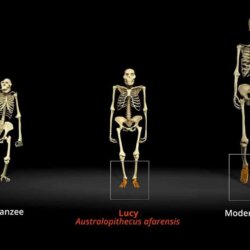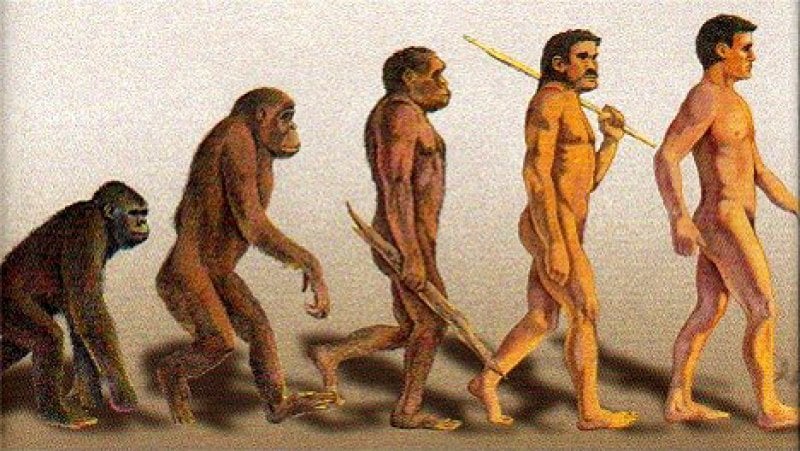
Walking upright emerged long before modern humans

upright

The question of whether our early ancestors walked fully upright or in a crouched position, like apes, has long been a hot debateĀ among scientists.

Now,Ā new researchĀ presented at the annual meeting of theĀ American Association of Anatomists during the 2018Ā Experimental Biology ConferenceĀ in San Diego suggests that the characteristic bipedalism of modern humans may have evolved much earlier than previously thought—long before our species had even emerged.

For the research, evolutionary anthropologist David Raichlen and his colleagues from the University of Arizona, examined 3.6-million-year-old hominin footprints recently discovered in Laetoli, Tanzania, which represent the earliest direct evidence of hominin bipedalism.

…
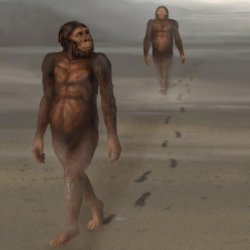
When analyzing footprints, looking at the difference between the impressions made by the toe and the heel reveals how the center of pressure moves along the foot during a step and therefore provides clues to walking posture. Ā After comparing the footprints, the results showed that the Laetoli prints were much more similar to those made by humans walking upright.

Walking in this manner with fully extended legs is more efficient—and therefore uses less energy—than shuffling in a crouched position. This means longer journeys can be undertaken, suggesting that the evolutionary switch from one mode of walking to another may have been linked to how human ancestors looked for food, according to the researchers.

Read full, original post:Ā Human evolution: Walking upright evolved at least 3.6 million years ago – long before modern humans appeared


Related Articles

Infographic: Global regulatory and health research agencies on whether glyphosate causes cancer

Infographic: Global regulatory and health research agencies on whether glyphosate causes cancer

Does glyphosate—the world's most heavily-used herbicide—pose serious harm to humans? Is it carcinogenic? Those issues are of both legal and ...

Most Popular

Screenshot-2026-10-01-at-10.52.08-AM
Non-browning CRISPR gene-edited bananas move one step closer to British markets
AI-Force-Leadership-Portrait
Jay Clayton controversy: The divisive history of Trump’s newly-appointed AI czar
Screenshot-2026-09-22-at-10.54.12-AM
ā€˜They misunderstand science’: Research attempting to tie autism to changes in the gut microbiome comes under fire
ChatGPT-Image-Mar-10-2026-01_39_01-PM
Viewpointā€”ā€œMiracle moleculeā€ debunked: Why acemannan supplements don’t work
Elderly-Speaker-at-MAHA-Institute
At anti-vaccine MAHA conference, RFK Jr. pledges to unify federal health information and combat vaccine safety ā€˜misinformation’
ChatGPT-Image-Sep-21-2026-11_21_39-AM
Viewpoint: Food cults: Online ā€˜nutrition communities’ can pose unique dangers
Screenshot 2026-10-01 at 12.30
Combating ā€˜narrative distortion’: Will pharma companies step up to challenge health misinformation?
ChatGPT-Image-Sep-10-2026-10_36_07-AM
Viewpoint: Even lousy scientific articles can shield authors when they hype dubious health claims and products
ChatGPT-Image-Sep-21-2026-03_15_09-PM
Viewpoint: Chipotle-inspired lesson: 10,000 sick customers suggest that processed foods can be safer than fresh ones
generated-1790707585414
Facts & Fallacies podcast: America's health care system is broken. A doctor explains how to fix it
glp menu logo outlined

Get news on human & agricultural genetics and biotechnology delivered to your inbox.