Argentine scientists develop non-browning potatoes using CRISPR gene editing

Screen Shot at AM
Image source: Revista de Investigaciones Agropecuarias

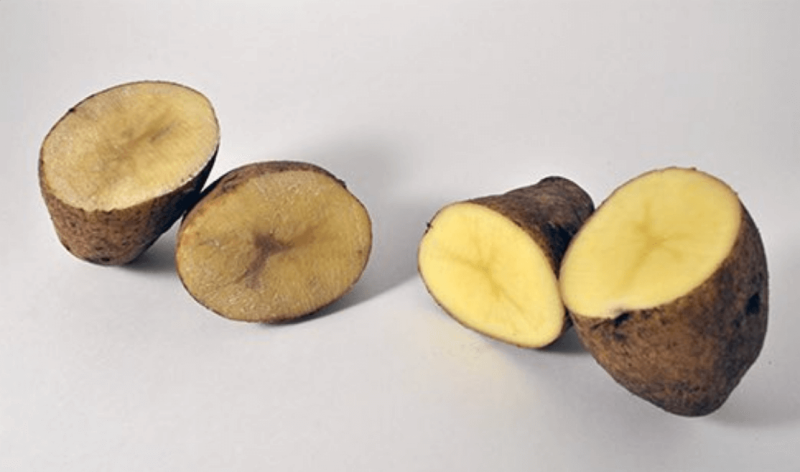
Researchers of the INTA [Instituto Nacional de Tecnología Agropecuaria] Balcarce [in Argentina] edited the genome that causes enzymatic browning in potatoes, alters the nutritional properties and quality of the tubers. It is an achievement for South America….

Editor’s note: This post has been translated from Spanish and lightly edited for clarity

“We verified that we are capable of generating, within a potato cell, a gene editing machinery that specifically targets the chosen gene and changes its genetic sequence,” explained Sergio Feingold, director of the INTA’s Agrobiotechnology Laboratory.

“The technique used was gene editing,” Feingold said of the technology used, also known as “gene scissors” or CRISPR / Cas9.

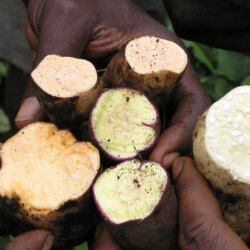
When applying this technique, the team led by Feingold focused on a polyphenol oxidase gene, whose enzyme causes browning in tubers when they are cut and exposed to air.

“The cutting or peeling of the tubers, as well as the mechanical damages suffered during the harvest, transport and storage, lead to the generation of brown or black stains caused by oxidation, which generates losses for consumption and industry,” he said.

“This achievement is the basis of new breeding techniques that allow us to do the same thing that was done for years through conventional breeding, but more quickly and accurately,” Feingold said.

Read full, original post: Modifying the gene that causes the potato to turn black (Google translate from Spanish)

{{ reviewsTotal }}{{ options.labels.singularReviewCountLabel }}
{{ reviewsTotal }}{{ options.labels.pluralReviewCountLabel }}
{{ options.labels.newReviewButton }}
{{ userData.canReview.message }}

Related Articles

Infographic: Global regulatory and health research agencies on whether glyphosate causes cancer

Infographic: Global regulatory and health research agencies on whether glyphosate causes cancer

Does glyphosate—the world's most heavily-used herbicide—pose serious harm to humans? Is it carcinogenic? Those issues are of both legal and ...

Most Popular

Screenshot-2026-05-01-at-1.29.41-PM
Viewpoint: What happens when whole grains meet modern food manufacturing? Labels don’t tell the whole story.
S
As vaccine rejectionism spreads, measles may be taking a more dangerous turn
Screenshot 2026-05-06 at 2.56
Singularity crisis ahead? Can super babies save us from rogue AI geniuses?
Screenshot-2026-03-13-at-12.14.04-PM
The FDA wants to make many popular prescription drugs OTC—a great idea. Here’s why it’s unlikely to happen
Screenshot-2026-05-06-at-2.07.43-PM
Manufacturing a conspiracy: The timeline of how  the White House embraced the fringe claim that scientists are being mysteriously murdered
Screenshot-2026-05-01-at-11.56.24-AM
‘Science moves forward when people are willing to think differently’: Memories of DNA maverick Craig Venter
Screenshot-2026-04-30-at-2.19.37-PM
5 myths about summer dehydration that could damage your health — or even kill you
Screenshot-2026-04-20-at-2.26.27-PM
Viewpoint — Food-fear world: The latest activist scientists campaign: Cancer-causing additives
Screenshot-2026-04-03-at-11.15.51-AM
Paraben panic: How a flawed study, media hype, and chemophobia convinced the public of the danger of one of the safest classes of preservatives
images
The never-ending GMO debate: Pros and cons
Screenshot-2026-04-12-135256
Bixonimania: The fake disease scam that AI swallowed whole
glp menu logo outlined

Get news on human & agricultural genetics and biotechnology delivered to your inbox.