Infographic: Examining shared genetics of different psychiatric disorders

cbd and schizophrenia x
Image credit: agsandrew/iStock

People who have autism, schizophrenia and bipolar disorder may have different challenges, but the ailments might arise from a common set of genes. Researchers compared genetic analyses of 700 human brains from deceased individuals who had one of those three disorders, major depression or alcoholism (columns) with brains of individuals who had none of the conditions. They examined 13 groups of genes thought to function together (rows). The scientists found that five groups had a pattern of overactivity or underactivity across at least three of the five conditions (blue and gray panels). Bipolar disorder, for example, was more similar to schizophrenia than to major depression even though clinicians may link bipolar disorder and depression, based on their symptoms. These insights could possibly reveal new treatments, says neurogeneticist Daniel Geschwind of the University of California, Los Angeles, one of the investigators. He adds that one path to that result, which has not yet been tested, could be to “put the different groups of genes in lab dishes and see which drugs reverse any overexpression or underexpression of the genes.”
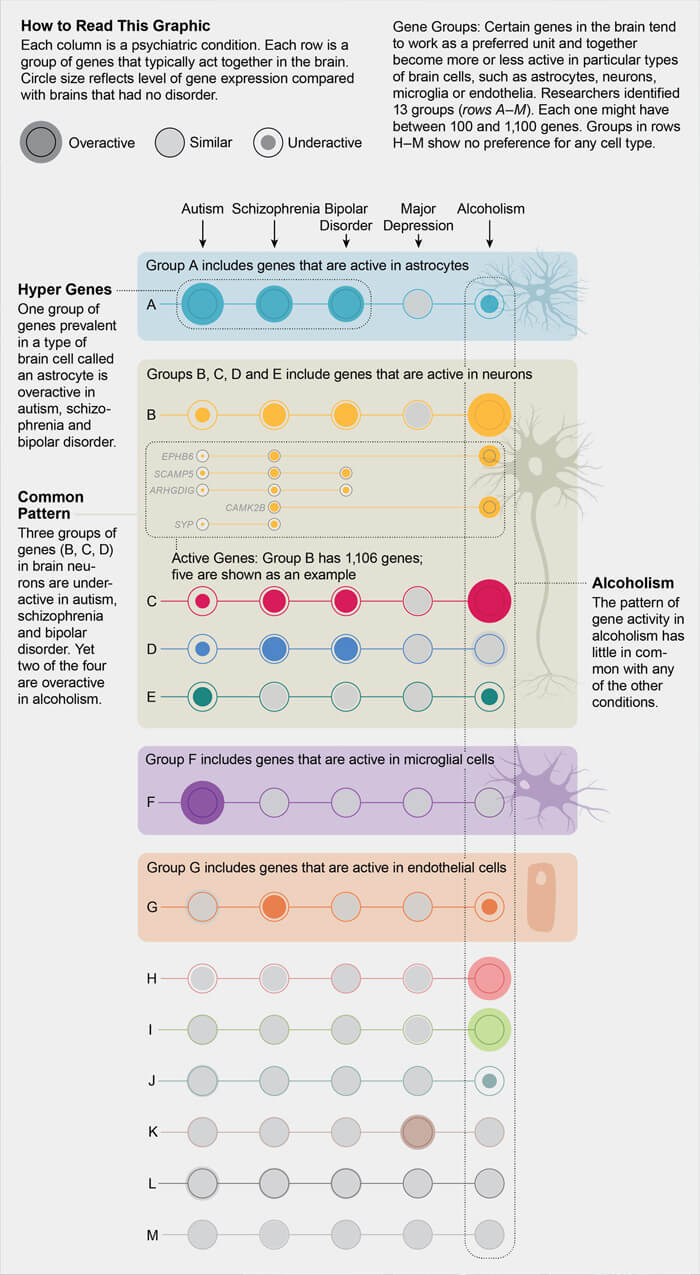
chart 7 24 18
Image credit: Martin Krzywinski;

Read full, original post: The Same Genes May Underlie Different Psychiatric Disorders

{{ reviewsTotal }}{{ options.labels.singularReviewCountLabel }}
{{ reviewsTotal }}{{ options.labels.pluralReviewCountLabel }}
{{ options.labels.newReviewButton }}
{{ userData.canReview.message }}

Related Articles

Infographic: Global regulatory and health research agencies on whether glyphosate causes cancer

Infographic: Global regulatory and health research agencies on whether glyphosate causes cancer

Does glyphosate—the world's most heavily-used herbicide—pose serious harm to humans? Is it carcinogenic? Those issues are of both legal and ...

Most Popular

ChatGPT Image May 26, 2026, 08_42_17 AM (1)
Viewpoint: Greenpeace and poison: How environmental advocacy groups rely on compliant (and often ignorant) journalists to spread disinformation and spark litigation
Screenshot 2025-07-30 at 10.48
Can gene editing eliminate Down syndrome? Scientists have done it in lab-grown cells
Screenshot-2026-05-28-at-1.36.28-PM
Viewpoint: Can mRNA research survive the Trump administration?
Screenshot-2026-06-02-at-11.59.11-AM
Magnifica Humanitas: Pope’s encyclical broadside against AI naivete and overreach
ChatGPT-Image-May-26-2026-07_51_21-AM-2
Viewpoint: There are more than 1,000 chemicals in a cup of coffee—including many substances that can cause cancer. Why isn’t it banned?
Screenshot 2025-11-18 at 3.45
Viewpoint—GMOs and sustainability: Why buying organic foods is the least environmentally-sensitive food choice—without offering any health benefits
Picture1
Sounds we can’t hear — the hidden planetary signals behind science, fear, and misinformation
ChatGPT-Image-Jun-2-2026-11_39_58-AM
Viewpoint: Who is RFK, Jr.’s newly-appointed CDC senior counselor, Sara Brenner — Vaccine skeptic and self-proclaimed “MAHA mom”
ChatGPT Image May 28, 2026, 08_16_38 PM
Viewpoint: Why the EPA mismeasures cancer risk of chemicals and what should be done to fix it
Screenshot-2026-05-27-at-10.51.25-AM
Viewpoint: ‘Monsanto’ blues—Planned Netflix movie promises yet another round of anti-glyphosate disinformation
Screenshot-2026-06-01-at-1.35.32-PM
Viewpoint: Swine farmers are under attack for allegedly mistreating their animals. Here are the facts.

glp menu logo outlined

Get news on human & agricultural genetics and biotechnology delivered to your inbox.