One researcher’s unorthodox approach to understanding memory

screen shot at pm
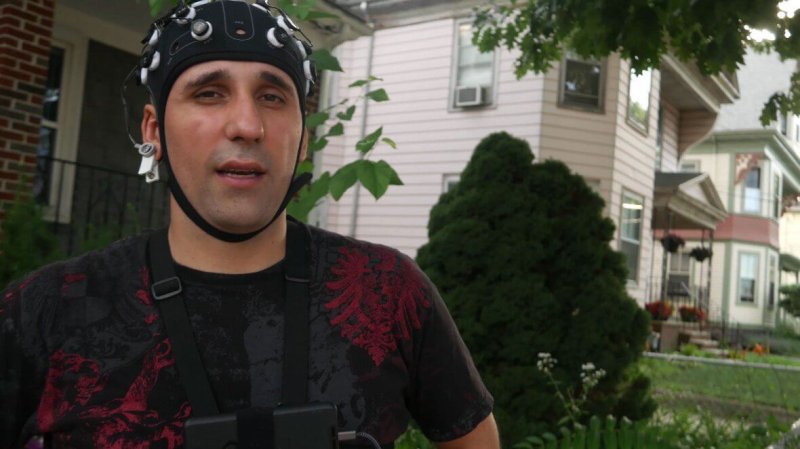
Neo Mohsenvand. Image credit: Hannah Campbell

Mostafa “Neo” Mohsenvand often walks around with a fisheye lens on a smartphone strapped to his chest and a black, electrode-covered neoprene EEG cap on his head. All, mind you, for science.

Mohsenvand, a graduate student in the Fluid Interfaces Group at MIT’s Media Lab, is trying to learn about what makes moments memorable by zealously gathering as much data as possible about himself and the world around him, and matching up his biometric signals with times and events.

So far, he’s logged over 1,500 hours of footage. Every few days he uses software to combine the videos and biometric signals, creating minutes-long films that slow down and speed up in accordance with metrics like the acceleration and deceleration of his heart rate and his level of skin conductance—things he can’t consciously control, and that he believes correspond with the noteworthiness of events in his life.

Heather Abercrombie, an associate professor at the University of Wisconsin—Madison who heads the school’s Mood and Memory Laboratory, says scientists tend to capture data from groups of people rather than looking at them as individuals. But since people are bound to have different physiological reactions to different situations, Mohsenvand’s one-person life logging could be useful.

“If we can capture, across time, what’s different about individuals, that’s actually great,” she says.

Read full, original post: This man’s quest to understand memory starts with obsessive bodycam recording and brain-wave tracking


{{ reviewsTotal }}{{ options.labels.singularReviewCountLabel }}
{{ reviewsTotal }}{{ options.labels.pluralReviewCountLabel }}
{{ options.labels.newReviewButton }}
{{ userData.canReview.message }}

Related Articles

Infographic: Global regulatory and health research agencies on whether glyphosate causes cancer

Infographic: Global regulatory and health research agencies on whether glyphosate causes cancer

Does glyphosate—the world's most heavily-used herbicide—pose serious harm to humans? Is it carcinogenic? Those issues are of both legal and ...

Most Popular

ChatGPT-Image-Jun-15-2026-11_00_13-AM-2
Glucosamine alert: Alzheimer’s progresses faster among those taking the popular supplement
Screen Shot at AM
Facts & Fallacies Podcast: Right-wing politics bad for your health? Separating speculation from science

ChatGPT-Image-Jun-9-2026-01_11_37-PM
Turmeric supplements: More risks than benefits
ChatGPT-Image-Jun-15-2026-12_13_41-PM
Viewpoint: Behind the effort to re-purpose the tobacco attack strategy to fight ultra-processed foods
ChatGPT-Image-Jun-3-2026-04_29_13-PM
Viewpoint: While unvaccinated children are dying overseas, Congress challenges Trump and Kennedy’s block on aid
Screenshot-2026-06-12-at-2.10.55-PM
Physician warns online statin myths delay care and raise heart risk
ChatGPT-Image-Mar-10-2026-01_39_01-PM
Viewpoint—“Miracle molecule” debunked: Why acemannan supplements don’t work
Screenshot-2026-06-14-at-9.14.26-AM
‘Humanitarian catastrophe’: Trump’s USAID shutdown could help drive nearly 23 million deaths — including 5.4 million children — by 2030, Lancet study warns
ChatGPT-Image-Jun-15-2026-10_42_06-AM
Viewpoint: ‘Steroid Olympics’ marketing stunt: ‘It seemed less like a sporting event and more like a loss leader to peddle testosterone injections, GLP-1s, and peptides’
ChatGPT-Image-Jun-14-2026-09_41_44-AM-2
Viewpoint—‘The gleeful efficiency of an arsonist’: Administration’s health and science research cuts are ‘sabotaging’ America’s future
Screenshot-2026-06-05-at-2.12.30-PM
Some plants can poison you. So how did humans figure out what is safe to eat?
ChatGPT-Image-Jun-11-2026-01_15_03-PM
Selective Pressure, Selective Silence
glp menu logo outlined

Get news on human & agricultural genetics and biotechnology delivered to your inbox.