Man whose rare blood type saved millions of babies retires from donating after 60 years

james harrison donating exlarge
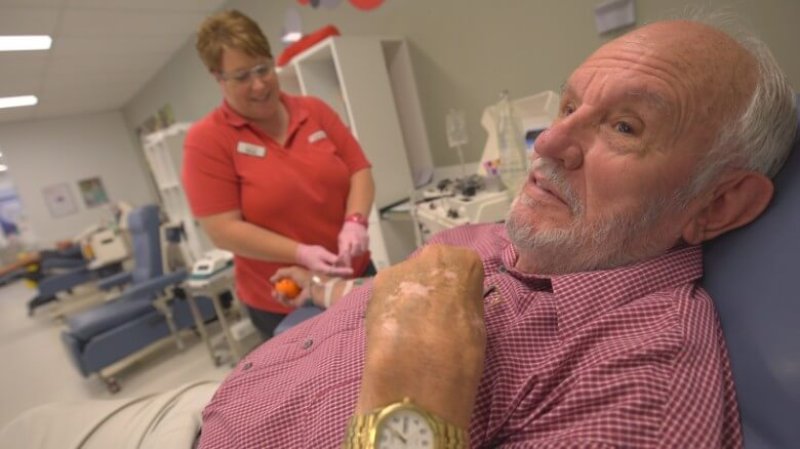
James Harrison donates plasma for one of the last times before retiring after 60 years of donating life-saving rare blood type. Image credit: CNN.

James Harrison, known as the “Man With the Golden Arm,” has donated blood nearly every week for 60 years. After all those donations, the 81-year-old Australian man “retired” [on May 11, 2018].

According to the Australian Red Cross Blood Service, he has helped saved the lives of more than 2.4 million Australian babies.

Harrison’s blood has unique, disease-fighting antibodies that have been used to develop an injection called Anti-D, which helps fight against rhesus disease.

This disease is a condition where a pregnant woman’s blood actually starts attacking her unborn baby’s blood cells. In the worst cases, it can result in brain damage, or death, for the babies.

Doctors aren’t exactly sure why Harrison has this rare blood type… He’s one of no more than 50 people in Australia known to have the antibodies, the blood service says.

“In Australia, up until about 1967, there were literally thousands of babies dying each year, doctors didn’t know why, and it was awful. Women were having numerous miscarriages and babies were being born with brain damage,” Jemma Falkenmire, of the Australian Red Cross Blood Service, told CNN in 2015. “Australia was one of the first countries to discover a blood donor with this antibody, so it was quite revolutionary at the time.”

Read full, original post: He donated blood every week for 60 years and saved the lives of 2.4 million babies.

{{ reviewsTotal }}{{ options.labels.singularReviewCountLabel }}
{{ reviewsTotal }}{{ options.labels.pluralReviewCountLabel }}
{{ options.labels.newReviewButton }}
{{ userData.canReview.message }}

Related Articles

Infographic: Global regulatory and health research agencies on whether glyphosate causes cancer

Infographic: Global regulatory and health research agencies on whether glyphosate causes cancer

Does glyphosate—the world's most heavily-used herbicide—pose serious harm to humans? Is it carcinogenic? Those issues are of both legal and ...

Most Popular

Picture1-5
Science Disinformation Gap: The transatlantic battle over social media and censorship
Screenshot-2026-04-23-at-11.00.36-AM
Regulators' dilemma: Thalidomide, Metformin, and the cost of getting drug approvals wrong
ChatGPT-Image-May-12-2026-08_39_41-PM
GLP podcast: Big Pharma, Big Ag, Big Food—health harming industries or life-saving innovators?
ChatGPT Image May 10, 2026, 08_16_59 PM 2
Overmedicalization? RFK Jr.’s antidepressant crackdown raises conflict questions over his fee stake in Wisner Baum, the tort firm built on suing drug makers
Screenshot-2026-05-12-at-9.58.31-PM
'He seems fine': Marty Makary out as FDA commissioner
Picture1-1
Cooling the planet with balloons: Could a geoengineering gamble slow global warming?
Screenshot-2026-05-12-at-10.05.11-AM
Pro-vaccine “hero” vs. an anti-vax “villain”: ‘Bad Vaxx’ video stirs MAHA backlash

Picture1-14
When superbugs threaten vulnerable children: Can AI help solve antibiotic resistance?
Screenshot-2026-05-11-104424
Hantavirus outbreak research: Trump administration shut down study last year on rodent-to-human transmission
ChatGPT Image May 12, 2026, 10_19_00 AM 2
Viewpoint— 'Muscular governance': How authoritarianism is surging corporate-linked energy misinformation
S
As vaccine rejectionism spreads, measles may be taking a more dangerous turn
Screenshot-2026-05-01-at-1.29.41-PM
Viewpoint: What happens when whole grains meet modern food manufacturing? Labels don’t tell the whole story.
Screenshot 2026-05-11 at 11.30
Despite politicized disinformation, Midwest AI data centers are fueling a solar energy boom
glp menu logo outlined

Get news on human & agricultural genetics and biotechnology delivered to your inbox.