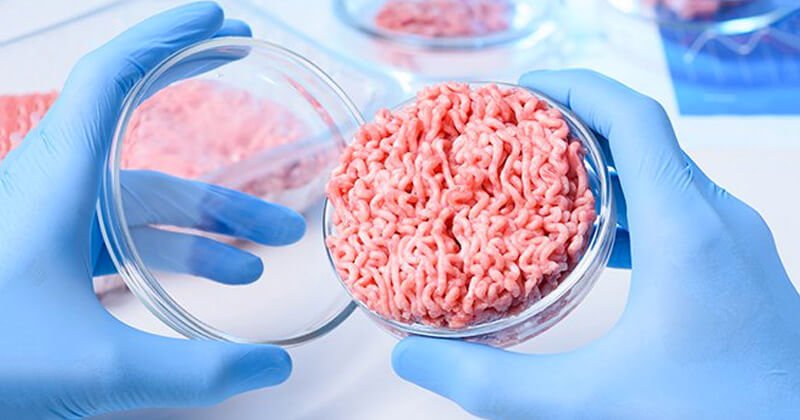
How do you make a lab-grown burger?

meat
Image Credit: Infowars

In July, [the alternative-meat] movement passed a new milestone: In a packed auditorium in suburban Maryland, the FDA convened the first public hearing (the U.S. Department of Agriculture is jumping in too) to discuss federal regulation of food grown from cells — no hooves or fins or feathers in sight.

The first lab-cultured burger publicly unveiled, in 2013, required hand assembly of some 20,000 individual muscle cells at Maastricht University in the Netherlands ….

Custom-making bits of living animal tissue for biology has been flourishing for decades. Medical teams have implanted lab-cultured bladders in people, and experimental lung tissue has survived several weeks in pigs ….These approaches, however, are very different from churning out gastronomically pleasing hamburger meat by the pound. Changing science experiments into food production takes so much more than just nicking a tiny pip of cells from a cow’s muscle and dropping them into a sciencey soup.

A muscle fiber cell that has matured into its full elongated glory can’t divide into two fibers. To grow muscles, researchers need to start with cells that still retain a lot of flexibility …. What are called pluripotent stem cells can turn into anything and divide many times, yet they can be trickier to control than cells already on their way to becoming a muscle. These cells, called myoblasts, naturally appear in animal muscles ready to repair damage ….

Read full, original article: Can science build a better burger?

{{ reviewsTotal }}{{ options.labels.singularReviewCountLabel }}
{{ reviewsTotal }}{{ options.labels.pluralReviewCountLabel }}
{{ options.labels.newReviewButton }}
{{ userData.canReview.message }}

Related Articles

Infographic: Global regulatory and health research agencies on whether glyphosate causes cancer

Infographic: Global regulatory and health research agencies on whether glyphosate causes cancer

Does glyphosate—the world's most heavily-used herbicide—pose serious harm to humans? Is it carcinogenic? Those issues are of both legal and ...

Most Popular

Screenshot-PM-24
Viewpoint: The herbicide glyphosate isn’t perfect. Banning it would be far worse.
d-b
Blocked arteries, kidney stones, nausea, constipation, fatigue: Long list of health problems caused by too much vitamin D 
79d03212-2508-45d0-b427-8e9743ff6432
Viewpoint: The Casey Means hustle—Wellness woo opportunism dressed up as medical wisdom
ChatGPT-Image-Mar-10-2026-01_39_01-PM
Viewpoint—“Miracle molecule” debunked: Why acemannan supplements don’t work
ChatGPT-Image-Apr-30-2026-12_21_05-PM-2
The tech billionaires behind the immortality movement
ChatGPT-Image-Mar-27-2026-11_27_05-AM
The myths of “process”: What science says about the “dangers’ of synthetic products and ultra-processed foods
ChatGPT-Image-Apr-30-2026-05_00_48-PM
Wellness grifter physician turned wellness influencer out as surgeon general nominee

Sorry. No data so far.

glp menu logo outlined

Get news on human & agricultural genetics and biotechnology delivered to your inbox.