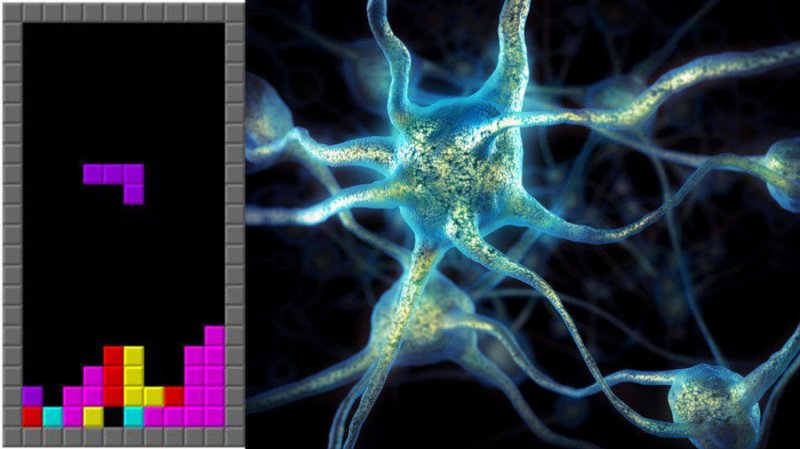
No more words? BrainNet enables ‘brain-to-brain’ communication, Tetris-like game play

bb bfc e df f b

What if we could do away with words altogether? What if, rather than relying on an intermediary, we could directly transmit our thoughts through a digital, internet-like space into another mind?

Yes, I’m talking about telepathy. No, we are absolutely not there. But a curious team of neural engineers from the University of Washington is pushing the boundaries of what human brain-to-brain communication could look like—a system not mired in the intricacies of grammar or subject to the limitations of language translation. A true universal means of communication for humankind.

[September], in a study uploaded to the pre-print server arXiv, the team, led by Dr. Rajesh P.D. Rao, describes a system that lets three people collaboratively play a Tetris-like game. Dubbed “BrainNet,” the interface reads the brain activity of two people, the “senders,” and teases out relevant instructions on game play. These instructions are then used to stimulate the “receiver’s” brain, who then uses the information to perform a move in the game.

For now, the instructions are incredibly simple in that they’re binary. The system can’t transmit words or sentence-like thoughts from one person to another. But it is proof-of-concept that, on an incredibly rudimentary level, we are inching towards technology that could potentially one day take telepathy out of the realm of science fiction into the real world.

Read full, original post: How BrainNet Enabled 3 People to Directly Transmit Thoughts

{{ reviewsTotal }}{{ options.labels.singularReviewCountLabel }}
{{ reviewsTotal }}{{ options.labels.pluralReviewCountLabel }}
{{ options.labels.noReviewsLabel }}
{{ options.labels.newReviewButton }}
{{ userData.canReview.message }}

Related Articles

Infographic: Global regulatory and health research agencies on whether glyphosate causes cancer

Infographic: Global regulatory and health research agencies on whether glyphosate causes cancer

Does glyphosate—the world's most heavily-used herbicide—pose serious harm to humans? Is it carcinogenic? Those issues are of both legal and ...

Most Popular

ChatGPT-Image-Mar-10-2026-01_39_01-PM
Viewpoint—“Miracle molecule” debunked: Why acemannan supplements don’t work
Picture1
Hiroshima at 81: America’s new nuclear bomb, a buried Iranian target, and a question no one wants to ask
Screenshot-2026-07-09-at-1.09.25-PM
Anti-vaccine myths rattle health care
ChatGPT Image Jul 29, 2026, 06_26_01 PM 2
Facts & Fallacies podcast: Organic food myths make a comeback on Instagram, with Dr. Kevin Folta
ChatGPT-Image-Jul-10-2026-12_21_03-PM
Viewpoint: Is there new evidence that the animal deworming drug ivermectin decreases the risk of Covid and cancer? Don’t waste your money.
ChatGPT-Image-Jul-10-2026-09_42_12-AM-1
Peptides, patient autonomy, and the limits of medical freedom
ChatGPT-Image-Jun-25-2026-12_23_17-PM
No, Bill Gates did not secretly engineer ticks to promote veganism
ChatGPT-Image-Jul-22-2026-09_13_07-AM
Viewpoint—The Strategic Litigation boom: Understanding the tightening coalition among NGOs, foundations, journalists, and tort lawyers
organic scaled
Facts & Fallacies podcast: Organic food cuts pesticide exposure? A response to Dr. Rhonda Patrick
leeteam
How Kennedy and his family could pocket millions from Merck’s $50 million vaccine injury settlement that he oversaw

Sorry. No data so far.

glp menu logo outlined

Get news on human & agricultural genetics and biotechnology delivered to your inbox.