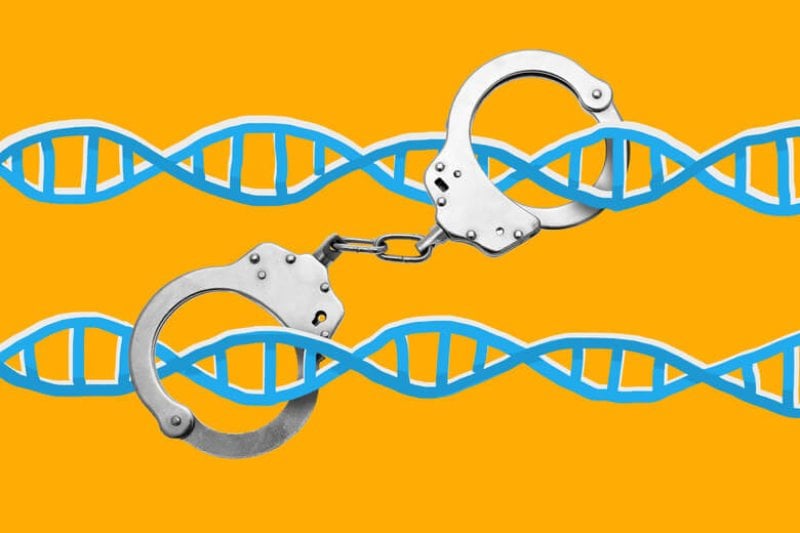
Should law enforcement have a universal genetic forensic database?

a a f f a fb ee
Image credit: Slate/Thinkstock

The idea of the government having access to every citizen’s DNA might sound like an Orwellian nightmare, but recent events suggest we’re not far from this being the ground truth. In April, police charged a suspect in the Golden State Killer case after linking crime scene DNA samples to a distant relative via the public GEDmatch database.

This poses a number of problems. Firstly, databases held by law enforcement inevitably end up showing the same biases present in all facets of policing—young, male, non-white populations are significantly over-represented.

That’s prompted researchers from Vanderbilt University to advocate for a universal genetic forensic database in a recent paper in the journal Science. The core of their argument is that law enforcement already has piecemeal and unregulated access to our genetic profiles, so it’s probably better to formalize and proactively control that access.

Such a registry would remove the bias associated with current collection methods, they say, as well as preventing the exposure of sensitive genetic information not relevant to law enforcement.

Just because the authorities can probably already access our genetic information doesn’t mean we should make absolutely sure that they can. And just because the current system means they’re likely to ensnare certain populations more effectively doesn’t mean we should make everyone more vulnerable.

Read full, original post: Would a Universal Genetic Database Be a Crime-Solving Wonder, Or an Orwellian Nightmare?

{{ reviewsTotal }}{{ options.labels.singularReviewCountLabel }}
{{ reviewsTotal }}{{ options.labels.pluralReviewCountLabel }}
{{ options.labels.noReviewsLabel }}
{{ options.labels.newReviewButton }}
{{ userData.canReview.message }}

Related Articles

Infographic: Global regulatory and health research agencies on whether glyphosate causes cancer

Infographic: Global regulatory and health research agencies on whether glyphosate causes cancer

Does glyphosate—the world's most heavily-used herbicide—pose serious harm to humans? Is it carcinogenic? Those issues are of both legal and ...

Most Popular

Screenshot 2026-07-11 094410
Growing animal muscle and fat cells inside rice grains and calling it beef: One of numerous genetically engineered products shaking up our ecosystem
ChatGPT-Image-Mar-10-2026-01_39_01-PM
Viewpoint—“Miracle molecule” debunked: Why acemannan supplements don’t work
file-f-d-d-
Facts & Fallacies Podcast: Europe's AC debacle underscores fatal flaw in green activism
Screenshot-2026-07-16-at-11.32.12-AM
Viewpoint: Trump appoints climate change hoax promoter to head influential government policy project
Screenshot 2026-07-16 at 8.49
Pete Hegseth’s bizarre Viagra commercial as Trump administration endorses ‘hormone replacement therapy’
ChatGPT-Image-Jun-25-2026-12_23_17-PM
No, Bill Gates did not secretly engineer ticks to promote veganism
Screenshot-2026-07-16-at-6.02.54-PM
Wellness grifters overwhelm information channels in the developing world, and the problem is escalating
Screenshot 2025-09-17 at 12.41
Misinformation alert: No, glyphosate use in Canadian forests is not spurring more wildfires
ChatGPT-Image-Jul-9-2026-02_39_22-PM
Viewpoint: Polyphenols or NAD+ supplements to combat aging: No, Gwenyth Paltrow and followers, don’t waste your money.
ChatGPT-Image-Jul-1-2026-03_33_49-PM
‘Alternative’ cancer treatments that could kill you
Screenshot-2026-07-16-at-12.08.38-PM
Viewpoint: With trust in doctors and mainstream medicine collapsing, medical professionals need a new communications strategy
Screenshot-2026-07-08-at-9.36.03-AM
Viewpoint: Long-contained diseases are on the rise in the U.S. Are Trump cuts to blame?

Sorry. No data so far.

glp menu logo outlined

Get news on human & agricultural genetics and biotechnology delivered to your inbox.