Do we really need a more potent, and more addictive, opioid?

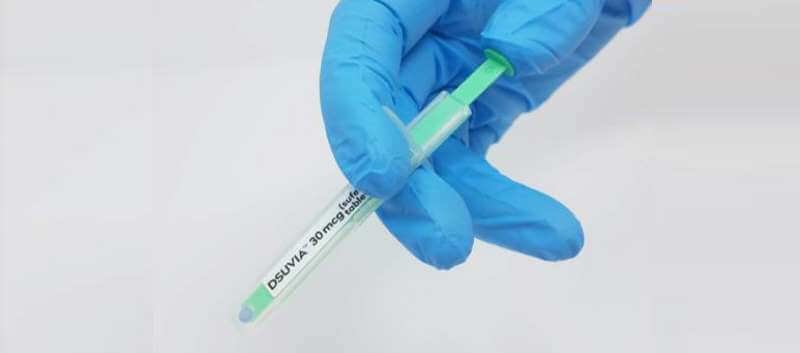
dsuviaapplicator
Image credit: Da Hee Han

In the midst of a national opioid crisis, how badly do we need another formidable painkiller?

This vexing question has been widely debated since the Food and Drug Administration set off a furor last month when it approved Dsuvia, a tablet version of a decades-old intravenous painkiller that is up to 10 times more potent than the highly addictive fentanyl. Critics argued that alternatives exists and that such a powerful opioid could easily be abused by being diverted, despite a prohibition on retail pharmacy sales. But the endorsement was championed by the military, which maintains that such a medicine is needed in combat zones.

Does the drug deliver the speedy pain relief that is advertised?

In a study of patients who underwent abdominal surgery, they first perceived decreased pain at 15 minutes, which was statistically significant. This is, indeed, rather quick, and was the primary endpoint, although the actual amount of pain did not lessen very much during that time.


In other words, they felt some pain relief in the early going, but Dsuvia did not meaningfully relieve their pain for nearly an hour.

Ultimately, Dsuvia does have a unique method of delivery and may, therefore, prove useful in some battlefield situations. But given the opioid crisis, this episode could prove painful in a very different way.

Read full, original post: The military pushed it for the battlefield. The FDA went along. Is the newest opioid any better?

{{ reviewsTotal }}{{ options.labels.singularReviewCountLabel }}
{{ reviewsTotal }}{{ options.labels.pluralReviewCountLabel }}
{{ options.labels.newReviewButton }}
{{ userData.canReview.message }}

Related Articles

Infographic: Global regulatory and health research agencies on whether glyphosate causes cancer

Infographic: Global regulatory and health research agencies on whether glyphosate causes cancer

Does glyphosate—the world's most heavily-used herbicide—pose serious harm to humans? Is it carcinogenic? Those issues are of both legal and ...

Most Popular

ChatGPT-Image-Jun-21-2026-02_33_08-PM
Texas Air Force base flu outbreak soars to over 220 cases, and one soldier has died after Secretary Hegseth scrapped mandatory military flu shots 
ChatGPT-Image-Jun-9-2026-01_11_37-PM
Turmeric supplements: More risks than benefits
ChatGPT-Image-Jun-15-2026-11_51_00-AM-4
Viewpoint: As the International Association for Research on Cancer loses influence, activists and trial lawyers scramble to protect a lucrative playbook
screenshot pm
Which is better for building healthy farm soil? Organic offers no special edge.
wuhan institute of virology main entrance
​​COVID lab leak? Making a case that the Wuhan market origins theory is wrong
ChatGPT-Image-Jun-19-2026-04_11_20-PM
Daubert for Dummies—Scientific Reliability in U.S. Courts: Daubert, Rule 702, and Made-for-Litigation Evidence
Screenshot-2026-06-05-at-2.12.30-PM
Some plants can poison you. So how did humans figure out what is safe to eat?
Screenshot-2026-06-17-at-9.44.03-AM
Viewpoint: Embryos are becoming the newest battleground of love, loss, and legal uncertainty
ChatGPT-Image-Jun-19-2026-05_21_35-PM
The American Medical Association doctors declare war on RFK, Jr.’s attack on safe vaccines
Screenshot-2026-06-18-at-11.41.51-AM
Viewpoint—Protecting baloney science: Far right senators move to protect the phony homeopathy industry
Screenshot-2026-06-19-at-4.53.19-PM
Viewpoint: How the Trump administration is thwarting the will of Congress and starving American science
ChatGPT-Image-Jun-11-2026-01_15_03-PM
Selective Pressure, Selective Silence
ChatGPT-Image-Jun-13-2026-11_51_39-AM
Viewpoint: COVID lab leak? Misguided backers of the lab leak theory refuse to give up
ChatGPT-Image-Mar-10-2026-01_39_01-PM
Viewpoint—“Miracle molecule” debunked: Why acemannan supplements don’t work
glp menu logo outlined

Get news on human & agricultural genetics and biotechnology delivered to your inbox.