How long can bacteria live? 500-year experiment could provide answers

1-30-2019 content bacteria
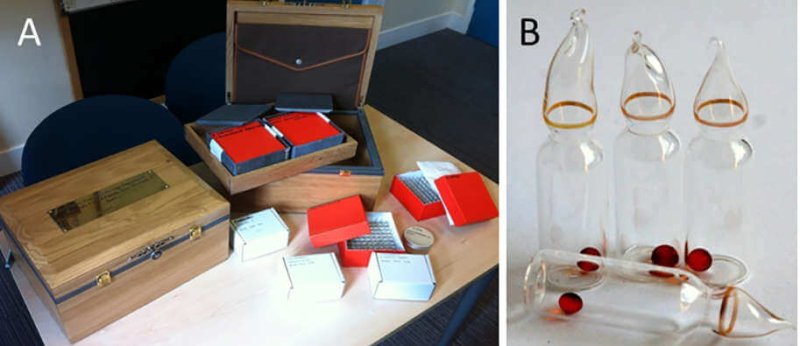
(A) Parts of the 500-Year Microbiology Experiment. (B) Glass vials containing 100 μL of B. subtilis spore stock solution (106 CFU/mL) and then desiccated before being sealed. Image credit: Ulrich et al./PLOS ONE.

In the year 2514, some future scientist will arrive at the University of Edinburgh (assuming the university still exists), open a wooden box (assuming the box has not been lost), and break apart a set of glass vials in order to grow the 500-year-old dried bacteria inside. This all assumes the entire experiment has not been forgotten, the instructions have not been garbled, and science—or some version of it—still exists in 2514.

By then, the scientists who dreamed up this 500-year experiment—Charles Cockell at the University of Edinburgh and his German and U.S. collaborators—will be long dead. They’ll never know the answers to the questions that intrigued them back in 2014, about the longevity of bacteria.

[Microbiologist Ralf Möller believes that] “life on our planet is not limited by human standards.” Understanding what that means requires work that goes well beyond the human life span.

Physically, the 500-year experiment consists of 800 simple glass vials containing either Chroococcidiopsis or another bacterium, Bacillus subtilis. The glass vials have been hermetically sealed with a flame.

Every other year for the first 24 years, and then every quarter century for the next 475, scientists are supposed to come test the dried bacteria for viability and DNA damage. The first set of data from the experiment was published last month.

Read full, original post: The 500-Year-Long Science Experiment

Related Articles

Infographic: Global regulatory and health research agencies on whether glyphosate causes cancer

Infographic: Global regulatory and health research agencies on whether glyphosate causes cancer

Does glyphosate—the world's most heavily-used herbicide—pose serious harm to humans? Is it carcinogenic? Those issues are of both legal and ...

Most Popular

ChatGPT-Image-Mar-10-2026-01_39_01-PM
Viewpoint—“Miracle molecule” debunked: Why acemannan supplements don’t work
ChatGPT-Image-Aug-4-2026-10_15_14-AM
Viewpoint—A hard look at the Fauci diaries: Do they change what we know about COVID’s origins?
Picture1
Hiroshima at 81: America’s new nuclear bomb, a buried Iranian target, and a question no one wants to ask
ChatGPT-Image-Aug-4-2026-12_42_58-PM
Viewpoint: Fact-checking CNN interview with RFK, Jr. underscores the depth of his disinformation delusions
png livestock cow cattle a
Consumer skepticism about gene-edited milk is neither fixed nor particularly high—and falls even more if it’s priced lower
ChatGPT-Image-Jul-31-2026-07_35_35-AM
Wikipedia has assembled an informative list of fake news websites from across the ideological spectrum
ChatGPT-Image-Aug-4-2026-09_31_50-AM-2
Viewpoint: Could the U.S. become dependent on China to develop critical new genetic and drug therapies?

ChatGPT-Image-Aug-4-2026-07_52_00-PM
No liability for scientific due diligence: California Supreme Court rejects bizarre lawsuit faulting Gilead for fully evaluating HIV drug before release
Screenshot-2026-07-31-at-10.52.03-AM
Love sweets and fatty foods? You can blame your genes, but there are ways to quell the obsessions
ChatGPT-Image-Jul-17-2026-09_50_27-AM
Viewpoint: How disease tracking and prevention has cratered under the Kennedy-Trump administration
Screenshot-2026-08-03-at-2.15.16-PM
Viewpoint: Trump’s relaxed controls on supplying China with microchips could undermine U.S. AI dominance
ChatGPT-Image-Aug-4-2026-02_05_46-PM
Does Congress have the guts to successfully challenge Trump’s politicization of science funding?
glp menu logo outlined

Get news on human & agricultural genetics and biotechnology delivered to your inbox.