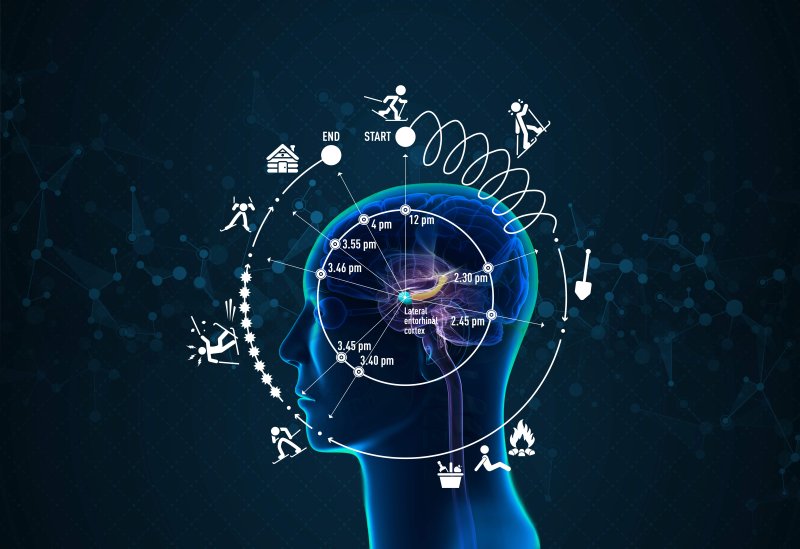

Marc Howard, a cognitive neuroscientist now at Boston University, and Karthik Shankar, who was then one of his postdoctoral students, wanted to figure out a mathematical model of time processing: … like a mental canvas onto which the brain could paint memories and perceptions.
…
The brain has no such receptors for time. “Color or shape perception, that’s much more obvious,” said Masamichi Hayashi, a cognitive neuroscientist at Osaka University in Japan. “But time is such an elusive property.” To encode that, the brain has to do something less direct.
Pinpointing what that looked like at the level of neurons became Howard and Shankar’s goal. Their only hunch going into the project, Howard said, was his “aesthetic sense that there should be a small number of simple, beautiful rules.”



…
Invigorated by empirical support for their theory, he and his colleagues have been working on a broader framework, which they hope to use to unify the brain’s wildly different types of memory, and more: If their equations are implemented by neurons, they could be used to describe not just the encoding of time but also a slew of other properties — even thought itself.
Read full, original post: How the Brain Creates a Timeline of the Past