

ENZYME CATALYSIS: A TUNNEL THROUGH THE BARRIER
Traditional theories of enzyme catalysis hold that the proteins speed up reactions by lowering the activation energy. But some researchers argue that a quantum trick known as tunneling also plays a role, and that the structure of enzymes’ active sites might have evolved to take advantage of this phenomenon.
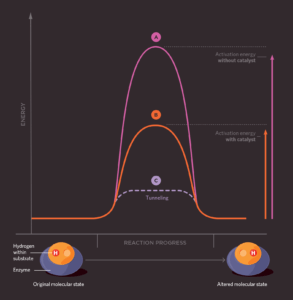
…
PHOTOSYNTHESIS: ALL PATHS TRAVELED
During the light-harvesting reaction of photosynthesis in plants and some microbes, a photon excites an electron in a chlorophyll molecule to create a structure called an exciton—an entity containing both the excited electron and the positively charged hole it leaves behind. This exciton is then transferred via other chlorophyll molecules until it reaches a protein complex called the reaction center.
Traditional Model




According to the traditional, or “incoherent,” model of this process, the exciton’s route to the reaction center is more or less random. Because energy can be lost during the transfer process, such a path can end up being wasteful.
Quantum Model

By contrast, if the energy transfer process is “quantum coherent” such that the exciton travels like a wave, it can explore all possible paths simultaneously.
Read full, original post: Infographic: Quantum Explanations for Biological Phenomena