Do farmers really need neonic insecticides? Study sparks debate over pesticides’ future

seed treating x
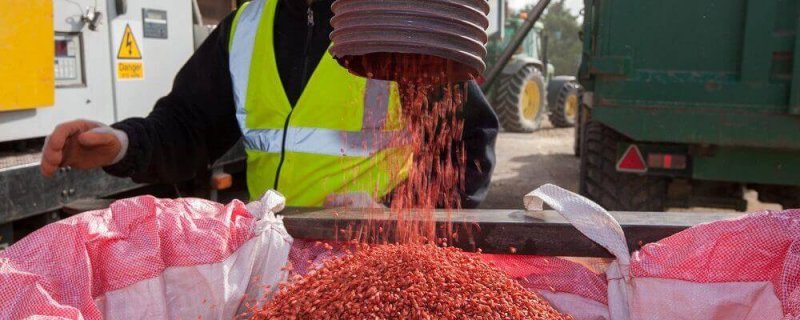
Seeds treated with neonicotinoid insecticide

New research has found a widely used and increasingly controversial insecticide has “negligible” benefits for commercially grown soybeans. Pesticide makers and farmers disagree.The insecticide, called neonicotinoid, has come under fire in recent years after scientists discovered it might be killing honey bees, monarch butterflies, certain birds and aquatic life.

“We’ve documented the costs and the downsides of neonicotinoids,” said Christian Krupke, an entomology professor at Purdue University, who was one of the 23 researchers who authored a study on the topic.”So the question we asked with this study was, what are the benefits? …. And our findings are that the benefits are negligible.”

The compiled results showed that, on average, neonicotinoid-treated crops produced an average of 2 additional bushels per acre than non-treated crops. When compared to the added cost farmers paid for the insecticide, the payoff is slim, the study concluded.

The companies that produce the insecticide and the farmers who use it were quick to refute that verdict …. These are farmers like Wayne Fredricks, who grows corn and soybeans in northern Iowa.

“I read through the study,” Fredricks said. “It points out that there are certain areas where neonic use is more responsive than others, and we fall right in the middle of one of those areas.”

Read full, original article: Farmers get ‘negligible’ benefit from insecticide that may kill bees, researchers say


{{ reviewsTotal }}{{ options.labels.singularReviewCountLabel }}
{{ reviewsTotal }}{{ options.labels.pluralReviewCountLabel }}
{{ options.labels.newReviewButton }}
{{ userData.canReview.message }}

Related Articles

Infographic: Global regulatory and health research agencies on whether glyphosate causes cancer

Infographic: Global regulatory and health research agencies on whether glyphosate causes cancer

Does glyphosate—the world's most heavily-used herbicide—pose serious harm to humans? Is it carcinogenic? Those issues are of both legal and ...

Most Popular

Screenshot 2025-07-30 at 10.48
Can gene editing eliminate Down syndrome? Scientists have done it in lab-grown cells
ChatGPT Image May 26, 2026, 08_42_17 AM (1)
Viewpoint: Greenpeace and poison: How environmental advocacy groups rely on compliant (and often ignorant) journalists to spread disinformation and spark litigation
Screenshot-2026-05-28-at-1.36.28-PM
Viewpoint: Can mRNA research survive the Trump administration?
ChatGPT-Image-May-26-2026-07_51_21-AM-2
Viewpoint: There are more than 1,000 chemicals in a cup of coffee—including many substances that can cause cancer. Why isn’t it banned?
Screenshot 2025-11-18 at 3.45
Viewpoint—GMOs and sustainability: Why buying organic foods is the least environmentally-sensitive food choice—without offering any health benefits
ChatGPT-Image-Jun-2-2026-11_39_58-AM
Viewpoint: Who is RFK, Jr.’s newly-appointed CDC senior counselor, Sara Brenner — Vaccine skeptic and self-proclaimed “MAHA mom”
Picture1
Sounds we can’t hear — the hidden planetary signals behind science, fear, and misinformation
Screenshot-2026-06-02-at-11.59.11-AM
Magnifica Humanitas: Pope’s encyclical broadside against AI naivete and overreach
ChatGPT Image May 28, 2026, 08_16_38 PM
Viewpoint: Why the EPA mismeasures cancer risk of chemicals and what should be done to fix it
tick-DNA
GLP podcast: Spread meat allergy with gene-edited ticks? Bioethicists pose vile ‘thought experiment’
Screenshot-2026-04-14-at-11.11.06-AM
‘Turbo cancer’ or mRNA cancer cure? Strategies to counter misinformation
ChatGPT-Image-Mar-10-2026-01_39_01-PM
Viewpoint—“Miracle molecule” debunked: Why acemannan supplements don’t work
glp menu logo outlined

Get news on human & agricultural genetics and biotechnology delivered to your inbox.