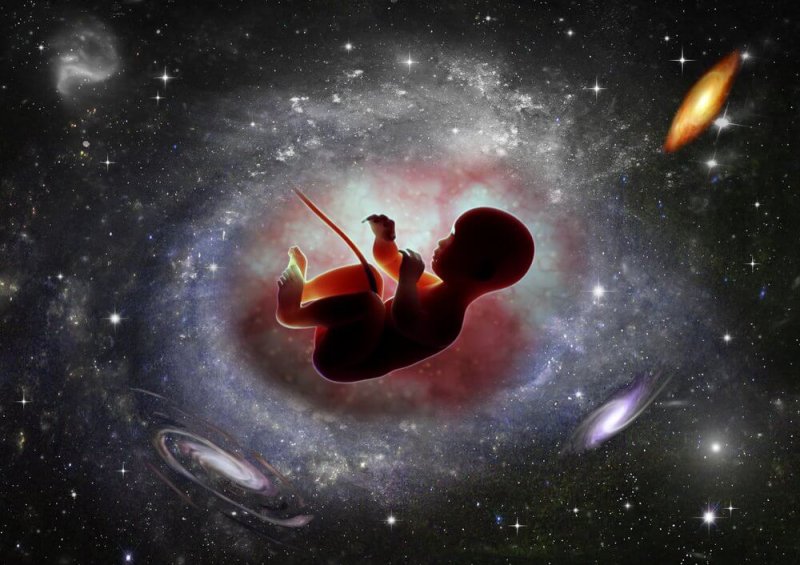
I’m not concerned about the actual baby making part — we can figure that out with practice. The part that’s tricky is the fine-tuned and carefully orchestrated process of human development, particularly in the brain. Cells in microgravity don’t grow exactly like cells on Earth, and a whole bunch of them in a developing baby’s brain may not grow exactly the same either.
Thankfully, there’s a researcher for that. UC San Diego scientist Alysson Muotri is using blossoming clumps of brain cells called ‘brain organoids’ to understand how neurons proliferate, form synapses, and communicate — but in space.
In late July, Muotri and his team sent a bunch of organoids to the International Space Station. Previous research has documented the proliferation of HeLA cells, cancer cells, bone cells and more, but there is limited information about the gravity-free growth of early brain cells, known as neural progenitor cells, or brain organoids. Such organoids have proven to be a useful model for understanding brain development, so understanding how they develop in the microgravity of space could demonstrate the ways in which human brain development might be affected if we ever become a space-faring society.
Muotri has long been intrigued by research in space, especially the NASA twins study. A while ago, he half-seriously talked about the idea of doing his own biology space study with one of his collaborators, but nothing quite came of it. He dreamed of sending organoids to space, but didn’t know if it was possible. Once he met an engineer who convinced him it was feasible to actually build a device to keep organoids alive in space, he decided it was time for takeoff.
Still, he had some trouble selling others, particularly granting organizations, on the idea. He’s funding the project out of his own salary savings and gifts to the lab, with the hope that his first wave of findings will draw attention to his work and convince funding agencies that his research is valuable.
Backed by his own money, the first task was figuring out how to keep the organoids healthy at the International Space Station.
Even on Earth, the organoids require a lot of care to ensure that they are at the proper temperature and growing conditions. For one, they’re kept in a shaker so that they are constantly suspended in a solution, without anchoring down to anything (though that won’t be a problem in microgravity). But like living cells in a body, organoids require nutrients, and they also spit out waste. To support these processes, their solutions need to be changed, and the temperature and pH needs to be carefully maintained, like fish in a tank. Organoids require a lot of babysitting, and Muotri simply can’t expect the astronauts to spend as much time caring for his cells as he and his students do back on Earth.
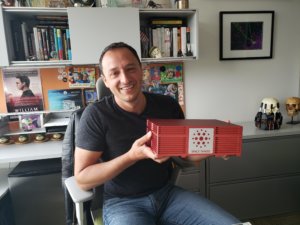
So, he collaborated with an engineering team from Kentucky that specializes in sending biological material into space. They developed a shiny red box called the Space Tango CubeLab.
Space Tango may sound like a bad 80’s science fiction film starring Antonio Banderas, but it’s actually the name of the company, and the products they make are so much cooler than ’80s sci-fi. The “CubeLab” essentially functions like a fully automated, climate-controlled mini-laboratory: it can change the media for the cells, monitor their growth, and send the data back to Earth. The astronauts just need to plug it in.

For this very first mission with the organoids, Muotri wants to see how the cells grow and proliferate. Based on previous research, he predicts that “The progenitor cells will proliferate faster and will probably generate a bigger organoid.” Although a bigger brain sounds better, this might actually be a problem: if the brain and surrounding skull are too big, it might prevent birth through the birth canal. It’s still speculation, but it’s entirely possible that “maybe humans cannot have natural deliveries in space.”
The other issue with faster brain development is that large brain volumes have been implicated in the development of autism spectrum disorder. In fact, having a larger brain circumference is one of the most robust biomarkers of autism. “We don’t fully understand how cell proliferation may later in life lead to intellectual problems or cognitive disability, so this gives us a model to understand that,” Muotri hopes.
At the moment, we don’t know much about the cellular mechanisms that microgravity could directly impact. Using genome sequencing and techniques to detect epigenetic signatures, Muotri’s team will look to see if the genomes of the organoids have changed. “There is definitely an epigenetic signature that changes neurons in space,” Muotri insists, “that’s what we want to figure out.”
Of course, organoids can’t capture brain development in utero in its full complexity. However, this study could point us to important considerations before we pack our space bags. For example, it’s possible that people with certain genetic backgrounds are less susceptible to the (lack of) pressures of microgravity and might fare better in space. However far-fetched, the social implications are staggering. If it turns out that some genetic backgrounds are better adapted to have babies in space, would this dictate who could become space-faring?
Lastly, Muotri would like to compare organoids generated from cells of healthy patients to those from people with Alzheimer’s or Parkinson’s disease. In 2011, a lab down the hall from Muotri’s at UC San Diego showed that neurons derived from schizophrenic patients were different than those derived from neurotypical patients. However, similar in-the-dish research on diseases of the aging brain have been limited. Organoids closely resemble young neural tissue, and it is a lot of work to keep them alive until they start to look like an aging brain. When Muotri compared neurotypical and Alzheimer’s organoids in Earth’s gravity, they were indistinguishable. However, this might not be true in space: “Maybe in the microgravity of space the organoids will age faster, and we could reveal their [Alzheimer’s] phenotypes.”
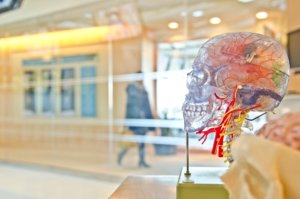
Muotri would also like to send the organoids up with even more sensors, including recording arrays that can actually measure the electrical activity of the organoids while they’re in space. Such data could provide clues about the functionality of these brain clumps, in addition to their genetic and anatomical signatures.
Muotri’s energy and enthusiasm for the project is palpable. But he has one big concern: when the mini-brains were sent into space, there was a 24-hour black out period during launch preparation over which the Space Tango couldn’t send back data. Muotri confessed that this was his biggest worry for the mission. But, he still laughed heartily, “We just have to hope that everything is going to be okay.”
Ashley Juavinett, PhD is a neuroscientist, educator, and writer. She currently works as an Assistant Teaching Professor at UC San Diego, where she is developing novel approaches to teaching and mentoring folks in neuroscience. Follow her on Twitter @analog_ashley
A version of this article was originally published on Massive’s website as “There might be some problems when we try to make babies in space” and has been republished here with permission.